

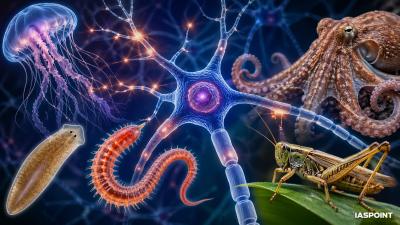
Nervous tissue is a specialized tissue of ectodermal origin that forms the communication and control network of the animal body. It is characterized by two fundamental properties: Excitability (the ability to respond to stimuli) and Conductivity (the ability to transmit electrical impulses). While all animals except sponges possess nervous tissue, its complexity varies significantly across the evolutionary tree.
Structural Components of Nervous Tissue
Regardless of the species, nervous tissue is composed of two primary cell types:
- Neurons (Nerve Cells): The structural and functional units. They consist of a Cyton (cell body), Dendrites (receiving ends), and an Axon (transmitting end).
- Neuroglia (Glial Cells): Non-conducting supporting cells that outnumber neurons. they provide nutrition, insulation (Myelin sheath), and protection to the neurons.
Evolutionary Progression of Nervous Tissue
The evolution of the nervous system is a journey from decentralized networks to highly centralized “brains.”
| Phylum / Group | Type of Nervous System | Characteristics |
| Porifera (Sponges) | None | Total absence of nerve cells; respond to stimuli via individual cells. |
| Cnidaria (Hydra) | Nerve Net | Most primitive nervous tissue. Neurons are apolar (no distinct axon/dendrite) and decentralized. |
| Platyhelminthes | Ladder-like | First signs of Cephalization. Two longitudinal nerve cords connected by transverse nerves. |
| Arthropoda | Ventral Nerve Cord | Consists of a brain-like “Cerebral Ganglion” and a solid, double ventral nerve cord with segment-specific ganglia. |
| Echinodermata | Radial System | A nerve ring around the mouth with radial nerves extending into each arm (e.g., Starfish). |
| Chordata | Dorsal Hollow System | Presence of a dorsal, hollow nerve cord and a highly developed brain protected by a cranium. |
Specialized Adaptations in Non-Human Animals
Animals have evolved unique nervous tissue features to survive in specific environments:
- Giant Axons of Squid: To facilitate an instantaneous “escape jet” response, squids possess axons that are up to 1 mm in diameter (100–1000 times thicker than vertebrate axons), allowing for exceptionally fast impulse conduction.
- Electric Organs: In the Electric Eel (Electrophorus electricus), nervous tissue and modified muscle cells form Electrocytes that coordinate to discharge high-voltage shocks for hunting and defense.
- Lateral Line System in Fish: A specialized sensory nervous tissue that detects vibrations and pressure changes in water, acting as “distant touch.”
- Mushroom Bodies in Insects: Clusters of neurons in the insect brain involved in learning and memory, particularly well-developed in social insects like bees and ants.
The Myelin Sheath: Vertebrates vs. Invertebrates
- Vertebrates: Most vertebrate axons are wrapped in a Myelin Sheath (formed by Schwann cells), which allows for Saltatory Conduction (jumping of impulses). This significantly increases the speed of nerve transmission.
- Invertebrates: Most invertebrates lack a true myelin sheath. To compensate for the slower speed of unmyelinated fibers, they often evolve thicker axons (like the Squid Giant Axon) to reduce internal resistance.
Key Facts for UPSC Prelims
- Synapse: The functional junction between two neurons where signals are transmitted via chemicals called Neurotransmitters (e.g., Acetylcholine).
- Apolar Neurons: Found in Hydra; these neurons lack a specific direction for impulse travel, meaning a stimulus at any point spreads in all directions.
- Unipolar Neurons: Common in the early embryonic stages of vertebrates and in many invertebrates.
- Bipolar Neurons: Found in specialized sensory organs, such as the retina of the eye and the olfactory epithelium of vertebrates.
- Nerve Impulse: An electrochemical phenomenon involving the exchange of Sodium (Na^+) and Potassium (K^+) ions across the neuronal membrane.
- Grey vs. White Matter: * Grey Matter: Composed mainly of neuron cell bodies and unmyelinated fibers.
- White Matter: Composed of myelinated axons, which give it the white appearance. In the vertebrate spinal cord, white matter is on the outside, whereas in the brain, it is on the inside.