

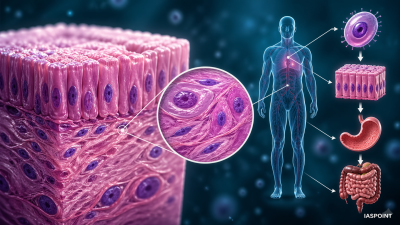
In the hierarchy of biological organization, tissues represent a group of cells similar in structure and function, held together by intercellular substances. The study of tissues is termed Histology.
Epithelial Tissue: The Protective Barrier
Epithelial tissues cover the external surfaces of the body and line internal organs and cavities. They are characterized by closely packed cells with very little intercellular matrix.
Classification Based on Cell Layers
- Simple Epithelium: Composed of a single layer of cells. It functions mainly as a mediator of absorption, diffusion, and filtration.
- Compound (Stratified) Epithelium: Consists of two or more cell layers. Its primary function is protection against chemical and mechanical stresses (e.g., skin).
Sub-types based on Cell Shape
| Type | Structure | Primary Locations | Function |
| Squamous | Flat, scale-like cells | Blood vessels (endothelium), Lung alveoli | Diffusion and filtration |
| Cuboidal | Cube-shaped cells | Kidney tubules, Ducts of glands | Secretion and absorption |
| Columnar | Tall, pillar-like cells | Lining of stomach and intestines | Secretion and absorption |
| Ciliated | Columnar/Cuboidal with cilia | Bronchioles, Fallopian tubes | Movement of particles/mucus |
Connective Tissue: The Structural Framework
Connective tissue is the most abundant and widely distributed tissue in the human body. It links and supports other tissues and organs. All connective tissues (except blood) secrete fibers of structural proteins like collagen or elastin.
Categories of Connective Tissue
- Loose Connective Tissue: Cells and fibers are loosely arranged in a semi-fluid ground substance.
- Areolar Tissue: Present beneath the skin; serves as a support framework for epithelium.
- Adipose Tissue: Specialized to store fats; located mainly beneath the skin.
- Dense Connective Tissue: Fibers and fibroblasts are compactly packed.
- Tendons: Attach skeletal muscles to bones (Dense Regular).
- Ligaments: Attach one bone to another bone (Dense Regular).
- Specialized Connective Tissue:
- Cartilage: Solid and pliable; resists compression. Found in the nose tip, outer ear joints, and between vertebral bones.
- Bone: Hard and non-pliable ground substance rich in calcium salts and collagen fibers. Osteocytes (bone cells) are present in spaces called lacunae.
- Blood: A fluid connective tissue containing plasma, RBCs, WBCs, and platelets. It is the main circulating fluid for transport.
Muscular Tissue: The Mechanism of Movement
Muscular tissue consists of long, excitable cells called muscle fibers. They contain contractile proteins—actin and myosin—which facilitate movement and locomotion.
Comparison of Muscle Types
| Feature | Skeletal Muscle | Smooth Muscle | Cardiac Muscle |
| Location | Attached to bones | Walls of internal organs (stomach, iris) | Wall of the Heart |
| Striations | Present (Striated) | Absent (Non-striated) | Present (Striated) |
| Control | Voluntary | Involuntary | Involuntary |
| Shape | Cylindrical, unbranched | Fusiform (needle-shaped) | Cylindrical, branched |
| Nucleus | Multinucleated | Uninucleated | Uninucleated |
Nervous Tissue: Control and Communication
Nervous tissue exerts the greatest control over the body’s responsiveness to changing conditions. It is composed of neurons and neuroglial cells.
Functional Components
- Neurons: The unit of the neural system. They are excitable cells that transmit electrical impulses.
- Neuroglia: These make up more than one-half the volume of neural tissue in the human body. They protect and support neurons but do not conduct impulses.
- Structure: A typical neuron consists of a cell body (cyton), dendrites (short branching processes), and an axon (long single process).
Key Facts and Trivia for Prelims
- Ectoderm, Mesoderm, Endoderm: Epithelial tissue originates from all three germ layers; Connective and Muscular tissues originate from the Mesoderm; Nervous tissue originates from the Ectoderm.
- Regeneration Power: Epithelial tissue has the highest regeneration capacity, while Nervous tissue (neurons) has the least.
- Largest Organ: The skin is the largest organ of the human body, primarily composed of stratified squamous epithelium.
- Blood Anomaly: Blood is considered a connective tissue even though it lacks fibers (in its fluid state) and its cells do not secrete the matrix.
- Matrix Composition: The matrix of bone is composed of Calcium Phosphate and Calcium Carbonate, providing it with extreme rigidity compared to cartilage.