

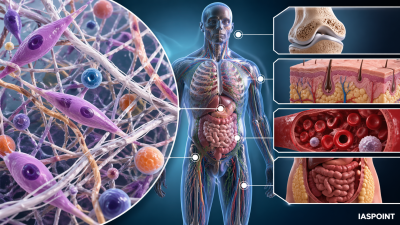
Connective tissue is the most abundant and widely distributed tissue in the human body. Unlike epithelial tissue, its cells are spread out in an extracellular matrix (ECM). Its primary functions include binding and supporting other tissues, protecting organs, insulating the body, and transporting substances.
Components of Connective Tissue
Connective tissue consists of three essential elements: cells, ground substance, and fibers. The latter two combine to form the Extracellular Matrix (ECM).
1. Specialized Cells
- Fibroblasts: The most common cell type; they secrete protein subunits to build fibers.
- Adipocytes: Fat cells that store triglycerides for energy and insulation.
- Mast Cells: Part of the immune system; they release histamine during inflammatory responses.
- Macrophages: Phagocytic cells that engulf pathogens and cellular debris.
- Leukocytes: White blood cells (neutrophils, lymphocytes) that migrate from blood to respond to infection.
2. Extracellular Fibers
- Collagen Fibers: Thick, straight fibers made of collagen protein. They provide high tensile strength (stronger than steel of the same diameter).
- Elastic Fibers: Composed of elastin protein; they allow tissues to stretch and recoil (found in skin, lungs, and blood vessel walls).
- Reticular Fibers: Thin, branching collagenous fibers that form a “net-like” framework (stroma) for soft organs like the liver and spleen.
3. Ground Substance
This is a fluid, semi-fluid, or calcified substance that fills the space between cells and fibers. It contains water and organic molecules like glycosaminoglycans (GAGs), such as hyaluronic acid, which help in lubrication and shock absorption.
Classification of Connective Tissue
| Category | Sub-type | Location/Function | Key Characteristics |
| Connective Tissue Proper (Loose) | Areolar | Under epithelia, around organs. | “Packing material” of the body; contains all fiber types. |
| Adipose | Subcutaneous layer, around heart/kidneys. | Energy storage, thermal insulation, and cushioning. | |
| Reticular | Spleen, lymph nodes, bone marrow. | Forms the structural framework (stroma) of lymphoid organs. | |
| Connective Tissue Proper (Dense) | Dense Regular | Tendons and Ligaments. | Parallel collagen fibers; resists pulling in one direction. |
| Dense Irregular | Dermis of skin, organ capsules. | Randomly arranged fibers; resists tension from many directions. | |
| Elastic | Walls of large arteries (Aorta), trachea. | High proportion of elastic fibers for stretching. | |
| Specialized Connective (Fluid) | Blood | Within blood vessels and heart. | Matrix is liquid (plasma); lacks fibers under normal conditions. |
| Lymph | Within lymphatic vessels. | Transports fats and immune cells. | |
| Specialized Connective (Supporting) | Cartilage | Nose, ears, joints, intervertebral discs. | Avascular; cells are called Chondrocytes; firm but flexible. |
| Bone (Osseous) | Skeleton. | Calcified matrix; cells are called Osteocytes; highly vascular. |
Types of Cartilage: A Comparative View
| Type | Characteristics | Key Locations |
| Hyaline Cartilage | Most abundant; smooth and glassy appearance. | Ribs (costal), nose, trachea, embryonic skeleton. |
| Fibrocartilage | Thick collagen fibers; highest tensile strength. | Intervertebral discs, pubic symphysis, knee menisci. |
| Elastic Cartilage | Rich in elastic fibers; maintains shape after bending. | External ear (pinna), Epiglottis. |
Vital Facts for UPSC Prelims
- Embryonic Origin: All connective tissues originate from the Mesoderm (specifically the embryonic tissue called Mesenchyme).
- Vascularity: Most connective tissues are highly vascular (rich blood supply). Exceptions include Cartilage (completely avascular) and Tendons/Ligaments (poorly vascular), which explains why they heal slowly.
- Scurvy Connection: Vitamin C is essential for collagen synthesis. Deficiency leads to Scurvy, characterized by the breakdown of connective tissue (bleeding gums, fragile capillaries).
- Tendons vs. Ligaments: Tendons connect Muscle to Bone; Ligaments connect Bone to Bone. Both are examples of Dense Regular Connective Tissue.
- Brown Fat vs. White Fat: White adipose tissue is for energy storage; Brown adipose tissue (rich in mitochondria and blood vessels) is specialized for thermogenesis (heat production), prevalent in newborns and hibernating animals.
- Blood as a Tissue: Blood is considered a connective tissue because it shares the same mesodermal origin as bone and because it consists of specialized cells circulating in an extracellular matrix (plasma).
Clinical Conditions related to Connective Tissue
- Ehlers-Danlos Syndrome: A genetic disorder affecting collagen production, leading to hypermobile joints and fragile skin.
- Marfan Syndrome: A genetic disorder of the elastic fibers, often affecting the aorta and the skeletal system (individuals are typically very tall with long limbs).
- Osteoporosis: A condition where bone resorption outpaces bone formation, leading to a weakened connective tissue matrix in the skeleton.