

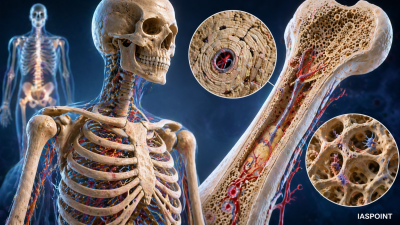
Bone, or osseous tissue, is a highly specialized, hard, and rigid fluid-connective tissue that forms the structural framework of the human body. Unlike cartilage, bone is a living, vascularized tissue that undergoes constant remodeling. It is characterized by a mineralized extracellular matrix that provides mechanical strength and metabolic functions.
Composition of Bone Tissue
Bone is composed of a unique combination of organic and inorganic materials, making it both strong and slightly flexible.
1. The Matrix
- Inorganic Component (65-70%): Primarily consists of Hydroxyapatite (a mineral complex of Calcium and Phosphate). This provides the tissue with its characteristic hardness and compressive strength.
- Organic Component (30-35%): Primarily Collagen fibers (Type I) and ground substance. This provides tensile strength and prevents the bone from being too brittle.
2. Specialized Bone Cells
- Osteoblasts: Bone-forming cells that secrete the organic matrix (osteoid).
- Osteocytes: Mature bone cells located in spaces called lacunae. They maintain the daily metabolism of bone tissue.
- Osteoclasts: Large, multi-nucleated cells responsible for bone resorption (breaking down bone matrix), essential for growth, repair, and calcium regulation.
- Osteoprogenitor Cells: Stem cells that divide to produce osteoblasts.
Structural Classification of Bone Tissue
On a microscopic and macroscopic level, bone tissue is divided into two types:
Compact (Cortical) Bone
- Characteristics: Dense, hard, and forms the outer shell of all bones.
- Haversian System (Osteon): The structural unit of compact bone. It consists of concentric layers called lamellae surrounding a central Haversian canal, which contains blood vessels and nerves.
- Volkmann’s Canals: Horizontal canals that connect Haversian canals to each other and to the periosteum.
Spongy (Cancellous/Trabecular) Bone
- Characteristics: Light, porous, and found at the ends of long bones and inside flat bones.
- Trabeculae: A lattice-like network of bony plates. The spaces between trabeculae are filled with Red Bone Marrow, where hematopoiesis (blood cell production) occurs.
Classification of Bones by Shape
| Type | Description | Examples |
| Long Bones | Greater length than width; consist of a shaft (diaphysis) and two ends (epiphyses). | Femur, Humerus, Phalanges. |
| Short Bones | Cube-shaped; nearly equal in length and width. | Carpals (wrist), Tarsals (ankle). |
| Flat Bones | Thin and provide extensive protection. | Cranium (skull), Sternum, Ribs, Scapula. |
| Irregular Bones | Complex shapes that do not fit other categories. | Vertebrae, Facial bones. |
| Sesamoid Bones | Small bones embedded in tendons. | Patella (kneecap). |
Vital Functions of Bone Tissue
- Structural Support: Provides a framework for the body and attachment points for skeletal muscles.
- Protection: Shields vital internal organs (e.g., skull protects the brain, rib cage protects heart/lungs).
- Movement: Acts as levers that muscles pull on to produce motion.
- Mineral Homeostasis: Stores 99% of the body’s calcium and about 85% of phosphorus. It releases these minerals into the blood to maintain critical physiological levels.
- Hematopoiesis: Red bone marrow produces RBCs, WBCs, and platelets.
- Energy Storage: Yellow bone marrow (found in the shafts of long bones) consists mainly of adipose cells, serving as a chemical energy reserve.
Vital Facts for UPSC Prelims
- Periosteum: A tough, fibrous sheath covering the outer surface of bones (except at joints). It contains blood vessels and nerves that enter the bone.
- Ossification (Osteogenesis): The process of bone formation. Intramembranous ossification forms flat bones, while Endochondral ossification replaces cartilage with bone in long bones.
- Hormonal Regulation: * Parathyroid Hormone (PTH): Stimulates osteoclasts to break down bone and release calcium into the blood when levels are low.
- Calcitonin: Secreted by the thyroid; inhibits osteoclasts and encourages calcium deposition in bone when blood levels are high.
- Vitamin D: Essential for the absorption of calcium from the digestive tract into the blood.
- The Hyoid Bone: The only bone in the human body that does not articulate (connect) with any other bone; it is supported by muscles in the neck.
- Smallest and Largest: The Stapes (in the middle ear) is the smallest bone; the Femur (thigh bone) is the largest and strongest.
- Bone Repair: Unlike cartilage, bone has a high regenerative capacity due to its rich blood supply. The repair process involves the formation of a callus.