

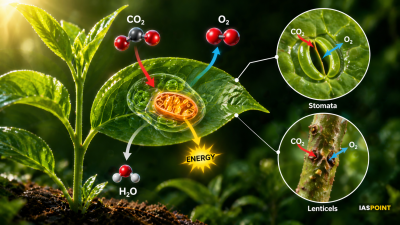
Respiration in plants is the process of breaking down food materials (complex organic compounds) within the cells to release energy for various cellular activities. Unlike animals, plants lack specialized respiratory organs like lungs; however, they possess structures like stomata and lenticels for gaseous exchange.
Cellular Respiration: The Mechanism
The energy released by oxidation in respiration is not used directly but is used to synthesize ATP (Adenosine Triphosphate), the energy currency of the cell.
- Aerobic Respiration: Complete oxidation of organic substances in the presence of oxygen, releasing CO2, water, and a large amount of energy.
- Anaerobic Respiration (Fermentation): Partial breakdown of glucose in the absence of oxygen.
Stages of Aerobic Respiration
The process occurs in four distinct stages, transitioning from the cytoplasm to the mitochondria.
1. Glycolysis (EMP Pathway)
This occurs in the cytoplasm and is common to both aerobic and anaerobic respiration. It does not require oxygen.
- Process: One molecule of Glucose (6C) is broken down into two molecules of Pyruvic acid (3C).
- Net Gain: 2 ATP and 2 NADPH + H^+.
2. Oxidative Decarboxylation (Link Reaction)
Pyruvic acid enters the mitochondrial matrix.
- Process: Pyruvic acid is converted into Acetyl CoA (2C).
- Significance: This step links glycolysis with the Krebs Cycle.
3. Tricarboxylic Acid (TCA) Cycle / Krebs Cycle
This occurs in the mitochondrial matrix.
- Process: Acetyl CoA is completely oxidized.
- Key Products: CO2 is released; NADH and FADH2 are produced as electron carriers.
4. Electron Transport System (ETS) and Oxidative Phosphorylation
This occurs on the inner mitochondrial membrane (Cristae).
- Process: Electrons from NADH and FADH2 are passed through a series of carriers to oxygen (O2), which acts as the final electron acceptor, forming water.
- ATP Synthesis: The energy released during ETS is used by the enzyme ATP Synthase to produce ATP.
Fermentation: Anaerobic Pathways
In the absence of oxygen, pyruvic acid undergoes fermentation in the cytoplasm.
- Alcoholic Fermentation: Occurs in yeast where pyruvic acid is converted to Ethanol and CO2.
- Lactic Acid Fermentation: Occurs in certain bacteria and animal muscle cells during vigorous exercise, converting pyruvic acid to Lactic Acid.
- Energy Yield: Very low (less than 7% of the energy in glucose is released).
Respiratory Quotient (RQ)
RQ is the ratio of the volume of CO2 evolved to the volume of O2 consumed during respiration. It depends on the type of respiratory substrate used.
| Substrate | RQ Value | Significance |
| Carbohydrates | 1.0 | Equal amounts of CO2 and O2 involved. |
| Fats (e.g., Tripalmitin) | 0.7 | Requires more O2 for oxidation. |
| Proteins | ~0.9 | Variable based on amino acid composition. |
| Organic Acids | > 1.0 | Contains more oxygen in their structure. |
Comparison: Respiration vs. Photosynthesis
| Feature | Photosynthesis | Respiration |
| Metabolic Nature | Anabolic (Constructive) | Catabolic (Destructive) |
| Energy Change | Endergonic (Stores energy) | Exergonic (Releases energy) |
| Site | Chloroplasts | Cytoplasm & Mitochondria |
| Gas Exchange | Takes in CO2, releases O2 | Takes in O2, releases CO2 |
| Time of Occurrence | Only in presence of light | Continuous (Day and Night) |
Critical Trivia for UPSC Prelims
- Amphibolic Pathway: Respiration is traditionally called catabolic, but it is actually amphibolic because respiratory intermediates are also used for the synthesis (anabolism) of other compounds (e.g., Acetyl CoA is used for fatty acid synthesis).
- Lenticels: Small openings in the bark of woody plants that allow gaseous exchange between the atmosphere and the internal tissues of the stem.
- Cyanide Poisoning: Cyanide inhibits the ETS by blocking Cytochrome c oxidase, effectively stopping ATP production and causing rapid cell death.
- Compensation Point: At this specific light intensity, the rate of photosynthesis equals the rate of respiration; net exchange of CO2 and O2 is zero.