

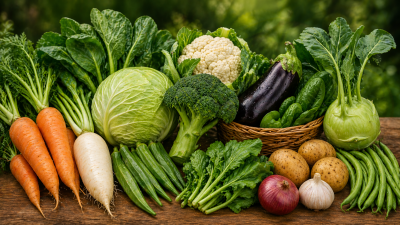
Vegetables are edible parts of plants, including stems, roots, leaves, and immature flowers or fruits. Unlike fruits (which are strictly matured ovaries), vegetables are classified based on the specific vegetative or reproductive organ consumed.
Root Vegetables
Root vegetables are modified roots that serve as storage organs for starch and nutrients.
- Tap Roots:
- Carrot (Daucus carota): Family Apiaceae. Rich in Beta-carotene (Vitamin A precursor).
- Radish (Raphanus sativus): Family Brassicaceae. Contains isothiocyanates which give it a pungent smell.
- Turnip (Brassica rapa): Family Brassicaceae.
- Beetroot (Beta vulgaris): Family Amaranthaceae. Source of Betalain pigments.
- Adventitious Roots:
- Sweet Potato (Ipomoea batatas): Family Convolvulaceae. Unlike the common potato, this is a root modification.
Underground Stem Modifications
These are often mistaken for roots but possess nodes, internodes, and axillary buds.
- Tubers: Potato (Solanum tuberosum). Family Solanaceae. The edible portion is the swollen tip of an underground stem (stolon). It contains “eyes” which are axillary buds.
- Bulbs: Onion (Allium cepa) and Garlic (Allium sativum). Family Amaryllidaceae. The edible part is the fleshy leaf bases or scales. Garlic contains Allicin, an organosulfur compound with antimicrobial properties.
- Corms: Arbi/Taro (Colocasia esculenta). A condensed vertical underground stem.
- Rhizomes: Ginger (Zingiber officinale) and Turmeric (Curcuma longa). Horizontal underground stems.
Leafy Vegetables
These are primary sources of dietary fiber, Iron, and Vitamin C.
- Spinach (Spinacia oleracea): High in Oxalic acid and Iron.
- Fenugreek (Trigonella foenum-graecum): Known for medicinal properties in managing blood sugar.
- Cabbage (Brassica oleracea var. capitata): The edible part is a giant terminal vegetative bud.
Modified Inflorescence (Flower-based Vegetables)
Certain vegetables are harvested during the reproductive stage of the plant.
- Cauliflower (Brassica oleracea var. botrytis): The edible part is the pre-anthesis inflorescence called a “curd.”
- Broccoli (Brassica oleracea var. italica): Consists of underdeveloped flower buds and fleshy stalks.
- Banana Flower: Used in various cuisines; the entire inflorescence (spadix) is consumed.
Fruit-Type Vegetables (Botanical Fruits)
These are botanically fruits (developed from ovaries) but are culinarily used as vegetables.
- Tomato (Solanum lycopersicum): A berry. Contains Lycopene, a powerful antioxidant.
- Brinjal/Eggplant (Solanum melongena): A berry. Known as the “King of Vegetables” in some regions.
- Lady’s Finger/Okra (Abelmoschus esculentus): Family Malvaceae. The fruit is a capsule.
- Cucurbits (Gourds): Includes Bitter Gourd, Bottle Gourd, and Pumpkin. Family Cucurbitaceae. Characterized by the presence of tendrils (modified stems).
Summary Table of Edible Parts
| Vegetable | Botanical Name | Family | Edible Part |
| Potato | Solanum tuberosum | Solanaceae | Stem Tuber |
| Sweet Potato | Ipomoea batatas | Convolvulaceae | Root Tuber |
| Onion | Allium cepa | Amaryllidaceae | Fleshy Leaves/Scales |
| Cauliflower | Brassica oleracea | Brassicaceae | Inflorescence (Curd) |
| Cabbage | Brassica oleracea | Brassicaceae | Vegetative Bud |
| Tomato | Solanum lycopersicum | Solanaceae | Berry (Fruit) |
| Carrot | Daucus carota | Apiaceae | Conical Tap Root |
UPSC Prelims: Vital Facts and Trivia
- Solanine: A toxic alkaloid found in green-colored potatoes (exposed to sunlight). It serves as a natural defense for the plant.
- Anthocyanins vs. Carotenoids: The red color of tomatoes is due to Lycopene (Carotenoid), while the purple color of Brinjal is due to Anthocyanins.
- Parthenocarpy in Vegetables: Some greenhouse cucumbers are developed without fertilization to ensure they remain seedless.
- Knol-Khol (Kohlrabi): A member of the cabbage family where the edible part is the swollen aerial stem.
- Sulfur Compounds: The pungent odor of onions and the characteristic smell of garlic are due to sulfur-containing volatile oils (e.g., Allyl propyl disulfide).
- Vegetative Propagation: Most underground vegetables (Potato, Ginger, Onion) are propagated vegetatively rather than by seeds in commercial farming.v