

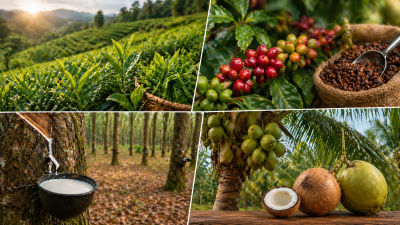
Plantation crops are large-scale commercial crops grown in a defined area, usually requiring specialized processing before consumption. They are perennial in nature and play a vital role in the national economy through export earnings. In the Indian context, these primarily include Tea, Coffee, Rubber, and Coconut.
Camellia sinensis (Tea)
Tea is the most widely consumed beverage in the world, after water.
- Family: Theaceae.
- Botanical Features: An evergreen shrub. The edible part is the youngest leaves and terminal buds.
- Alkaloids: Contains Theine (caffeine), Tannins (responsible for astringency), and polyphenols.
- Processing Varieties:
- Black Tea: Fully fermented.
- Green Tea: Unfermented; leaves are steamed to prevent oxidation.
- Oolong Tea: Partially fermented.
- Climate: Requires a tropical or sub-tropical climate with well-drained acidic soil (pH 4.5 to 5.5). Stagnant water is injurious to the roots.
Coffea species (Coffee)
- Family: Rubiaceae.
- Fruit Type: Drupe (commonly referred to as a “cherry”).
- Edible Part: Seeds (beans), which are roasted and ground.
- Major Species:
- Coffea arabica (Arabica): High quality, grown at higher altitudes, susceptible to pests like Coffee Rust.
- Coffea canephora (Robusta): Higher caffeine content, more resilient, grown at lower altitudes.
- Climate: Requires warm and humid climate with “blossom showers” for fruit setting.
Hevea brasiliensis (Natural Rubber)
- Family: Euphorbiaceae.
- Source: Derived from the Latex, a milky white fluid found in the laticiferous vessels of the bark.
- Tapping: The process of making a strategic incision in the bark to collect latex.
- Chemistry: Natural rubber is a polymer of Isoprene (C5H8).
- Origin: Amazon Basin (Brazil); however, South-East Asia (including India’s Kerala) is now a major producer.
Cocos nucifera (Coconut)
Known as the “Kalpavriksha” or “Tree of Heaven” due to its multi-purpose utility.
- Family: Arecaceae (Palmae).
- Fruit Type: Fibrous Drupe.
- Botanical Parts:
- Exocarp: Outer thin green/brown skin.
- Mesocarp: Fibrous layer used for making Coir.
- Endocarp: The hard shell.
- Edible Part: Endosperm. The “water” is liquid endosperm (free-nuclear), and the “meat” is cellular endosperm.
- Trivia: The coconut “apple” found in sprouting coconuts is the absorbed embryo.
Areca catechu (Areca Nut / Betel Nut)
- Family: Arecaceae.
- Botany: A tall, unbranched palm (caudex stem).
- Edible Part: The Seed (Endosperm).
- Chemicals: Contains alkaloids like Arecoline, which has stimulant properties.
Summary Table of Plantation Crops
| Crop | Family | Useful Part | Key Chemical/Product |
| Tea | Theaceae | Tender Leaves/Buds | Theine, Tannins |
| Coffee | Rubiaceae | Roasted Seeds | Caffeine |
| Rubber | Euphorbiaceae | Latex (from Bark) | Isoprene |
| Coconut | Arecaceae | Endosperm | Lauric Acid (Oil) |
| Cashew | Anacardiaceae | Seed (Kernel) | Anacardic Acid |
Other Notable Plantation Crops
Theobroma cacao (Cocoa)
- Family: Malvaceae.
- Fruit: Pods containing seeds (beans).
- Product: Cocoa butter and chocolate. The seeds must undergo fermentation to develop flavor.
Anacardium occidentale (Cashew)
- Botanical Oddity: It produces two types of fruit structures. The Cashew Apple is a fleshy false fruit (swollen pedicel), while the Cashew Nut is the true fruit (a nut).
- CNSL: Cashew Nut Shell Liquid is an important industrial byproduct used in resins and lubricants.
UPSC Prelims: Essential Trivia
- Board Headquarters: * Tea Board: Kolkata.
- Coffee Board: Bengaluru.
- Rubber Board: Kottayam.
- Spices Board: Kochi.
- Shifting Cultivation: Often discouraged in favor of plantation crops to prevent soil erosion and forest loss.
- Beverage Botany: Tea and Coffee are technically “stimulant crops” rather than “food crops.”
- Tannins: These are secondary metabolites in tea that act as a defense mechanism against herbivores and provide the characteristic “bite” to the brew.
- Vulcanization: While related to industrial chemistry, the transition from raw latex to usable rubber involves heating with sulfur, a process discovered by Charles Goodyear.