

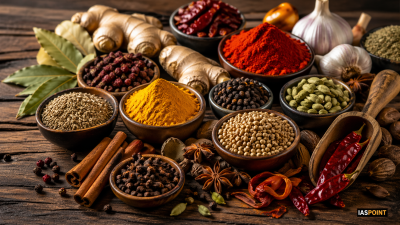
Spices are aromatic or pungent plant substances used primarily for flavoring, coloring, or preserving food. Unlike herbs (which are typically leafy green parts), spices are derived from various other plant parts, including seeds, fruits, bark, rhizomes, and flower buds. They are rich in essential oils and secondary metabolites.
Rhizomatic Spices (Underground Stems)
These spices are modified underground stems that store food and aromatic compounds.
Curcuma longa (Turmeric)
- Family: Zingiberaceae.
- Active Compound: Curcumin (a polyphenol responsible for the yellow color).
- Botany: The edible part is the Rhizome.
- Significance: Known for antiseptic, antioxidant, and anti-inflammatory properties. India is the largest producer and exporter.
Zingiber officinale (Ginger)
- Family: Zingiberaceae.
- Active Compound: Gingerol and Shogaol.
- Botany: Like turmeric, it is a Rhizome.
- Significance: Used as a carminative and for treating motion sickness.
Bark and Flower Bud Spices
Cinnamomum verum (Cinnamon/Dalchini)
- Family: Lauraceae.
- Botany: Derived from the inner bark of the tree.
- Active Compound: Cinnamaldehyde.
- Trivia: “True Cinnamon” (Ceylon cinnamon) is often substituted with Cassia, which has higher levels of Coumarin, a substance that can be toxic in large amounts.
Syzygium aromaticum (Clove)
- Family: Myrtaceae.
- Botany: The edible part is the unopened, dried flower bud.
- Active Compound: Eugenol.
- Significance: Widely used in dentistry for its analgesic (pain-relieving) properties.
Fruit and Seed Spices
Piper nigrum (Black Pepper)
- Family: Piperaceae.
- Botany: The fruit is a Drupe.
- Active Compound: Piperine (responsible for pungency).
- Trivia: Known as the “King of Spices” and “Black Gold.” Black, white, and green peppers all come from the same plant but differ in processing and maturity.
Capsicum annuum (Chilli)
- Family: Solanaceae.
- Active Compound: Capsaicin (found in the placental tissue/pith).
- Botany: Botanically a Berry.
- Measurement: Heat is measured in Scoville Heat Units (SHU).
Elettaria cardamomum (Small Cardamom)
- Family: Zingiberaceae.
- Botany: The fruit is a loculicidal capsule.
- Significance: Known as the “Queen of Spices.” It thrives in the “Cardamom Hills” of the Western Ghats.
The Unique Case of Saffron
Crocus sativus (Saffron/Kesar)
- Family: Iridaceae.
- Botany: The spice consists of the dried trifid stigmas and part of the style of the flower.
- Active Compounds: Crocin (color), Picrocrocin (taste), and Safranal (aroma).
- Significance: It is the world’s most expensive spice by weight. In India, it is primarily grown in the Karewas (glacial clay deposits) of Jammu & Kashmir.
Summary Table of Spice Botany
| Spice | Botanical Name | Part Used | Key Component |
| Turmeric | Curcuma longa | Rhizome | Curcumin |
| Clove | Syzygium aromaticum | Flower Bud | Eugenol |
| Cinnamon | Cinnamomum verum | Inner Bark | Cinnamaldehyde |
| Pepper | Piper nigrum | Fruit (Drupe) | Piperine |
| Saffron | Crocus sativus | Stigma & Style | Crocin |
| Coriander | Coriandrum sativum | Seed & Leaf | Linalool |
| Asafoetida | Ferula asafoetida | Oleo-gum-resin | Ferulic acid |
UPSC Prelims: Essential Facts
- Asafoetida (Heeng): It is not a fruit or seed but an oleo-gum-resin obtained from the exudate of the thick roots of Ferula species. It is not native to India and is mostly imported from Afghanistan and Iran.
- Essential Oils: These are volatile oils that give spices their characteristic aroma. They are usually extracted via steam distillation.
- Spices Board of India: Headquartered in Kochi, Kerala.
- GI Tags: Several Indian spices hold Geographical Indication tags, such as Kandhamal Haldi (Odisha), Coorg Green Cardamom (Karnataka), and Guntur Sannam Chilli (Andhra Pradesh).
- Seed Spices: India is a global leader in seed spices like Cumin (Jeera), Fennel (Saunf), Coriander (Dhania), and Fenugreek (Methi). These belong largely to the Apiaceae family.