

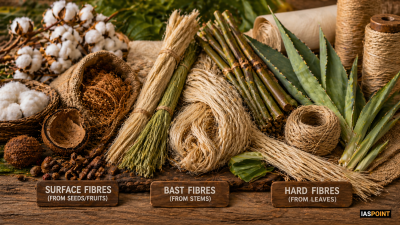
Plant fibres are elongated, thick-walled cells, usually consisting of cellulose and lignin, that provide structural support to the plant. In economic botany, these are harvested for textile, cordage, and paper industries. Based on their botanical origin, fibres are classified as Surface fibres (from seeds/fruits), Bast fibres (from stems), or Hard fibres (from leaves).
Surface Fibres: Seed and Fruit Origin
Gossypium species (Cotton)
Cotton is the most important vegetable fibre in the world.
- Family: Malvaceae.
- Botanical Origin: These are surface fibres (trichomes/epidermal hairs) of the seed coat.
- Composition: Nearly 90% pure cellulose.
- Types of Fibre: * Lint: The long, commercially valuable fibres.
- Fuzz: Short hairs remaining on the seed after ginning.
- Species in India: India is unique for growing all four cultivated species: G. hirsutum, G. arboreum, G. herbaceum, and G. barbadense.
- Bt Cotton: A genetically modified variety containing genes from the bacterium Bacillus thuringiensis to resist the bollworm pest.
Cocos nucifera (Coir)
- Family: Arecaceae.
- Botanical Origin: Fibres obtained from the fibrous mesocarp of the coconut fruit.
- Significance: It is the only fruit fibre used extensively. It is highly resistant to saltwater, making it ideal for marine ropes and mats.
Bast Fibres: Stem/Phloem Origin
These fibres are obtained from the pericycle or secondary phloem of the stems of dicotyledonous plants. They are extracted through a process called Retting (microbial decomposition of non-fibrous tissues in water).
Corchorus species (Jute)
Known as the “Golden Fibre” due to its color and high cost-effectiveness.
- Family: Malvaceae (formerly Tiliaceae).
- Species: Corchorus capsularis (White Jute) and Corchorus olitorius (Tossa Jute).
- Botany: Jute fibres are secondary phloem fibres.
- Processing: Requires stagnant water for retting. It is highly biodegradable and used primarily for gunny bags and packaging.
Crotalaria juncea (Sunn Hemp)
- Family: Fabaceae.
- Significance: A versatile crop used for high-quality tissue paper, cigarette paper, and as a “Green Manure” crop because it fixes nitrogen in the soil.
Cannabis sativa (Hemp)
- Family: Cannabaceae.
- Botany: A bast fibre known for its extreme strength and durability.
- Industrial Use: Used for sails, canvas, and heavy-duty ropes.
Leaf Fibres: Hard Fibres
Obtained from the vascular bundles of leaves in monocotyledonous plants. These are stiffer and coarser than bast fibres.
Agave sisalana (Sisal)
- Family: Asparagaceae.
- Botany: Fibres extracted from the leaves.
- Usage: Primarily for twine and industrial carpets.
Musa textilis (Abaca / Manila Hemp)
- Family: Musaceae.
- Botany: Extracted from the leaf sheaths of a relative of the banana plant.
- Significance: Renowned for being the strongest of all natural fibres and resistant to water decomposition.
Summary Table of Plant Fibres
| Fibre | Botanical Name | Part Used | Classification |
| Cotton | Gossypium spp. | Seed Hairs | Surface Fibre |
| Jute | Corchorus spp. | Stem Phloem | Bast Fibre |
| Coir | Cocos nucifera | Fruit Mesocarp | Surface Fibre |
| Sisal | Agave sisalana | Leaf | Hard Fibre |
| Flax | Linum usitatissimum | Stem Phloem | Bast Fibre |
| Sunn Hemp | Crotalaria juncea | Stem Phloem | Bast Fibre |
UPSC Prelims: Essential Facts and Trivia
- Retting: This is a biological process using bacteria (e.g., Clostridium) and moisture to dissolve the pectin that binds the fibres to the stem.
- Ginning: The mechanical process of separating cotton fibres (lint) from the seeds.
- Lignification: Unlike cotton, fibres like Jute and Hemp contain Lignin, which makes them stiffer and less flexible than pure cellulose fibres.
- Kapok: Derived from Ceiba pentandra (Silk Cotton Tree), these are seed fibres used for stuffing life jackets and pillows because they are highly buoyant and water-repellent.
- Economic Classification: Fibres are often divided into Textile fibres (Cotton), Cordage fibres (Jute, Sisal for ropes), and Filling fibres (Kapok, Coir).
- Flax (Linseed): Linum usitatissimum is a unique crop grown both for its bast fibre (used to make Linen) and its seeds (for Linseed oil).