

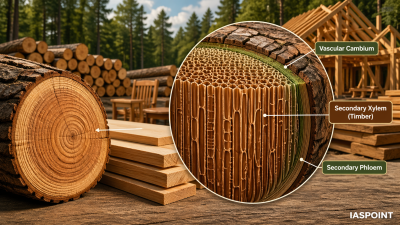
Timber refers to the wood of trees processed for use in construction, furniture, and industry. Botanically, timber is derived from the Secondary Xylem produced by the vascular cambium during secondary growth. Timber is classified into two main types based on the botanical origin:
- Softwood: Derived from Gymnosperms (e.g., Pine, Cedar). It lacks vessels and consists mostly of tracheids.
- Hardwood: Derived from Angiosperms (e.g., Teak, Sal). It contains vessels, making the wood more complex and usually denser.
Tectona grandis (Teak)
Known as the “King of Timber,” Teak is the most important commercial timber tree in India.
- Family: Lamiaceae (formerly Verbenaceae).
- Botanical Features: A large deciduous tree with high oil content in its heartwood.
- Properties: Exceptional durability, resistance to termites, and resistance to water decay. It does not corrode iron nails.
- Usage: Shipbuilding, high-end furniture, and exterior construction.
- Distribution: Found in the deciduous forests of Central and South India (Madhya Pradesh, Maharashtra, Karnataka).
Shorea robusta (Sal)
- Family: Dipterocarpaceae.
- Botanical Features: A semi-deciduous tree. The wood is very heavy, hard, and coarse-grained.
- Properties: Extremely durable underground or underwater. It is difficult to plane and polish due to its hardness.
- Usage: Railway sleepers, bridge construction, and mining frames.
- Trivia: The tree is also a source of “Sal Dammar” (resin) and Sal seed oil.
Dalbergia sissoo (Shisham / Indian Rosewood)
- Family: Fabaceae (Sub-family: Papilionoideae).
- Botanical Features: A deciduous tree with nitrogen-fixing root nodules.
- Properties: The heartwood is golden brown to dark brown with deep purple streaks. It is highly elastic and takes a high polish.
- Usage: Fine furniture, musical instruments, and agricultural implements.
Cedrus deodara (Deodar)
- Family: Pinaceae (Gymnosperm).
- Botanical Features: An evergreen conifer. The name is derived from “Devadaru,” meaning “Wood of the Gods.”
- Properties: The wood is scented (contains essential oils), light, and decay-resistant.
- Usage: Houseboats (Srinagar), temple architecture, and railway sleepers (historically).
- Distribution: High altitudes of the Western Himalayas.
Santalum album (Sandalwood)
- Family: Santalaceae.
- Botanical Nature: A root hemi-parasite; it draws nutrients from the roots of host plants.
- Properties: Heavily scented heartwood due to the presence of Santalol oil.
- Usage: Carving, incense, and extraction of sandalwood oil.
- Legal Fact: In India, it is a protected species; private felling is strictly regulated.
Summary Table of Timber Plants
| Common Name | Botanical Name | Family | Type | Primary Use |
| Teak | Tectona grandis | Lamiaceae | Hardwood | Shipbuilding/Furniture |
| Sal | Shorea robusta | Dipterocarpaceae | Hardwood | Heavy Construction |
| Shisham | Dalbergia sissoo | Fabaceae | Hardwood | High-quality Furniture |
| Deodar | Cedrus deodara | Pinaceae | Softwood | Himalayan Construction |
| Red Sanders | Pterocarpus santalinus | Fabaceae | Hardwood | Musical Instruments/Dye |
| Chir Pine | Pinus roxburghii | Pinaceae | Softwood | Resins/Matchsticks |
Specialized Timber and UPSC Trivia
Pterocarpus santalinus (Red Sanders)
- Significance: Endemic to the Seshachalam hills of Andhra Pradesh.
- Feature: It is a non-scented wood, unlike true sandalwood. It is highly valued in East Asia for furniture and traditional medicines.
- CITES Status: Listed in Appendix II due to over-exploitation and smuggling.
Heartwood vs. Sapwood
- Sapwood (Alburnum): The outer, light-colored part of the wood that conducts water and minerals. It is susceptible to decay.
- Heartwood (Duramen): The central, dark-colored, non-conducting part of the stem. It is impregnated with tannins, resins, and oils (Tyloses), making it the commercially valuable timber.
Dendrochronology
- Definition: The science of dating based on the study of Annual Rings (growth rings).
- Biology: One annual ring consists of “Spring wood” (wider vessels) and “Autumn wood” (narrower vessels). In tropical regions like South India, where seasons are not distinct, annual rings are often not clearly formed.
Other Notable Woods
- Balsa (Ochroma pyramidale): The lightest commercial wood, used in model making and insulation.
- Lignum vitae (Guaiacum officinale): The heaviest and hardest wood.
- Willow (Salix alba): Used specifically for making high-quality cricket bats.