

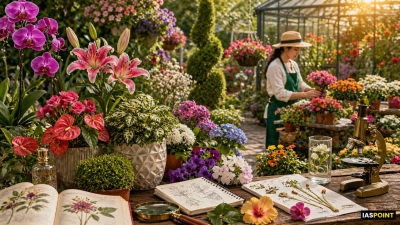
Ornamental or decorative plants are grown for aesthetic purposes, including their flowers, foliage, scent, or unique physical forms. In economic botany, these plants contribute significantly to the global Floriculture industry. Botanically, they are studied for their diverse reproductive structures, specialized vegetative adaptations, and phylogenetic variety.
Flowering Ornamentals (Angiosperms)
These are primarily valued for their inflorescence (the arrangement of flowers on a plant) and floral morphology.
Rosa species (Rose)
- Family: Rosaceae.
- Botanical Feature: Characterized by a “hypanthium” (a cup-like structure) and numerous stamens. The fruit is called a Rose hip, which is exceptionally rich in Vitamin C.
- Significance: Known as the “Queen of Flowers.” Apart from decoration, species like Rosa damascena are used to extract Attar (essential oil) and Gulkand.
Jasminum species (Jasmine)
- Family: Oleaceae.
- Botanical Feature: Known for terminal or axillary cymes.
- Significance: Valued for its fragrance due to essential oils like Benzyl acetate. Major species include J. sambac (Mogra) and J. grandiflorum.
Tagetes species (Marigold)
- Family: Asteraceae (Compositae).
- Inflorescence: A Capitulum (Head) composed of ray and disc florets.
- Significance: Widely used in India for religious and social ceremonies. It contains Lutein (a carotenoid) used in the food industry.
Orchidaceae (Orchids)
- Family: Orchidaceae.
- Botanical Feature: Characterized by Zygomorphic (bilaterally symmetrical) flowers and a specialized petal called the Labellum.
- Adaptive Feature: Many are Epiphytes (plants that grow on other plants for support but are not parasitic), possessing Velamen tissue in their roots to absorb moisture from the atmosphere.
Foliage and Architectural Plants
These plants are selected for the color, shape, or texture of their leaves rather than their flowers.
Anthurium and Caladium
- Family: Araceae.
- Botanical Feature: They possess a specialized inflorescence called a Spadix subtended by a large, often brightly colored bract known as a Spathe.
- Significance: Popular indoor plants due to their ability to thrive in low-light conditions.
Codiaeum variegatum (Croton)
- Family: Euphorbiaceae.
- Botanical Feature: High degree of leaf polymorphism (varied shapes) and variegation caused by different concentrations of chlorophyll and anthocyanins.
Palms (Cycads vs. Arecaceae)
- True Palms: Members of the Arecaceae family (e.g., Areca lutescens / Yellow Palm).
- Cycads: (e.g., Cycas revoluta / Sago Palm). Despite the name, these are Gymnosperms, representing a primitive evolutionary link.
Hydrophytic Ornamentals (Water Plants)
Nelumbo nucifera (Lotus)
- Family: Nelumbonaceae.
- Status: The National Flower of India.
- Botanical Feature: An aquatic herb with a peltate leaf (petiole attached to the center of the leaf blade).
- Adaptation: The leaves exhibit the “Lotus Effect” (ultrahydrophobicity) due to microscopic wax bumps that repel water and dirt.
Nymphaea species (Water Lily)
- Family: Nymphaeaceae.
- Distinction: Unlike the Lotus (where leaves are emergent), Water Lily leaves usually float on the water surface.
Summary Table of Decorative Plants
| Plant Name | Botanical Name | Family | Key Decorative Feature |
| Rose | Rosa spp. | Rosaceae | Scented Flower / Petals |
| Marigold | Tagetes spp. | Asteraceae | Capitulum Inflorescence |
| Bougainvillea | Bougainvillea spectabilis | Nyctaginaceae | Brightly colored Bracts |
| Tulip | Tulipa spp. | Liliaceae | Perianth (Tepals) |
| Money Plant | Epipremnum aureum | Araceae | Heart-shaped foliage |
| Bonsai | Ficus/Juniperus | Various | Art of dwarfing (Physiological) |
UPSC Prelims: Essential Facts and Trivia
- Bracts: In plants like Bougainvillea and Poinsettia, the “colorful petals” are actually modified leaves called Bracts. The true flowers are small and inconspicuous.
- Aerenchyma: A specialized parenchyma tissue with large air spaces found in ornamental hydrophytes (like Lotus), providing buoyancy and facilitating gas exchange.
- Bonsai: A Japanese art form that uses physiological techniques like root pruning, potting, and wiring to mimic the shape of mature, full-size trees in miniature.
- Xerophytic Ornamentals: Plants like Cacti and Succulents (Aloe, Echeveria) are popular for decoration due to their Crassulacean Acid Metabolism (CAM), allowing them to conserve water.
- Air Purifying Plants: NASA’s Clean Air Study identified several decorative plants like the Snake Plant (Sansevieria), Spider Plant (Chlorophytum), and Peace Lily (Spathiphyllum) as effective in removing indoor toxins like Formaldehyde and Benzene.
- Floriculture in India: The National Botanical Research Institute (NBRI) in Lucknow is a premier institute involved in the development of new ornamental varieties.