

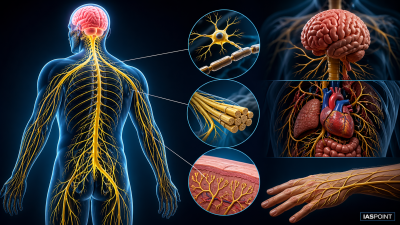
The Peripheral Nervous System (PNS) comprises all the nerves that lie outside the Central Nervous System (CNS). Its primary role is to connect the CNS (Brain and Spinal Cord) to the limbs, organs, and skin. Unlike the CNS, the PNS is not protected by bone or the blood-brain barrier, making it more susceptible to toxins and mechanical injuries.
Classification of Nerve Fibers
The PNS consists of two types of nerve fibers categorized by the direction of impulse conduction:
- Afferent (Sensory) Fibers: These fibers transmit impulses from tissues or organs (receptors) to the CNS.
- Efferent (Motor) Fibers: These fibers transmit regulatory impulses from the CNS to the concerned peripheral tissues or organs (effectors).
Functional Divisions of the PNS
The PNS is functionally divided into two main systems based on whether the actions are voluntary or involuntary.
Somatic Nervous System (SNS)
- Role: Relays impulses from the CNS to skeletal muscles.
- Nature: It governs voluntary movements and conscious sensory perceptions.
- Mechanism: It uses single neurons to connect the CNS directly to the skeletal muscle.
Autonomic Nervous System (ANS)
- Role: Relays impulses from the CNS to involuntary organs and smooth muscles (e.g., heart, lungs, stomach).
- Nature: It regulates “automatic” body functions like digestion, heart rate, and pupillary response.
- Subdivisions:
- Sympathetic Nervous System: Prepares the body for “Fight or Flight” during stress or emergencies. It increases heart rate, dilates pupils, and inhibits digestion.
- Parasympathetic Nervous System: Promotes the “Rest and Digest” state. It slows the heart rate, constricts pupils, and stimulates digestive secretions to conserve energy.
Cranial and Spinal Nerves
The PNS is anatomically composed of nerves originating from the brain and the spinal cord.
Cranial Nerves (12 Pairs)
These emerge directly from the brain and pass through foramina (holes) in the skull.
- Key Cranial Nerves for UPSC:
- Vagus Nerve (X): The longest cranial nerve; it controls the parasympathetic regulation of the heart, lungs, and digestive tract.
- Optic Nerve (II): Responsible for vision.
- Olfactory Nerve (I): Responsible for the sense of smell.
Spinal Nerves (31 Pairs)
These emerge from the spinal cord and are all mixed nerves (containing both sensory and motor fibers).
- Cervical: 8 pairs
- Thoracic: 12 pairs
- Lumbar: 5 pairs
- Sacral: 5 pairs
- Coccygeal: 1 pair
The Visceral Nervous System
A specialized part of the PNS, the Visceral Nervous System, comprises the complex of nerves, fibers, ganglia, and plexuses by which impulses travel from the CNS to the viscera (internal organs) and from the viscera to the CNS.
Comparison: Sympathetic vs. Parasympathetic Systems
| Feature | Sympathetic System (Stress) | Parasympathetic System (Relax) |
| Heart Rate | Increases | Decreases |
| Pupils | Dilates (Mydriasis) | Constricts (Miosis) |
| Salivation | Inhibits | Stimulates |
| Bronchi (Lungs) | Dilates (more oxygen) | Constricts |
| Digestion | Inhibits peristalsis | Stimulates peristalsis |
| Neurotransmitter | Norepinephrine (mostly) | Acetylcholine |
UPSC Prelims Fact File
- Ganglia: These are clusters of nerve cell bodies located in the PNS. In the CNS, similar clusters are called Nuclei.
- Nerve vs. Tract: A bundle of axons in the PNS is called a Nerve, whereas a bundle of axons in the CNS is called a Tract.
- Plexus: A network of intersecting nerves (e.g., Brachial plexus in the shoulder).
- Reflex Integration: While the CNS processes the reflex, the sensory and motor nerves involved are components of the PNS.
- Demyelination: Diseases like Guillain-Barré Syndrome affect the PNS by damaging the myelin sheath of peripheral nerves, leading to muscle weakness.