

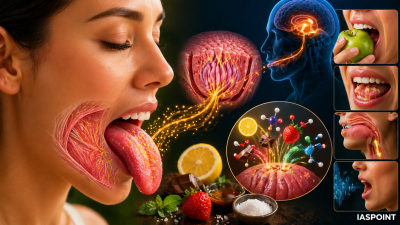
The tongue is a specialized muscular organ located in the oral cavity. It facilitates Gustation (taste) through chemoreceptors, while also playing a vital role in mastication (chewing), deglutition (swallowing), and speech.
1. Anatomical Structure of the Tongue
The surface of the tongue is covered with a moist mucous membrane and characterized by small projections called Papillae.
Types of Papillae
Not all papillae contain taste buds. For UPSC, it is important to distinguish between their structural and sensory roles:
- Circumvallate Papillae: Large, circular structures located at the back of the tongue in a V-shape. They contain numerous taste buds.
- Fungiform Papillae: Mushroom-shaped structures scattered mostly at the tip and sides of the tongue. They appear as red dots and contain taste buds.
- Foliate Papillae: Leaf-like folds located on the lateral (side) edges of the tongue. They contain taste buds, though these often degenerate in early childhood.
- Filiform Papillae: The most numerous type, covering the front two-thirds of the tongue. Crucial Fact: They do not contain taste buds; their primary function is mechanical (providing friction for food manipulation).
2. Structure and Function of Taste Buds
Taste buds are the functional units of taste, located within the epithelial lining of the papillae.
- Composition: Each taste bud contains 50–100 cells, including Gustatory Receptor Cells (sensory), supporting cells, and basal cells (stem cells for regeneration).
- Taste Pore: A small opening at the surface of the taste bud through which dissolved food chemicals contact the receptor cells.
- Mechanism: Food chemicals (tastants) dissolve in saliva and bind to receptors on the gustatory hairs (microvilli). This triggers a nerve impulse.
3. The Five Primary Tastes
The traditional “Tongue Map” (which suggested specific regions for specific tastes) is now considered a scientific myth; all regions of the tongue with taste buds can detect all five tastes, though sensitivity levels may vary slightly.
| Taste | Stimulus / Chemical Trigger | Biological Significance |
| Sweet | Sugars, Alcohols, some Amino Acids | Energy-rich nutrients |
| Sour | Hydrogen ions (H^+) from Acids | Warning for spoiled or acidic food |
| Salty | Metal ions (e.g., Sodium Na^+) | Electrolyte balance |
| Bitter | Alkaloids (e.g., Quinine, Nicotine) | Warning for potential toxins/poisons |
| Umami | L-Glutamate (Savory/Meaty taste) | Presence of proteins/amino acids |
4. Neural Pathway
- Cranial Nerves: Three nerves carry taste information to the brain:
- Facial Nerve (VII): Front 2/3 of the tongue.
- Glossopharyngeal Nerve (IX): Back 1/3 of the tongue.
- Vagus Nerve (X): Throat and epiglottis area.
- Brain Integration: The impulses travel to the Thalamus and then to the Gustatory Cortex in the parietal lobe.
Key Facts for UPSC Prelims
- Chemoreception Link: Flavor is a multisensory perception. About 80% of what we perceive as “taste” is actually smell. This is why food loses its flavor during a cold (nasal congestion).
- Regeneration: Gustatory receptor cells are replaced approximately every 10 to 14 days by basal cells.
- Thermoreception vs. Taste: Spicy “heat” (Capasaicin) is not a taste but a pain signal transmitted by the Trigeminal Nerve (V), which detects temperature and texture in the mouth.
- Ageusia: The total loss of the sense of taste. Dysgeusia refers to a persistent foul, salty, or metallic taste sensation.
- Saliva Requirement: A dry tongue cannot taste. Tastants must be in a liquid state (dissolved in saliva) to enter the taste pore and stimulate receptors.