

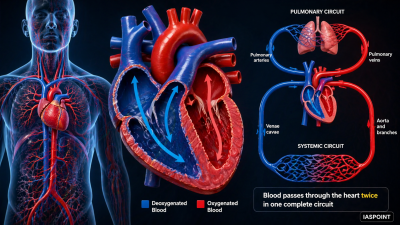
Double circulation is a sophisticated mechanism of blood flow where blood passes through the heart twice to complete one full circuit of the body. This system is a hallmark of “warm-blooded” animals (birds and mammals), including humans, and is essential for maintaining a high metabolic rate and constant body temperature (Homeothermy). It ensures that oxygenated and deoxygenated blood remain strictly separated, maximizing the efficiency of oxygen delivery to tissues.
Components of Double Circulation
Double circulation consists of two distinct but interconnected loops: Pulmonary Circulation and Systemic Circulation.
1. Pulmonary Circulation
This loop is responsible for the exchange of gases between the heart and the lungs.
- Path: Deoxygenated blood is pumped from the Right Ventricle into the Pulmonary Artery.
- Gas Exchange: The blood reaches the lungs, where CO2 is released and O2 is absorbed.
- Return: The now oxygenated blood returns to the Left Atrium via the Pulmonary Veins.
- Key Fact: The Pulmonary Artery is the only artery in the adult body carrying deoxygenated blood, and the Pulmonary Vein is the only vein carrying oxygenated blood.
2. Systemic Circulation
This loop provides nutrients and oxygen to all body tissues and collects metabolic wastes and carbon dioxide.
- Path: Oxygenated blood is pumped from the Left Ventricle into the Aorta (the largest artery).
- Distribution: Blood is distributed through a network of arteries, arterioles, and capillaries to various organs.
- Return: Deoxygenated blood is collected by venules and veins, eventually entering the Right Atrium via the Superior and Inferior Vena Cava.
Associated Specialized Circulatory Pathways
Beyond the primary loops, the systemic circulation includes specialized “portal” and “coronary” systems.
- Hepatic Portal System: A unique vascular connection where blood from the digestive tract (intestines) is carried to the Liver by the Hepatic Portal Vein before it reaches the systemic circulation. This allows the liver to detoxify substances and process nutrients.
- Coronary Circulation: A dedicated set of blood vessels (Coronary Arteries and Veins) responsible for supplying oxygenated blood to the cardiac musculature (heart muscles) and draining deoxygenated blood from it.
- Renal Circulation: The pathway through which blood is filtered by the kidneys.
Advantages of Double Circulation
- No Mixing of Blood: Unlike amphibians (3-chambered heart), there is no mixing of oxygenated and deoxygenated blood, leading to higher oxygen concentration in the blood sent to tissues.
- Pressure Regulation: It allows the heart to pump blood at a higher pressure to the systemic circuit (to reach extremities) while maintaining a lower pressure for the pulmonary circuit (to protect delicate lung tissue).
- High Efficiency: Supports the high energy demands required for internal thermoregulation.
Comparison of Circulation Types in Animal Kingdom
| Type of Circulation | Heart Chambers | Examples | Description |
| Single Circulation | 2 (1 Atrium, 1 Ventricle) | Fishes | Blood passes through the heart only once per cycle. |
| Incomplete Double | 3 (2 Atria, 1 Ventricle) | Amphibians, Reptiles | Oxygenated and deoxygenated blood mix in the single ventricle. |
| Complete Double | 4 (2 Atria, 2 Ventricle) | Mammals, Birds, Crocodiles | Complete separation of blood; no mixing occurs. |
Critical Facts for UPSC Prelims
- Left Ventricle Thickness: The walls of the left ventricle are three times thicker than the right ventricle because systemic circulation requires much higher pressure than pulmonary circulation.
- Crocodiles: Even though they are reptiles, crocodiles possess a four-chambered heart, representing an evolutionary transition toward complete double circulation.
- Aorta: All systemic arteries branch out from the Aorta.
- Vena Cava: All systemic deoxygenated blood eventually converges into the Superior Vena Cava (draining the upper body) or the Inferior Vena Cava (draining the lower body).