

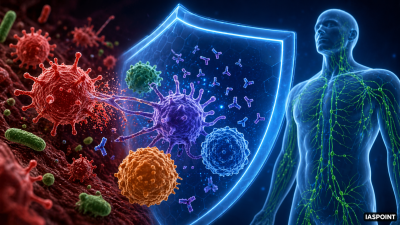
The immune system is a complex network of biological structures and processes that protects an organism against disease. It identifies and kills pathogens and tumor cells while distinguishing them from the organism’s own healthy tissue.
Classification of Immunity
Immunity is broadly categorized into two types based on the specificity and time of acquisition.
Innate Immunity (Non-Specific)
This is the inborn resistance present from birth. It provides the first line of defense and does not depend on prior exposure to a pathogen.
- Physical Barriers: Skin (prevents entry), mucus coating of the epithelium (traps microbes).
- Physiological Barriers: Acid in the stomach, saliva in the mouth, and tears from eyes (contain lysozyme).
- Cellular Barriers: Specific White Blood Cells (WBCs) like Polymorpho-nuclear leukocytes (PMNL-neutrophils), monocytes, and Natural Killer (NK) cells.
- Cytokine Barriers: Virus-infected cells secrete proteins called interferons, which protect non-infected cells from further viral infection.
Acquired Immunity (Specific)
This is pathogen-specific and characterized by memory. It is acquired during an individual’s lifetime.
- Primary Response: The low-intensity response produced when the body encounters a pathogen for the first time.
- Secondary (Anamnestic) Response: A highly intensified response upon subsequent encounter with the same pathogen, based on the principle of memory.
Components of Acquired Immunity
The acquired immune system relies on two specialized types of lymphocytes present in the blood:
- B-lymphocytes (B-cells): These produce an army of proteins called antibodies into the blood to fight pathogens.
- T-lymphocytes (T-cells): These do not secrete antibodies themselves but help B-cells to produce them. They are responsible for Cell-Mediated Immunity (CMI), which is crucial for graft rejection in organ transplants.
Structure and Types of Antibodies
Antibodies are Ig (Immunoglobulin) molecules. Each antibody molecule has four peptide chains: two small light chains and two longer heavy chains (H2L2).
| Antibody Type | Key Characteristics and Functions |
| IgG | Most abundant; can cross the placenta to provide natural passive immunity to the fetus. |
| IgA | Present in colostrum (initial breast milk) and secretions like saliva/tears; protects mucosal surfaces. |
| IgM | The first antibody produced during an initial immune response; indicates recent infection. |
| IgE | Involved in allergic reactions; triggers histamine release from mast cells and basophils. |
| IgD | Acts as a receptor on B-cell surfaces; involved in B-cell activation. |
Active and Passive Immunity
| Feature | Active Immunity | Passive Immunity |
| Mechanism | Produced by the host’s own body in response to antigens. | Ready-made antibodies are directly injected or transferred. |
| Speed | Slow; takes time to develop a full effective response. | Fast; provides immediate relief/protection. |
| Duration | Long-lasting and develops memory. | Short-lived; no memory developed. |
| Example | Natural infection or Vaccination. | Injection of anti-venom or IgA via Colostrum. |
Vaccination and Immunisation
The principle of immunization is based on the ‘memory’ of the immune system.
- Vaccination: Introduction of an inactivated/weakened pathogen (antigenic protein) into the body. It generates B and T-memory cells.
- Passive Immunisation: Direct injection of pre-formed antibodies or antitoxins (e.g., for Tetanus or snake bites) when an immediate immune response is required.
- Recombinant DNA Technology: Allows for the large-scale production of antigenic polypeptides in bacteria or yeast (e.g., Hepatitis B vaccine produced from yeast).
Immune System Disorders
Allergies
Allergy is the exaggerated response of the immune system to certain antigens present in the environment (pollen, dust, animal dander).
- Mediators: Involves IgE antibodies and chemicals like histamine and serotonin from mast cells.
- Treatment: Drugs like anti-histamines, adrenaline, and steroids quickly reduce symptoms.
Autoimmunity
A condition where the body’s immune system loses the ability to distinguish “self” from “non-self” and starts attacking its own cells.
- Example: Rheumatoid Arthritis, Myasthenia Gravis, and Type 1 Diabetes Mellitus.
Lymphoid Organs
These are the organs where the origin, maturation, and proliferation of lymphocytes occur.
Primary Lymphoid Organs
Where immature lymphocytes differentiate into antigen-sensitive lymphocytes.
- Bone Marrow: The main lymphoid organ where all blood cells including lymphocytes are produced.
- Thymus: A lobed organ located near the heart; it is large at birth but keeps reducing in size with age (reason for weakened immunity in elderly).
Secondary Lymphoid Organs
Where lymphocytes interact with antigens and proliferate to become effector cells.
- Spleen: Acts as a filter of the blood by trapping blood-borne microorganisms; it is a large reservoir of erythrocytes (RBCs).
- Lymph Nodes: Trap microorganisms or other antigens that get into the lymph and tissue fluid.
- MALT (Mucosal-Associated Lymphoid Tissue): Located within the lining of major tracts (respiratory, digestive, urogenital); it constitutes about 50% of the lymphoid tissue in the human body.