

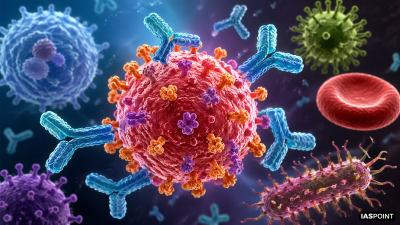
Antigens (Antibody Generators) are substances, usually foreign to the body, that induce an immune response and the production of antibodies. They are typically large molecules such as proteins, polysaccharides, or glycoproteins found on the surfaces of pathogens (bacteria, viruses, fungi) or on the surface of foreign cells like red blood cells from a different blood group.
- Epitope: The specific part of an antigen molecule to which an antibody attaches itself. A single antigen can have multiple epitopes.
- Haptens: Small molecules that are not antigenic by themselves but can become antigenic when coupled with a larger carrier protein.
Chemical Structure of Antibodies
Antibodies, also known as Immunoglobulins (Ig), are Y-shaped gamma globulin proteins produced by B-lymphocytes. They are found in blood, lymph, and various body secretions.
- Polypeptide Chains: Every antibody consists of four peptide chains—two identical Heavy (H) chains and two identical Light (L) chains, linked by disulfide bonds (H2L2).
- Variable Region (V): Located at the tips of the “Y,” this region varies between antibodies and provides the specificity to bind to a particular antigen (the Paratope).
- Constant Region (C): Determines the biological mechanism of the antibody (e.g., whether it crosses the placenta or binds to mast cells).
Antigen-Antibody Interactions
The binding between an antigen and an antibody is highly specific, similar to a lock-and-key mechanism. This interaction leads to several defense mechanisms:
- Agglutination: Antibodies cause particulate antigens (like bacteria) to clump together, making them easier targets for phagocytes.
- Opsonization: Antibodies coat the surface of a pathogen to “mark” it for destruction by neutrophils and macrophages.
- Neutralization: Antibodies block the binding sites of bacterial toxins or prevent viruses from entering body cells.
- Complement Activation: The binding triggers a cascade of plasma proteins (the complement system) that punctures the cell membrane of the pathogen, leading to lysis.
Blood Groups and Antigens
In the ABO blood group system, the antigens are located on the surface of Red Blood Cells (RBCs), while the antibodies are found in the plasma.
| Blood Group | Antigen on RBC | Antibody in Plasma | Can Donate To | Can Receive From |
| A | A | anti-B | A, AB | A, O |
| B | B | anti-A | B, AB | B, O |
| AB | A and B | None | AB (Universal Recipient) | A, B, AB, O |
| O | None | anti-A and anti-B | A, B, AB, O (Universal Donor) | O |
The Rh Factor (Rhesus Antigen)
The Rh antigen is another crucial protein found on the surface of RBCs in nearly 80% of humans (Rh positive).
- Erythroblastosis Fetalis: A clinical condition occurring when an Rh-negative mother carries an Rh-positive fetus. If maternal blood mixes with fetal blood during delivery, the mother develops antibodies against the Rh factor. In subsequent pregnancies, these antibodies can cross the placenta and destroy the fetal RBCs, leading to severe anemia or jaundice in the infant.
- Prevention: Administering anti-Rh antibodies (RhoGAM) to the mother immediately after the first delivery prevents the formation of memory cells.
Monoclonal vs. Polyclonal Antibodies
- Polyclonal Antibodies: Secreted by different B-cell lineages in the body. They recognize multiple epitopes on a single antigen.
- Monoclonal Antibodies (mAbs): Produced in a lab from a single B-cell clone (using Hybridoma technology). They are identical and recognize only one specific epitope.
- UPSC Trivia: Monoclonal antibodies are extensively used in diagnostic kits (like pregnancy tests) and targeted cancer therapies (e.g., Trastuzumab).
Antigen-Presenting Cells (APCs)
Certain cells are specialized to “present” antigens to T-cells to initiate the adaptive immune response.
- Main APCs: Macrophages, B-cells, and Dendritic cells.
- Mechanism: They engulf the pathogen, break it down, and display fragments of the antigen on their surface using Major Histocompatibility Complex (MHC) molecules. T-cells only recognize antigens when they are presented in this manner.