

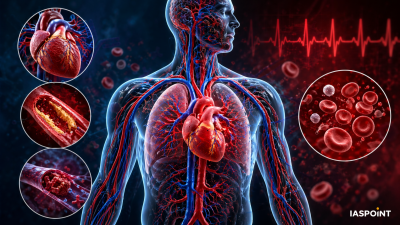
Circulatory system disorders encompass conditions affecting the heart, blood vessels, and the composition of the blood itself.
Hypertension (High Blood Pressure)
Hypertension is defined as blood pressure that is consistently higher than the normal range of 120/80 mmHg.
- Systolic Pressure (120 mmHg): The pressure in the arteries when the heart beats (pumping pressure).
- Diastolic Pressure (80 mmHg): The pressure in the arteries when the heart rests between beats (resting pressure).
Clinical Thresholds
| Category | Systolic (mmHg) | Diastolic (mmHg) |
| Normal | 120 | 80 |
| Pre-hypertension | 121–139 | 81–89 |
| Hypertension (Stage 1) | 140 or higher | 90 or higher |
Impact and Complications
- Vital Organs: Persistent high blood pressure affects the brain (leading to stroke) and kidneys (renal failure).
- Silent Killer: Often asymptomatic until significant damage occurs to the vascular system.
- Coronary Artery Disease (CAD): Often a precursor to atherosclerosis, where arteries become narrow due to plaque deposition.
Anaemia
Anaemia is a condition characterized by a deficiency in the number of healthy Red Blood Cells (RBCs) or the amount of hemoglobin in the blood, leading to reduced oxygen-carrying capacity.
Types of Anaemia and Causes
- Iron-Deficiency Anaemia: The most common form globally; occurs due to lack of iron, which is essential for hemoglobin synthesis.
- Pernicious Anaemia: Caused by a deficiency of Vitamin B12 or the lack of “Intrinsic Factor” in the stomach needed to absorb B12.
- Sickle Cell Anaemia: A genetic/hereditary disorder where RBCs take a sickle shape due to a point mutation in the hemoglobin gene. This causes cells to get stuck in small blood vessels.
- Aplastic Anaemia: Occurs when the bone marrow fails to produce sufficient new blood cells.
- Thalassemia: An inherited blood disorder where the body makes an abnormal form of hemoglobin.
Coronary Artery Disease (CAD) and Heart Conditions
CAD is often referred to as Atheosclerosis, which affects the vessels that supply blood to the heart muscle.
- Atheosclerosis: Caused by deposits of calcium, fat, cholesterol, and fibrous tissue, which makes the lumen of arteries narrower.
- Angina Pectoris: Also known as “chest pain.” It occurs when not enough oxygen is reaching the heart muscle. It can occur in men and women of any age but is more common among the middle-aged and elderly.
- Heart Failure: A state in which the heart is not pumping blood effectively enough to meet the needs of the body. It is sometimes called “congestive heart failure” because lung congestion is a primary symptom.
Comparison: Heart Attack vs. Cardiac Arrest
| Feature | Heart Attack (Myocardial Infarction) | Cardiac Arrest |
| Cause | A “circulation” problem: blood flow to the heart is blocked. | An “electrical” problem: the heart stops beating unexpectedly. |
| Effect | Heart muscle begins to die due to lack of oxygen. | The heart stops pumping blood to the brain and lungs. |
| Symptoms | Chest pain, sweating, shortness of breath. | Sudden collapse, loss of consciousness, no pulse. |
Other Notable Disorders
- Erythroblastosis Fetalis: An alloimmune condition where maternal antibodies attack fetal RBCs (Rh incompatibility).
- Haemophilia: A genetic disorder (X-linked recessive) where the blood’s ability to clot is severely reduced, causing even minor injuries to bleed profusely.
- Thrombosis: The formation of a blood clot (thrombus) inside a blood vessel, obstructing the flow of blood through the circulatory system.
- Lymphoedema: Swelling in an arm or leg caused by a lymphatic system blockage.
Fact Sheet for UPSC Prelims
- Sphygmomanometer: The instrument used to measure blood pressure.
- Normal Blood pH: Human blood is slightly alkaline, with a pH range of 7.35 to 7.45.
- Universal Donor/Recipient: O negative is the universal donor; AB positive is the universal recipient.
- Anaemia Mukt Bharat: A Government of India initiative aimed at reducing the prevalence of anaemia through a 6x6x6 strategy (6 target groups, 6 interventions, 6 institutional mechanisms).