

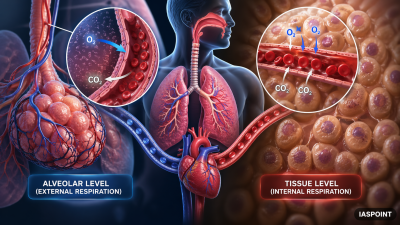
Gas exchange in the human body occurs at two primary levels: the Alveolar level (External Respiration) and the Tissue level (Internal Respiration). The exchange is driven by Simple Diffusion, primarily based on pressure/concentration gradients, the solubility of gases, and the thickness of the membranes.
Factors Affecting Diffusion
- Partial Pressure (P): The pressure contributed by an individual gas in a mixture of gases. It is represented as pO2 for oxygen and pCO2 for carbon dioxide.
- Solubility: The solubility of CO2 is 20–25 times higher than that of O2, meaning CO2 can diffuse much faster through the diffusion membrane per unit difference in partial pressure.
- Thickness of Membrane: The diffusion membrane is made of three layers (Alveolar epithelium, Capillary endothelium, and the basement substance), yet its total thickness is much less than a millimeter (0.2 mm), facilitating rapid exchange.
Partial Pressures of Oxygen and Carbon Dioxide
| Gas | Atmospheric Air | Alveoli | Oxygenated Blood | Deoxygenated Blood | Tissues |
| pO2 | 159 | 104 | 95 | 40 | 40 |
| pCO2 | 0.3 | 40 | 40 | 45 | 45 |
| (Values in mmHg) |
Transport of Oxygen (O2)
Oxygen is transported from the lungs to the tissues in two ways:
- As Oxyhemoglobin (97%): Oxygen binds with Hemoglobin (Hb), a red iron-containing pigment in RBCs. Each Hb molecule can carry a maximum of four molecules of O2.
- Dissolved State (3%): A small fraction is carried dissolved in the blood plasma.
Oxygen-Dissociation Curve
The binding of oxygen with hemoglobin is primarily related to pO2. When plotted, it yields a Sigmoid Curve.
- Shift to Right: Occurs in tissues where pO2 is low, pCO2 is high, H^+ concentration is high (low pH), and temperature is high. This promotes the dissociation (release) of oxygen from hemoglobin.
- Shift to Left: Occurs in alveoli where pO2 is high and pCO2 is low, favoring the formation of oxyhemoglobin.
Transport of Carbon Dioxide (CO2)
CO2 is transported from tissues to the alveoli in three forms:
- As Bicarbonate Ions (70%): CO2 enters RBCs and reacts with water to form carbonic acid (H2CO3), which dissociates into HCO3^- and H^+. This is catalyzed by the enzyme Carbonic Anhydrase.
- As Carbamino-hemoglobin (20-25%): CO2 binds directly to the amino groups of hemoglobin.
- Dissolved in Plasma (7%): Carried in a simple dissolved state.
The Haldane Effect
The binding of CO2 is related to pCO2. However, pO2 is a major factor affecting this binding. When pO2 is high (in alveoli), it facilitates the release of CO2 from hemoglobin.
Key Physiological Facts
- Delivery to Tissues: Every 100 ml of oxygenated blood can deliver around 5 ml of O2 to the tissues under normal physiological conditions.
- Removal from Tissues: Every 100 ml of deoxygenated blood delivers approximately 4 ml of CO2 to the alveoli.
- Chloride Shift (Hamburger’s Phenomenon): To maintain electrostatic neutrality, chloride ions (Cl^-) diffuse into RBCs from the plasma when bicarbonate ions diffuse out.
Regulation of Exchange
- Medulla Oblongata: Contains the Respiratory Rhythm Center.
- Chemoreceptors: Located in the carotid and aortic bodies, they are highly sensitive to CO2 and H^+ levels. Interestingly, the role of Oxygen in the regulation of respiratory rhythm is quite insignificant.