

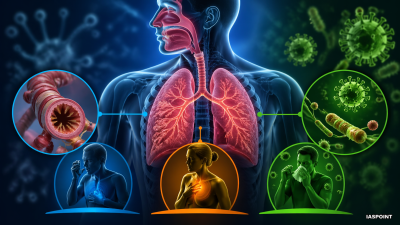
Respiratory disorders in humans are primarily classified into obstructive, restrictive, and infectious categories.
Asthma
Asthma is a chronic inflammatory disease of the airways characterized by hyper-responsiveness to various stimuli.
- Physiological Effect: Inflammation causes the bronchi and bronchioles to narrow. This is often accompanied by the overproduction of mucus and spasms in the smooth muscles of the airway.
- Symptoms: Difficulty in breathing, chest tightness, and wheezing (a whistling sound during expiration).
- Triggers: Allergens (pollen, dust), cold air, exercise, or pollutants.
- Key Fact: It involves an allergic response mediated by IgE antibodies and the release of histamine from mast cells.
Bronchitis
Bronchitis is the inflammation of the lining of the bronchial tubes, which carry air to and from the lungs. It is categorized into acute and chronic forms.
- Acute Bronchitis: Often follows a viral infection like the common cold or flu. It is usually temporary.
- Chronic Bronchitis: Defined as a cough that occurs for at least three months a year for two consecutive years. It is a major component of COPD (Chronic Obstructive Pulmonary Disease).
- Pathology: The irritants (primarily cigarette smoke or pollution) cause the goblet cells to secrete excessive mucus, which thickens the airway and limits airflow.
- Symptom: A persistent “smoker’s cough” with thick sputum.
Tuberculosis (TB)
TB is a serious infectious disease that mainly affects the lungs but can spread to other parts of the body like the spine and brain.
- Causative Agent: The bacterium Mycobacterium tuberculosis.
- Transmission: Through the air via droplets (coughing or sneezing).
- Pathology: The bacteria destroy lung tissue, which the body replaces with fibrous tissue. These areas of infection are called “tubercles.”
- Diagnosis: The Mantoux tuberculin skin test or the more modern Sputum Smear Microscopy and Nucleic Acid Amplification Test (NAAT).
- Treatment: A long course of antibiotics. India uses the DOTS (Directly Observed Treatment, Short-course) strategy under the National TB Elimination Programme.
- Vaccination: The BCG (Bacillus Calmette-Guérin) vaccine provides protection against severe forms of TB in children.
Emphysema
Though not explicitly listed by the user, it is a critical “neighbor” concept for UPSC.
- Definition: A chronic disorder where alveolar walls are damaged, resulting in the reduction of the surface area for gas exchange.
- Primary Cause: Majorly caused by cigarette smoking.
- Result: The lungs lose elasticity, making it difficult to exhale air, leading to shortness of breath.
Occupational Respiratory Disorders
Occur in individuals working in specific industries where long-term exposure to dust is prevalent.
| Disorder | Causative Agent | Industry Involved |
| Silicosis | Silica dust | Stone breaking, mining, pottery. |
| Asbestosis | Asbestos fibers | Construction, insulation, cement manufacturing. |
| Pneumoconiosis | Coal dust | Coal mining (Black Lung Disease). |
| Siderosis | Iron dust | Welding, iron ore mining. |
Comparative Summary of Respiratory Pathologies
| Feature | Asthma | Bronchitis | Tuberculosis |
| Primary Site | Bronchi/Bronchioles | Lining of Bronchial tubes | Alveoli/Lung Parenchyma |
| Nature | Allergic/Inflammatory | Inflammatory/Irritant | Infectious (Bacterial) |
| Reversibility | Usually reversible with inhalers | Chronic form is irreversible | Curable with antibiotics |
| Characteristic | Spasms and Wheezing | Excessive mucus production | Tissue destruction (Cavitation) |
Important Trivia for UPSC Prelims
- Hypoxia: A condition where there is an inadequate supply of oxygen to the tissues.
- Asphyxia: A condition of severely deficient supply of oxygen to the body that arises from abnormal breathing (e.g., choking or drowning).
- Carbon Monoxide (CO) Poisoning: CO has a much higher affinity (200-250 times) for hemoglobin than oxygen. It forms stable Carboxyhemoglobin, preventing oxygen transport and leading to death.
- Pneumonia: Unlike TB, pneumonia is an acute infection where the alveoli get filled with fluid (edema), severely hampering gas exchange. It can be viral, bacterial (e.g., Streptococcus pneumoniae), or fungal.