

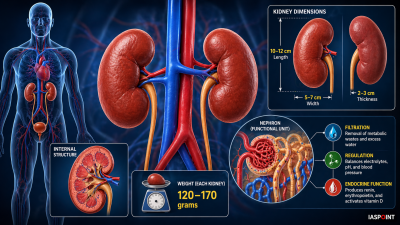
The kidneys are bean-shaped, reddish-brown organs essential for filtration and endocrine functions. In an adult human, each kidney measures approximately 10-12 cm in length, 5-7 cm in width, and 2-3 cm in thickness, weighing between 120-170 grams.
External Features
- Location: They are situated retroperitoneally (behind the peritoneum) against the posterior abdominal wall.
- Hilum: A notch on the inner concave surface through which the renal artery enters, and the renal vein and ureter exit.
- Renal Capsule: A tough, fibrous outer layer that protects the kidney from trauma and infection.
Internal Zones
- Renal Cortex: The outer light-colored region that extends between the medullary pyramids as the Columns of Bertini.
- Renal Medulla: The inner darker region divided into a few conical masses called Medullary Pyramids projecting into the calyces.
- Renal Pelvis: A broad funnel-shaped space internal to the hilum which collects urine before it enters the ureter.
The Functional Unit: The Nephron
Each kidney houses nearly one million nephrons. A nephron consists of two main parts: the Glomerulus and the Renal Tubule.
1. Renal Corpuscle (Malpighian Body)
- Glomerulus: A tuft of capillaries formed by the afferent arteriole (a fine branch of the renal artery).
- Bowman’s Capsule: A double-walled cup-like structure enclosing the glomerulus.
2. Renal Tubule
- Proximal Convoluted Tubule (PCT): Lined by simple cuboidal brush border epithelium which increases the surface area for reabsorption.
- Henle’s Loop: A hairpin-shaped structure with a descending limb (permeable to water) and an ascending limb (permeable to electrolytes).
- Distal Convoluted Tubule (DCT): A coiled portion where conditional reabsorption of sodium and water occurs.
- Collecting Duct: A straight tube where many DCTs open; it plays a crucial role in concentrating urine.
Physiological Functions of the Kidney
The kidney maintains the body’s internal environment through three distinct processes of urine formation and several non-excretory roles.
Mechanism of Urine Formation
- Glomerular Filtration: Blood is filtered through three layers (endothelium of capillaries, epithelium of Bowman’s capsule, and their basement membrane). This is called Ultrafiltration because almost all plasma constituents except proteins pass into the lumen.
- Selective Reabsorption: Nearly 99% of the filtrate is reabsorbed by the renal tubules. Active reabsorption occurs for glucose and amino acids, while nitrogenous wastes are reabsorbed by passive transport.
- Tubular Secretion: Cells of the tubule secrete substances like H^+, K^+, and ammonia into the filtrate to maintain ionic and acid-base balance (pH).
Regulatory and Endocrine Functions
- Osmoregulation: Regulating the water and electrolyte balance (osmolarity) of the blood.
- Erythropoietin Secretion: The kidney produces erythropoietin, a hormone that stimulates the bone marrow to produce Red Blood Cells (RBCs).
- Renin-Angiotensin Mechanism: The Juxtaglomerular Apparatus (JGA) releases Renin when blood pressure drops, initiating a hormonal cascade to restore GFR.
- Vitamin D Activation: Converts calcidiol into calcitriol (the active form of Vitamin D), essential for calcium absorption in the gut.
Comparison of Nephron Types
| Feature | Cortical Nephrons | Juxtamedullary Nephrons |
| Abundance | 85% of total nephrons | 15% of total nephrons |
| Loop of Henle | Very short; extends very little into the medulla | Very long; runs deep into the medulla |
| Vasa Recta | Absent or highly reduced | Well-developed |
| Primary Role | General filtration under normal conditions | Water conservation during dehydration |
Important Facts for UPSC Prelims
- Podocytes: Specialized epithelial cells of the Bowman’s capsule that leave minute spaces called filtration slits or slit pores.
- Vasa Recta: A U-shaped minute vessel of the peritubular capillary network that runs parallel to the Loop of Henle, essential for the Counter-Current Mechanism.
- Counter-Current Mechanism: The specific orientation of the Loop of Henle and Vasa Recta that helps maintain a concentration gradient in the medullary interstitium, allowing humans to excrete concentrated urine (nearly 4 times more concentrated than the initial filtrate).
- Uremia: A condition where urea accumulates in the blood due to kidney malfunction, which can lead to kidney failure.