

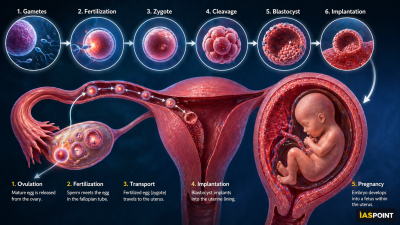
Human reproduction is a sequential process beginning with the fusion of gametes and concluding with the development of a fetus within the uterus.
Fertilization: The Fusion of Gametes
Fertilization is the process where a haploid sperm fuses with a haploid ovum to form a diploid zygote.
- Site of Fertilization: It occurs specifically at the ampullary-isthmic junction of the Fallopian tube (Oviduct).
- Insemination: During coitus, semen is released into the vagina. Sperm swim through the cervix, enter the uterus, and reach the Fallopian tube.
- Capacitation: The functional maturation of the sperm within the female reproductive tract, enabling it to fertilize the egg.
- Acrosomal Reaction: Upon contact with the zona pellucida layer of the ovum, the acrosome releases enzymes (hyaluronidase). These enzymes dissolve the layer, allowing the sperm nucleus to enter the ovum.
- Polyspermy Block: Once one sperm touches the plasma membrane of the ovum, it induces changes in the zona pellucida that block the entry of additional sperm, ensuring only one sperm fertilizes the egg.
- Completion of Meiosis: The entry of sperm induces the completion of the second meiotic division of the secondary oocyte, resulting in a second polar body and a haploid ootid (ovum).
Zygote Formation and Cleavage
- Zygote: The fusion of the haploid nucleus of the sperm and the ovum results in a diploid (2n) zygote.
- Cleavage: Rapid mitotic divisions start as the zygote moves through the isthmus toward the uterus.
- Blastomeres: The daughter cells produced during cleavage.
- Morula: An embryo with 8 to 16 blastomeres, resembling a mulberry.
- Blastocyst: The morula continues to divide and transforms into a blastocyst as it moves further into the uterus.
Implantation
Implantation is the attachment of the blastocyst to the uterine wall.
- Blastocyst Structure: It is organized into an outer layer called the trophoblast and an inner group of cells called the inner cell mass.
- Mechanism: The trophoblast layer attaches to the endometrium. The endometrial cells then divide rapidly and cover the blastocyst.
- Result: The blastocyst becomes embedded in the endometrium of the uterus. This is the point at which pregnancy is officially established.
- Inner Cell Mass: These cells are the “stem cells” that eventually differentiate into all the tissues and organs of the embryo.
Pregnancy and Placenta Formation
After implantation, finger-like projections appear on the trophoblast called chorionic villi, which are surrounded by uterine tissue and maternal blood.
- Placenta: The chorionic villi and uterine tissue become interdigitated to form the placenta, a structural and functional unit between the developing embryo (fetus) and the maternal body.
- Functions of the Placenta:
- Supplies oxygen and nutrients to the embryo.
- Removes carbon dioxide and excretory/waste materials produced by the embryo.
- Acts as an endocrine tissue.
- Umbilical Cord: Connects the placenta to the embryo, facilitating the transport of substances to and from the embryo.
Endocrine Regulation During Pregnancy
The placenta and the maternal system secrete specific hormones to maintain the pregnancy.
| Hormone | Source | Role |
| hCG (Human Chorionic Gonadotropin) | Placenta | Maintains the corpus luteum; detected in pregnancy tests. |
| hPL (Human Placental Lactogen) | Placenta | Regulates maternal metabolism to support fetal growth. |
| Estrogens & Progestogens | Placenta/Ovary | Support fetal growth and maintain the uterine lining. |
| Relaxin | Ovary/Placenta | Relaxes pelvic ligaments to facilitate childbirth later. |
Note: Hormones like hCG, hPL, and relaxin are produced in women only during pregnancy. Additionally, levels of other hormones like cortisol, prolactin, and thyroxine increase several-fold in maternal blood.
Embryonic Development (Gestation)
The human pregnancy (gestation) lasts approximately 9 months (approx. 280 days from the last menstrual period).
- First Month: The embryo’s heart is formed.
- Second Month: Limbs and digits develop.
- Third Month (First Trimester): Most major organ systems are formed (external genitalia are visible).
- Fifth Month: First movements of the fetus and appearance of hair on the head.
- Sixth Month (Second Trimester): Body is covered with fine hair, eyelids separate, and eyelashes are formed.
- Ninth Month: The fetus is fully developed and ready for delivery.
UPSC Prelims Fact Sheet
- Ectopic Pregnancy: Implantation of the embryo at a site other than the uterus (most commonly the Fallopian tube). It is a medical emergency.
- Germ Layers: Immediately after implantation, the inner cell mass differentiates into an outer ectoderm, an inner endoderm, and a middle mesoderm. These give rise to all organs.
- Stem Cells: The inner cell mass contains certain cells called stem cells which have the potency to give rise to all the tissues and organs.
- HCG Presence: The presence of hCG in a woman’s urine is the definitive biological marker used in “Gravindex” or home pregnancy test kits.