

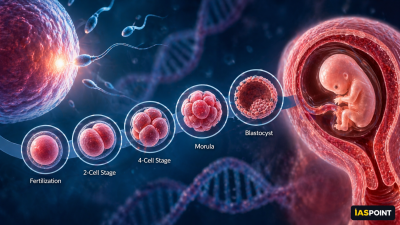
In the context of human reproduction, the term “embryo” refers to the early stages of development following fertilization.
- Timeline: The embryonic period generally spans from the second week to the end of the eighth week post-fertilization.
- Transition: After the eighth week, when major organ systems have begun to form and the organism takes a recognizable human shape, it is termed a fetus.
Cleavage and the Formation of the Blastocyst
Following the formation of the zygote in the fallopian tube, the organism undergoes “cleavage”—a series of rapid mitotic divisions.
- Blastomeres: The individual cells produced during cleavage.
- Morula: A solid ball of 8–16 blastomeres.
- Blastocyst: A hollow sphere formed as the morula moves into the uterus. It consists of:
- Trophoblast: The outer layer that attaches to the endometrium and later forms the placenta.
- Inner Cell Mass (ICM): The group of internal cells that will differentiate into the actual embryo.
Gastrulation: The Formation of Germ Layers
Immediately after implantation, the Inner Cell Mass (ICM) undergoes gastrulation. This is the most critical phase in early development, where the single-layered blastula is reorganized into a multilayered structure. The ICM differentiates into three primary germ layers, which are the precursors to all adult tissues and organs:
| Germ Layer | Derived Tissues and Organs |
| Ectoderm (Outer) | Central Nervous System (Brain & Spinal Cord), Peripheral Nervous System, Epidermis (Skin), Hair, Nails. |
| Mesoderm (Middle) | Muscles, Bones, Circulatory System (Heart & Blood Vessels), Excretory System (Kidneys), Dermis of skin. |
| Endoderm (Inner) | Epithelial lining of the Digestive Tract, Respiratory System (Lungs), Liver, Pancreas, Thyroid Gland. |
Stem Cells and Totipotency
The Inner Cell Mass contains certain specialized cells known as Stem Cells.
- Potency: These cells possess the unique ability (potency) to give rise to all the tissues and organs of the human body.
- Significance: This biological property is the foundation of regenerative medicine and developmental biology studies relevant to Science and Technology sections of the UPSC syllabus.
Milestones of Embryonic Development (Organogenesis)
The transformation of the embryo into a fetus follows a strict chronological order:
- First Month: The heart is the first organ to be formed. The heartbeat can be heard through a stethoscope by the end of the first month.
- Second Month: The embryo develops limbs and digits (fingers and toes).
- Third Month (End of First Trimester): Most of the major organ systems are formed. External genitalia become distinct, allowing for sex determination (though regulated/prohibited in India under the PCPNDT Act).
- Fifth Month: Significant milestones include the first movements of the fetus (quickening) and the appearance of hair on the head.
- Sixth Month (End of Second Trimester): The body is covered with fine hair, eyelids separate, and eyelashes are formed.
Extra-Embryonic Membranes
While the embryo develops, four membranes form outside the embryo to protect and nourish it:
- Amnion: Filled with amniotic fluid, it acts as a shock absorber and prevents the embryo from desiccation (drying out).
- Chorion: The outermost layer that contributes to the formation of the placenta.
- Yolk Sac: In humans, it is vestigial (non-functional for yolk storage) but is the site of early blood cell formation.
- Allantois: Involved in early fluid exchange and the formation of the umbilical cord.
UPSC Prelims Fact File: Human Embryo
- Twinning: * Monozygotic (Identical): One zygote splits into two embryos; they share 100% DNA.
- Dizygotic (Fraternal): Two separate eggs are fertilized by two separate sperm; they share 50% DNA.
- Amniocentesis: A medical procedure used to test for chromosomal abnormalities by analyzing amniotic fluid. In India, its use for sex determination is a criminal offense under the PCPNDT Act, 1994.
- Teratogens: External agents (like alcohol, certain drugs, or radiation) that can cause malformations in the developing embryo. The embryo is most vulnerable to these during the first trimester.
- Primitive Streak: The first sign of the nervous system and the longitudinal axis of the body appearing during the third week of development.