

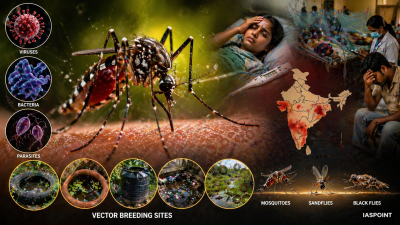
Vector-borne diseases are human illnesses caused by parasites, viruses, and bacteria that are transmitted by vectors. Vectors are living organisms that can transmit infectious pathogens between humans, or from animals to humans. In India, VBDs account for a significant portion of the infectious disease burden, largely due to tropical climatic conditions conducive to vector breeding.
Common Vectors and Associated Diseases
Different vectors transmit specific pathogens. Understanding the link between the vector species and the disease is crucial for UPSC Prelims.
| Vector Type | Common Name | Diseases Transmitted |
| Mosquito | Aedes aegypti | Dengue, Chikungunya, Zika, Yellow Fever |
| Mosquito | Anopheles (Female) | Malaria |
| Mosquito | Culex | Japanese Encephalitis, Lymphatic Filariasis |
| Sandfly | Phlebotomus argentipes | Kala-azar (Visceral Leishmaniasis) |
| Ticks | Hard/Soft Ticks | Kyasanur Forest Disease (KFD), Lyme Disease |
| Flies | Tsetse Fly | African Sleeping Sickness |
| Flies | Housefly | Cholera, Amoebiasis, Typhoid (Mechanical vector) |
| Louse | Body Louse | Epidemic Typhus |
Major Mosquito-Borne Diseases in India
Mosquitoes are the most prominent vectors in the Indian subcontinent. The National Center for Vector Borne Diseases Control (NCVBDC) monitors six primary diseases.
Lymphatic Filariasis (Elephantiasis)
- Causative Agent: Helminthic worms (Wuchereria bancrofti and Brugia malayi).
- Vector: Culex quinquefasciatus mosquito.
- Impact: Causes inflammation of the lymphatic system, leading to abnormal enlargement of limbs and genitals.
- Elimination Goal: India aims to eliminate Filariasis by 2027, ahead of the global target of 2030, through Mass Drug Administration (MDA).
Japanese Encephalitis (JE)
- Causative Agent: JE Virus (Flavivirus).
- Vector: Culex tritaeniorhynchus and Culex vishnui groups.
- Host: Pigs and wild birds act as “amplifier hosts.”
- Target: Central Nervous System; it is a major cause of Pediatric Encephalitis in India (e.g., Gorakhpur outbreaks).
Emerging and Re-emerging Vector Diseases
Zika Virus
- Transmission: Primarily Aedes mosquitoes; also through sexual contact and blood transfusion.
- Complications: Microcephaly in newborns and Guillain-Barré syndrome in adults.
Kyasanur Forest Disease (KFD)
- Popular Name: Monkey Fever.
- Transmission: Transmitted to humans via tick bites (Haemaphysalis spinigera) or contact with an infected animal (especially monkeys).
- Location: Endemic to the Western Ghats of India (Karnataka, Maharashtra, Kerala).
National Framework for VBD Control
The Government of India operates under the National Center for Vector Borne Diseases Control (NCVBDC), which falls under the Directorate General of Health Services.
Key Government Initiatives
- National Framework for Malaria Elimination (NFME) 2016-2030: Aims to eliminate malaria throughout the country and maintain a malaria-free status.
- Kala-azar Elimination: Focused on “Elimination as a public health problem,” defined as less than 1 case per 10,000 population at the block level.
- Integrated Vector Management (IVM): A strategic approach that combines environmental management (draining stagnant water), biological control (Gambusia fish), and chemical control (Indoor Residual Spraying).
Technical Facts for UPSC Prelims
Biological vs. Mechanical Vectors
- Biological Vector: The pathogen undergoes a part of its life cycle or multiplication inside the vector (e.g., Plasmodium in Anopheles).
- Mechanical Vector: The vector simply carries the pathogen from one place to another without being infected itself (e.g., Houseflies carrying bacteria on their legs).
Wolbachia Method
- A modern biological control method where Aedes aegypti mosquitoes are infected with Wolbachia bacteria. This bacteria competes with viruses like Dengue and Zika, making it harder for the mosquito to transmit the disease to humans.
World Health Organization (WHO) Targets
- World Malaria Day: Observed on April 25.
- Neglected Tropical Diseases (NTDs): Many VBDs like Kala-azar and Lymphatic Filariasis are classified as NTDs because they disproportionately affect impoverished populations with little visibility in global health agendas.
Trivia and Quick Revision Points
- Smallest Vector: The Sandfly is roughly one-third the size of a typical mosquito.
- Biting Patterns: Aedes mosquitoes are “day-biters,” whereas Anopheles and Culex are primarily active at night or dusk.
- Larvicidal Fish: Gambusia affinis and Poecilia reticulata (Guppy) are used in India’s public health program to control mosquito larvae in permanent water bodies.