

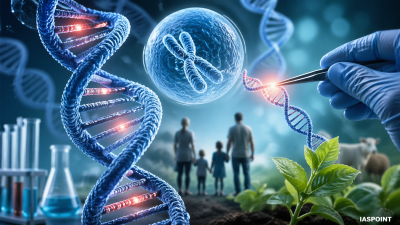
Genetics is the branch of biology concerned with the study of genes, genetic variation, and heredity in organisms.
Principles of Inheritance and Variation
Mendelian Genetics
Gregor Johann Mendel, known as the “Father of Genetics,” conducted hybridization experiments on garden peas (Pisum sativum) for seven years (1856–1863).
- Law of Dominance: In a heterozygote, one trait will conceal the presence of another trait for the same characteristic.
- Law of Segregation: During gamete formation, the alleles for each gene segregate from each other so that each gamete carries only one allele for each gene.
- Law of Independent Assortment: Genes for different traits can segregate independently during the formation of gametes.
Key Genetic Terminologies
| Term | Definition |
| Gene | The functional unit of heredity; a segment of DNA coding for a protein. |
| Allele | Alternative forms of a gene located at the same locus on homologous chromosomes. |
| Phenotype | The observable physical properties of an organism (e.g., height, color). |
| Genotype | The genetic makeup of an organism (e.g., TT, Tt, tt). |
| Homozygous | An organism with two identical alleles for a character (TT or tt). |
| Heterozygous | An organism with two different alleles for a character (Tt). |
Chromosomal Theory and Linkage
Chromosomal Basis of Inheritance
Proposed by Sutton and Boveri, this theory states that chromosomes are the vehicles of genetic heredity. They behave similarly to Mendelian factors (genes) during meiosis and fertilization.
Linkage and Recombination
- Linkage: The physical association of genes on a chromosome. Closely linked genes tend to be inherited together, defying the Law of Independent Assortment.
- Recombination: The process of “crossing over” during meiosis that leads to genetic variation.
- Discovery: Thomas Hunt Morgan’s work on Drosophila melanogaster (fruit flies) proved the chromosomal basis of linkage and sex-linked inheritance.
Molecular Basis of Inheritance: DNA and RNA
DNA (Deoxyribonucleic Acid)
DNA is the primary genetic material in most organisms. Its structure was decoded by Watson and Crick in 1953 using X-ray diffraction data from Rosalind Franklin and Maurice Wilkins.
- Structure: A double helix composed of nucleotides (Nitrogenous base + Pentose sugar + Phosphate group).
- Nitrogenous Bases: Adenine (A) pairs with Thymine (T), and Guanine (G) pairs with Cytosine (C).
- Central Dogma: Proposed by Francis Crick, it explains the flow of genetic information: DNA → RNA → Protein.
RNA (Ribonucleic Acid)
RNA acts as a genetic material in some viruses (e.g., Tobacco Mosaic Virus) but primarily functions as an adapter, structural molecule, or catalytic molecule (ribozyme).
Genetic Mutations and Disorders
Mutations are sudden, inheritable changes in the DNA sequence. They can be caused by mutagens like UV radiation, chemicals, or errors during DNA replication.
Mendelian Disorders
These are caused by an alteration or mutation in a single gene.
- Haemophilia: A sex-linked recessive disease where blood fails to clot.
- Sickle-cell Anaemia: An autosomal recessive disorder where hemoglobin molecules undergo polymerization, changing RBC shape to sickle-like.
- Phenylketonuria (PKU): An inborn error of metabolism where the body cannot convert phenylalanine to tyrosine.
Chromosomal Disorders
These are caused by the absence, excess, or abnormal arrangement of one or more chromosomes.
- Down’s Syndrome: Trisomy of chromosome 21. Characterized by short stature and mental retardation.
- Klinefelter’s Syndrome: Presence of an additional X chromosome in males (XXY). Leads to sterile males with feminine features.
- Turner’s Syndrome: Absence of one X chromosome in females (XO). Results in sterile females and lack of secondary sexual characters.
Modern Genetic Applications and Facts
Human Genome Project (HGP)
A mega-project launched in 1990 to sequence the entire human genome.
- Key Fact: The human genome contains approximately 3 × 10⁹ base pairs.
- Finding: Less than 2 percent of the genome codes for proteins.
DNA Fingerprinting
Developed by Alec Jeffreys, this technique identifies the variations in DNA (VNTRs – Variable Number Tandem Repeats). It is widely used in forensic science and paternity testing.
Epigenetics
The study of changes in organisms caused by modification of gene expression rather than alteration of the genetic code itself (e.g., DNA methylation).
Evolution and Genetics
Evolution is the change in the heritable characteristics of biological populations over successive generations.
Key Evolutionary Theories
- Lamarckism: Theory of use and disuse of organs (e.g., giraffe’s neck).
- Darwinism: Natural Selection and “Survival of the Fittest.”
- Mutation Theory: Proposed by Hugo de Vries, suggesting that evolution occurs through sudden, large mutations (saltation) rather than minor variations.
Hardy-Weinberg Principle
This principle states that allele frequencies in a population are stable and constant from generation to generation in the absence of evolutionary influences (mutation, selection, genetic drift, etc.).
- Equation: p2 + 2pq + q2 = 1.