

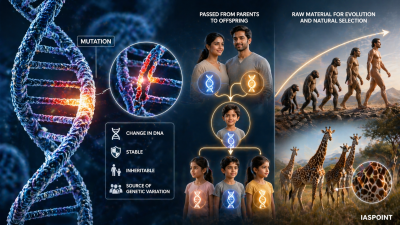
In genetics, a mutation is a sudden, stable, and inheritable change in the genetic material (DNA or RNA) of an organism. While often associated with diseases, mutations are the primary source of genetic variation, acting as the raw material for evolution and natural selection.
Classification of Mutations
Mutations are classified based on the scale of the genetic change and the type of cells affected.
1. Based on Cell Type
- Somatic Mutations: Occur in non-reproductive cells. These are not passed on to offspring (e.g., most cancers).
- Germline Mutations: Occur in gametes (sperm or eggs). These are heritable and can be passed to future generations.
2. Based on Molecular Change (Gene Mutations)
Gene mutations involve changes in the nucleotide sequence of a single gene.
- Point Mutation: A change in a single base pair of DNA. A classic example is Sickle-cell anemia, where a single base change in the gene for beta-globin chain results in the substitution of Glutamic acid by Valine.
- Frameshift Mutation: Caused by the insertion or deletion of one or more nucleotides. This shifts the “reading frame” of the genetic code, usually resulting in a completely non-functional protein.
3. Based on Structural/Numerical Change (Chromosomal Mutations)
- Structural Aberrations: These include Deletion, Duplication, Inversion, and Translocation of chromosome segments.
- Numerical Aberrations (Aneuploidy): The gain or loss of a chromosome due to the failure of chromatids to segregate during cell division (non-disjunction).
Agents of Mutation: Mutagens
Mutagens are physical or chemical agents that increase the frequency of mutations.
| Type of Mutagen | Examples |
| Physical Mutagens | Ionizing radiation (X-rays, Gamma rays), Non-ionizing radiation (UV rays). |
| Chemical Mutagens | Mustard gas, Nitrous acid, Colchicine, Acridine orange. |
| Biological Agents | Certain viruses and bacteria can integrate their DNA into the host genome. |
Major Genetic Disorders Caused by Mutation
For UPSC Prelims, it is essential to distinguish between Mendelian (gene-level) and Chromosomal disorders.
Mendelian Disorders (Point Mutations)
- Cystic Fibrosis: Mutation in the CFTR gene affecting mucus production.
- Haemophilia: Mutation in genes responsible for blood clotting factors (X-linked).
- Thalassemia: Mutations reducing the synthesis of hemoglobin chains.
Chromosomal Disorders (Numerical Mutations)
- Down’s Syndrome: Trisomy of chromosome 21 (47 chromosomes).
- Klinefelter’s Syndrome: An extra X chromosome in males (47, XXY).
- Turner’s Syndrome: Absence of one X chromosome in females (45, XO).
Role of Mutation in Evolution
Mutation is one of the five forces of evolution (alongside natural selection, genetic drift, gene flow, and non-random mating).
- Saltation: Hugo de Vries, based on his work on the evening primrose (Oenothera lamarckiana), proposed the “Mutation Theory of Evolution.” He coined the term Saltation to describe single-step, large mutations that lead to speciation.
- Direction: Unlike Darwinian variations which are small and directional, mutations are generally random and directionless.
- Adaptive Mutation: In rare cases, mutations provide a survival advantage in a changing environment, such as antibiotic resistance in bacteria.
Key Facts and Trivia for UPSC
- DNA Repair Mechanisms: Living cells have specialized enzymes (like DNA polymerase) that “proofread” and repair mutations during replication. Failure of these mechanisms often leads to malignancy.
- Silent Mutations: Not all mutations result in a change in the organism. Because the genetic code is “degenerate” (multiple codons can code for the same amino acid), some base changes do not alter the protein produced.
- Induced vs. Spontaneous: Spontaneous mutations occur naturally due to metabolic errors, while induced mutations are caused by environmental factors.
- CRISPR-Cas9: A modern “genetic scissor” technology used to intentionally induce or correct mutations to treat genetic diseases or improve crop yields.