

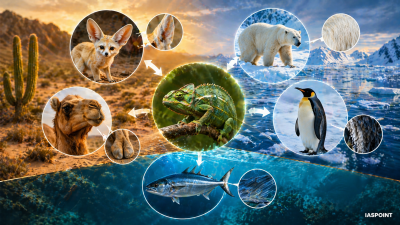
Adaptation is an evolutionary process where an organism becomes better suited to its habitat. It involves heritable traits—structural, physiological, or behavioral—that enhance an organism’s fitness, increasing its chances of survival and reproduction.
Types of Adaptations
Morphological (Structural) Adaptations
These involve physical changes in the body structure of an organism to survive in specific environments.
- Xerophytes (Desert Plants): Features include thick cuticles, sunken stomata to reduce transpiration, and leaves modified into spines (e.g., Opuntia). They often use the CAM (Crassulacean Acid Metabolism) pathway to keep stomata closed during the day.
- Hydrophytes (Aquatic Plants): Presence of aerenchyma (large air cavities) for buoyancy and mechanical support, and poorly developed roots.
- Animal Examples: The streamlined bodies of aquatic animals (fishes, whales) to reduce friction in water.
Physiological Adaptations
These are internal systematic responses to environmental stimulus.
- Altitude Sickness: When humans move to high altitudes (e.g., Rohtang Pass), the body compensates for low oxygen by increasing Red Blood Cell (RBC) production, decreasing the binding affinity of hemoglobin, and increasing breathing rate.
- Kangaroo Rat: In the North American deserts, it meets its water requirements through internal fat oxidation (where water is a byproduct) and has the ability to concentrate its urine to a minimal volume.
- Antifreeze Proteins: Fishes in Antarctic waters possess proteins that prevent their blood from freezing in sub-zero temperatures.
Behavioral Adaptations
These involve actions or movements performed by organisms to survive.
- Desert Lizards: Unlike mammals, they lack physiological ability to deal with high temperatures. They bask in the sun to absorb heat when body temperature drops and move to shade when the ambient temperature increases.
- Migration: Seasonal movement of animals (e.g., Siberian Cranes to Keoladeo National Park, Bharatpur) to escape harsh winters.
Evolutionary Rules Related to Adaptation
Several biological “rules” summarize common patterns of adaptation observed globally.
| Rule | Description |
| Allen’s Rule | Mammals from colder climates generally have shorter ears and limbs to minimize heat loss. |
| Bergmann’s Rule | Within a broadly distributed taxonomic group, populations and species of larger size are found in colder environments. |
| Gloger’s Rule | Within a species of endotherms, more heavily pigmented forms tend to be found in more humid environments, e.g. near the equator. |
Specific Ecological Adaptations
Adaptations to Water Scarcity
- Phreatophytes: Plants with extremely long roots that reach the water table (e.g., Mesquite).
- Ephemeral Plants: Desert plants that complete their entire life cycle in a very short period during the rainy season to avoid drought.
Adaptations to Extreme Cold
- Blubber: A thick layer of fat under the skin in polar seals and whales that acts as an insulator to reduce the loss of body heat.
- Hibernation: A state of minimal activity and metabolic depression in endotherms (e.g., Polar Bears) during winter.
Mimicry and Camouflage
- Camouflage (Crypsis): Ability of an organism to blend in with its surroundings (e.g., Leaf insects, Chameleons).
- Batesian Mimicry: A harmless species mimics the warning signals of a harmful species to deter predators.
- Mullerian Mimicry: Two or more harmful species resemble each other, sharing the “burden” of predator education.
Importance of Adaptation in Evolution
- Natural Selection: Adaptations are the direct result of natural selection acting on favorable genetic variations over many generations.
- Adaptive Radiation: When a single ancestral species evolves into a variety of forms adapted to different ecological niches (e.g., Darwin’s Finches).
- Speciation: Long-term accumulation of adaptations can eventually lead to the formation of new species, especially when populations are geographically isolated.
Key Trivia for UPSC
- Pneumatophores: Specialized roots in mangroves (e.g., Rhizophora) that grow vertically upwards to get oxygen from the air, an adaptation to salty, anaerobic marshy soils.
- Echolocation: A physiological adaptation in bats and dolphins to navigate and hunt in low-visibility environments using sound waves.
- Thermal Vent Extremophiles: Bacteria living in deep-sea hydrothermal vents at temperatures exceeding 100°C have specialized heat-stable enzymes (Taq polymerase).