

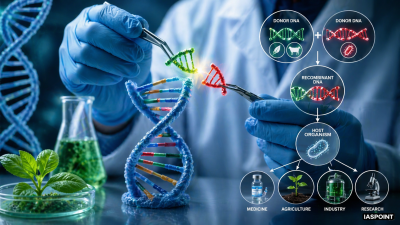
Recombinant DNA technology, often referred to as Genetic Engineering, is the process of joining together DNA molecules from two different species. The goal is to insert the newly created DNA combination into a host organism to produce new genetic combinations that are of value to science, medicine, agriculture, or industry.
The Toolkit of rDNA Technology
To perform genetic engineering, specific biological tools are required to manipulate the molecular structure of DNA.
1. Restriction Endonucleases (Molecular Scissors)
These enzymes recognize specific base sequences in DNA and cut the strands at defined points.
- Type II Restriction Enzymes: Most commonly used in rDNA technology because they cut at specific locations within or near their recognition sites.
- Nomenclature: The first letter comes from the Genus, the next two from the Species of the prokaryotic cell from which they were isolated (e.g., EcoRI from Escherichia coli RY 13).
2. Cloning Vectors (Vehicles)
Vectors are DNA molecules that can carry a foreign DNA fragment into a host cell and replicate there.
- Plasmids: Circular, extra-chromosomal DNA found in bacteria. The most famous engineered plasmid is pBR322.
- Bacteriophages: Viruses that infect bacteria; they are highly efficient at delivering large DNA fragments.
- Essential Features: A vector must have an Origin of Replication (ori), Selectable Markers (like antibiotic resistance genes), and Cloning Sites (where the foreign DNA is inserted).
Step-by-Step Process of rDNA Technology
The technology follows a rigorous sequence of laboratory steps to ensure the successful expression of the desired gene.
Step 1: Isolation of Genetic Material (DNA)
Since DNA is enclosed within membranes, the cell must be broken open. Enzymes like Lysozyme (for bacteria), Cellulase (for plants), and Chitinase (for fungi) are used. RNA is removed by Ribonucleases, and proteins are removed by Proteases. Purified DNA is finally precipitated out by adding chilled ethanol.
Step 2: Fragmentation and PCR Amplification
The DNA is cut into fragments using restriction enzymes. To obtain enough material for manipulation, the Polymerase Chain Reaction (PCR) is used to amplify the gene of interest billions of times.
- Denaturation: High temperature (94°C) separates the DNA strands.
- Annealing: Primers bind to the strands.
- Extension: Taq Polymerase (a heat-stable enzyme) adds nucleotides to the primers.
Step 3: Ligation (Joining DNA)
The “gene of interest” and the “cut vector” are mixed. The enzyme DNA Ligase forms phosphodiester bonds between the fragments, creating a single Recombinant DNA molecule.
Step 4: Insertion of rDNA into Host Cell (Transformation)
The host (usually E. coli) must be made “competent” to take up the rDNA. This is done by:
- Chemical Treatment: Using divalent cations like Calcium (Ca2+).
- Heat Shock: Brief treatment at 42°C.
- Micro-injection: Directly injecting rDNA into the nucleus of an animal cell.
- Biolistics (Gene Gun): Bombarding plant cells with gold or tungsten particles coated with DNA.
Step 5: Culturing and Extraction
The transformed cells are grown in large vessels called Bioreactors (usually 100–1000 liters). These provide optimal growth conditions (temperature, pH, substrate, salts, vitamins, and oxygen).
Applications and Products of rDNA Technology
| Field | Application | Example |
| Medicine | Production of therapeutic proteins | Humulin (First recombinant human insulin). |
| Agriculture | Pest resistance and nutrition | Bt Cotton (Cry genes) and Golden Rice. |
| Industry | Enzyme production | Proteases for detergents; Amylases for food. |
| Environment | Bioremediation | Modified bacteria to clean oil spills (Superbug). |
Critical UPSC Trivia: Key Terms
- Palindromic Sequence: The sequence of base pairs that reads the same on the two strands when orientation of reading is kept the same (e.g., 5′-GAATTC-3′ and 3′-CTTAAG-5′).
- Insertional Inactivation: A method to select transformants where a gene for an enzyme (like β-galactosidase) is inactivated by the insertion of foreign DNA, resulting in a color change in colonies (Blue-White screening).
- DNA Gel Electrophoresis: A technique used to separate DNA fragments based on their size; DNA moves toward the positive Anode because it is negatively charged.
- Ethidium Bromide: The dye used to stain DNA in gel electrophoresis, which appears as bright orange bands under UV light.
Downstream Processing
This is the final stage where the product is separated, purified, and formulated. It involves strict quality control testing before the product (like a vaccine) is released for clinical use or the market.
Last Modified: April 22, 2026