

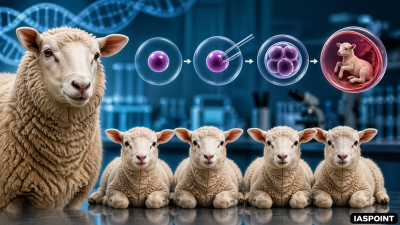
Cloning is the process of producing genetically identical individuals of an organism, either naturally or artificially. In biological terms, a clone is a cell, group of cells, or an organism that is descended from and is genetically identical to a single common ancestor.
Types of Cloning
Cloning is classified into three functional categories based on the objective and the biological material involved.
Gene Cloning (DNA Cloning)
- Definition: The process of making multiple copies of a specific gene or segment of DNA.
- Mechanism: The target DNA is inserted into a self-replicating genetic element (vector), such as a bacterial plasmid, and then introduced into a host cell.
- Application: Used extensively in the production of insulin, growth hormones, and for genetic mapping.
Reproductive Cloning
- Definition: The creation of an entire organism that is genetically identical to a donor organism.
- Mechanism: Utilizes Somatic Cell Nuclear Transfer (SCNT). The nucleus of a somatic cell (non-reproductive cell) is transferred into an enucleated egg cell (an egg with its nucleus removed).
- Historical Milestone: Dolly the Sheep (1996) was the first mammal cloned from an adult somatic cell using SCNT.
Therapeutic Cloning
- Definition: The production of cloned embryos for the purpose of harvesting stem cells.
- Mechanism: Similar to SCNT, but the embryo is not allowed to develop fully. It is grown only until the blastocyst stage to extract embryonic stem cells.
- Application: Potential to treat degenerative diseases like Parkinson’s, Alzheimer’s, and spinal cord injuries by growing replacement tissues that match the patient’s DNA.
Somatic Cell Nuclear Transfer (SCNT) Process
- Enucleation: The nucleus is removed from a healthy unfertilized donor egg.
- Transfer: The nucleus of a somatic cell from the subject to be cloned is inserted into the enucleated egg.
- Stimulation: The egg is stimulated (via chemical or electrical pulse) to begin dividing as if it were a naturally fertilized embryo.
- Implantation: In reproductive cloning, the embryo is placed in a surrogate mother’s uterus.
Cloning Achievements in India
India has made significant strides in cloning, particularly focusing on livestock to improve milk production and conservation.
| Clone Name | Species | Institute | Notable Fact |
| Samrupa | Buffalo | NDRI, Karnal | World’s first cloned buffalo (2009); died shortly after. |
| Garima | Buffalo | NDRI, Karnal | Survived and later gave birth to a healthy calf (Mahima). |
| Noori | Pashmina Goat | SKUAST-K/NDRI | World’s first cloned Pashmina goat (2012). |
| Deepali | Buffalo | NDRI, Karnal | First buffalo calf cloned from the skin of an adult buffalo. |
| Assamese Buffalo | Buffalo | ICAR-CIRB | First cloned Assamese buffalo named ‘Sach-Gaurav’. |
Ethical and Biological Challenges
- High Failure Rate: SCNT is highly inefficient; many clones do not survive the gestation period or die shortly after birth.
- Large Offspring Syndrome (LOS): Cloned animals often have abnormally large organs, leading to breathing and circulatory problems.
- Premature Aging: Some clones exhibit shorter telomeres (protective caps on chromosomes), leading to age-related diseases earlier in life.
- Ethical Dilemma: Human cloning is globally condemned and banned in most countries due to concerns regarding “playing God,” lack of individuality, and safety risks.
Fact Sheet and Trivia for UPSC Prelims
- Natural Clones: Identical twins are the most common example of natural clones in humans, as they share the exact same genetic code.
- Telomeres: These are the ends of chromosomes that shorten as cells divide. Dolly the Sheep had shorter telomeres than sheep of her same age, which led to debates about “biological age” vs. “chronological age.”
- Parthenogenesis: A form of asexual reproduction where growth and development of embryos occur without fertilization. Some consider it a form of natural cloning in certain reptiles and insects.
- NDRI: The National Dairy Research Institute (Karnal, Haryana) is the premier center for animal cloning research in India.
- Conservation Cloning: Scientists are exploring the use of cloning to “de-extinct” species like the Woolly Mammoth or to save the Asiatic Cheetah.