

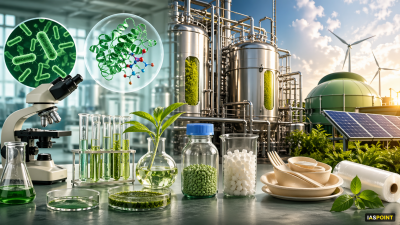
Industrial biotechnology, often termed White Biotechnology, involves the application of biotechnology for industrial purposes, including manufacturing, alternative energy, and biomaterials. It utilizes living cells—such as bacteria, yeast, and algae—or components of cells like enzymes to generate industrial products that are more easily degradable, require less energy, and create less waste during production.
Key Biological Catalysts: Enzymes and Microbes
The core of industrial biotechnology lies in biocatalysis. Enzymes are biological catalysts that speed up chemical reactions without being consumed.
1. Microbial Fermentation
Microorganisms are used as “cell factories” to convert raw materials (substrates) into high-value products.
- Aerobic Fermentation: Requires oxygen (e.g., production of citric acid by Aspergillus niger).
- Anaerobic Fermentation: Occurs in the absence of oxygen (e.g., ethanol production by Saccharomyces cerevisiae).
2. Recombinant Enzymes
Through rDNA technology, scientists can produce specific enzymes in large quantities.
- Proteases and Lipases: Used in detergents to break down protein and fat stains at lower temperatures, saving energy.
- Amylases: Used in the textile and paper industries to break down starch.
- Cellulases: Used in the “stone-washing” of denim and in biofuel production.
Major Applications in Industry
| Sector | Application | Biological Agent/Process |
| Textile Industry | Biopolishing and Desizing | Cellulases and Amylases remove surface fuzz and starch. |
| Food & Beverage | Cheese making and Brewing | Rennet (enzyme) for curdling; Yeast for fermentation. |
| Bioplastics | Production of PLA and PHA | Fermentation of sugar/lipids by bacteria like Cupriavidus necator. |
| Paper & Pulp | Bio-bleaching | Xylanases reduce the need for chlorine-based bleaching agents. |
| Leather Industry | Bating and Unhairing | Proteases and Lipases replace toxic sulfides and lime. |
Biopolymers and Bioplastics
Industrial biotechnology offers a sustainable alternative to petroleum-based plastics.
1. Polylactic Acid (PLA)
- Source: Derived from renewable resources like corn starch or sugarcane.
- Process: Bacterial fermentation of starch into lactic acid, followed by polymerization.
- Properties: Biodegradable and bioactive thermoplastic.
2. Polyhydroxyalkanoates (PHAs)
- Source: Produced naturally by various microorganisms as a way to store carbon and energy.
- Fact: Unlike PLA, which requires industrial composting, many PHAs are marine-biodegradable.
Bioremediation: Cleaning the Environment
Bioremediation is an industrial application where biological systems (microbes/plants) are used to neutralize or remove pollutants from a contaminated site.
- In-situ Bioremediation: Treating the contaminated material at the site (e.g., Bioventing, Biosparging).
- Ex-situ Bioremediation: Removing the contaminated material to be treated elsewhere (e.g., Landfarming, Biopiles).
- Phytoremediation: Using plants to clean up soil, air, and water contaminated with hazardous contaminants.
- Oil-zapping: A technique using a “Oil-zapper” (a cocktail of five bacteria) developed by TERI, India, to degrade crude oil and oily sludge.
India’s Industrial Biotech Ecosystem
1. BIRAC (Biotechnology Industry Research Assistance Council)
A Section 8 (Not-for-Profit) Public Sector Enterprise set up by the Department of Biotechnology (DBT). It acts as an interface agency to strengthen and empower emerging Biotech enterprises.
2. Bio-Manufacturing and Bio-Foundry
Under the Interim Budget 2024-2025, the government announced a new scheme for bio-manufacturing and bio-foundry to provide environment-friendly alternatives such as biodegradable polymers, bio-plastics, and bio-pharmaceuticals.
Technical Facts for Prelims
Synthetic Biology
An emerging field within industrial biotechnology that involves redesigning organisms for useful purposes by engineering them to have new abilities. It moves beyond simple genetic modification to creating new biological parts and systems.
Biosensors
Analytical devices that combine a biological component (like an enzyme or antibody) with a physicochemical detector. They are used in industries for monitoring fermentation processes, food quality control, and detecting environmental pollutants.
Immobilized Enzymes
Technique where enzymes are physically confined or localized in a certain region of space while retaining their catalytic activities. This allows the enzymes to be reused multiple times, significantly cutting industrial costs.
Metabolic Engineering
The practice of optimizing genetic and regulatory processes within cells to increase the production of specific substances. It is the backbone of producing “Green Chemicals” like succinic acid and 1,3-propanediol from renewable biomass.
Last Modified: May 7, 2026