
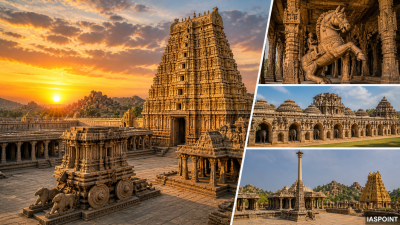
The Vijayanagara Empire (1336–1646 CE) represented the final great era of South Indian Hindu architecture. Based in the capital city of Hampi (on the banks of the Tungabhadra River), the style is a brilliant synthesis of earlier Dravidian traditions, specifically those of the Cholas, Pandyas, Hoysalas, and Chalukyas. It also incorporated unique Indo-Islamic influences in its secular structures, making it a multifaceted architectural school.
Distinctive Features of Vijayanagara Style
Vijayanagara architecture is easily identified by several unique structural and ornamental innovations that moved away from the delicate soapstone of the Hoysalas back to the massive, durable granite.
The Multi-Pillared Mandapa (Kalyana Mantapa)
One of the most significant contributions was the evolution of the temple hall.
- Kalyana Mantapa: A dedicated marriage hall within the temple complex used for the ceremonial wedding of the deity.
- Maha Mantapa: Large open assembly halls featuring hundreds of pillars.
- Ornate Pillars: These were carved out of single blocks of granite. The most famous are the monolithic carvings of charging horses (Hippogryphs) or riders on Yalis (mythical creatures) leaping from the pillars.
Evolution of the Gopuram (Raya Gopuram)
The Pallava and Chola gateways evolved into the massive Raya Gopuram under this empire.
- These gateways were often taller than the central temple tower (Vimana).
- The base was made of granite, while the upper soaring levels were constructed using brick and terracotta, decorated with stucco figures.
Secular and Military Architecture
Vijayanagara is one of the few ancient Indian sites where secular architecture is as prominent as religious structures.
- Indo-Islamic Synthesis: Structures like the Lotus Mahal and the Elephant Stables display Islamic features such as domes, ribbed vaults, and pointed arches combined with Hindu plinths and carvings.
- The Mahanavami Dibba: A massive square stone platform (80 feet high) decorated with relief carvings of hunting scenes, dancers, and royal processions. It was used as a stage for the king to view the Mahanavami festival.
Major Centers and Masterpieces
| Temple / Structure | Location | Unique Architectural Feature |
| Virupaksha Temple | Hampi | The oldest temple in Hampi; famous for its 50-meter high Gopuram and the inverted shadow effect of the tower on the wall. |
| Vittala Temple | Hampi | Known for the Monolithic Stone Chariot and the 56 Musical Pillars (SaReGaMa pillars) that emit musical notes when tapped. |
| Hazara Rama Temple | Hampi | Once the private temple of the kings; its exterior walls are covered in extensive bas-reliefs depicting scenes from the Ramayana. |
| Lepakshi Temple | Anantapur | Famous for the Hanging Pillar (which does not touch the ground) and the largest monolithic Nandi in India. |
| Ugra Narasimha | Hampi | A 6.7-meter high monolithic statue of Narasimha seated on a seven-headed serpent (Sesha). |
Comparison: Vijayanagara vs. Earlier Dravidian Styles
| Feature | Chola Architecture | Vijayanagara Architecture |
| Primary Material | Granite / Sandstone | Hard Granite |
| Dominant Structure | The Vimana (Tower over Sanctum) | The Raya Gopuram (Gateway) |
| Pillar Work | Simple, focused on niches | Highly complex, charging Yalis and horses |
| Mandapas | Smaller, functional | Grand Kalyana Mantapas with musical pillars |
| Decoration | Sculptural panels on walls | Deep relief carvings on pillars and high platforms |
Urban Planning and Water Management
The capital Hampi (Vijayanagara) was an early example of sophisticated urban engineering.
- Fortifications: The city was surrounded by seven concentric circles of walls. No mortar or cementing agent was used; the stones were wedge-cut to lock perfectly.
- Aqueducts and Tanks: The Stepped Tank (Pushkarini) is a masterpiece of geometric precision, carved from black schist and supplied by a complex network of stone aqueducts.
- Zonal Division: The city was clearly divided into a “Sacred Center” (temples) and a “Royal Center” (palaces and administration).
Trivia and Facts for UPSC Prelims
- UNESCO Status: The Group of Monuments at Hampi was declared a UNESCO World Heritage Site in 1986.
- The Musical Pillars: Scientific analysis shows that the musical pillars in the Vittala temple were designed with different densities and metallic ore content to produce varying sound frequencies.
- Foreign Accounts: Travelers like Nicolo de Conti, Abdur Razzaq, and Domingos Paes provided extensive written accounts of the city’s architectural splendor, comparing it favorably to Rome.
- Monolithic Nandi: The Nandi at Lepakshi is carved from a single granite boulder and is considered one of the finest specimens of animal sculpture in India.
- Amman Shrine: The Vijayanagara architects standardized the inclusion of a separate shrine for the female consort (Amman Shrine) within the main temple enclosure.