

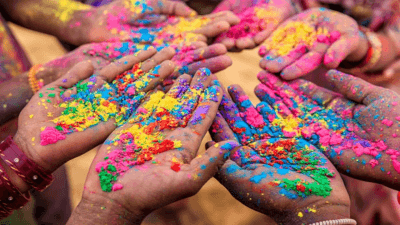
Holi, popularly known as the “Festival of Colors,” is a major Hindu festival celebrated across the Indian subcontinent. In the Indian Luni-Solar calendar, it is observed on the Purnima (Full Moon day) of the month of Phalguna.
Seasonal Transition and Ritu Cycle
Holi marks the departure of Shishira Ritu (Winter) and the arrival of Vasanta Ritu (Spring). It serves as a transitionary festival that celebrates the end of the winter harvest and the blossoming of nature. The festival is timed with the vernal equinox, symbolizing the rebirth of life and the fertility of the land.
Mythological Foundations and Symbolism
The festival is built upon a tapestry of legends that emphasize the victory of Dharma (righteousness) over Adharma (evil).
- The Legend of Prahlad and Holika: The primary narrative involves the demon king Hiranyakashipu and his son Prahlad, a devotee of Lord Vishnu. The burning of Prahlad’s aunt, Holika, who had a boon of fire resistance but perished while Prahlad survived, is the basis for the Holika Dahan ritual (the bonfire).
- The Legend of Radha and Krishna: In the Braj region (Mathura, Vrindavan), Holi is associated with the divine love of Radha and Krishna. It is said that Krishna, self-conscious of his dark complexion, playfully smeared color on Radha’s face, giving birth to the tradition of playing with Gulal.
- The Sacrifice of Kamadeva: In South Indian traditions, Holi is linked to Lord Shiva and Kamadeva (the God of Love). It is believed that Kamadeva sacrificed himself by disturbing Shiva’s meditation to save the world, leading to his incineration by Shiva’s third eye.
Regional Variations and Cultural Diversities
Holi manifests in diverse forms across different Indian states, each incorporating local folklore and social structures.
| Region | Local Name | Unique Characteristics |
| Barsana & Nandgaon (UP) | Lathmar Holi | Women playfully beat men with sticks (lathis) in a re-enactment of Krishna’s visit to Barsana. |
| West Bengal & Odisha | Dol Jatra / Dol Purnima | Devotees place idols of Krishna and Radha on decorated palanquins and carry them in processions while singing devotional songs. |
| Manipur | Yaosang | A five-day festival where a small thatched hut is burnt, followed by the indigenous Thabal Chongba folk dance. |
| Goa | Shigmo | A massive spring festival featuring traditional folk dances like Ghode Modni and elaborate street processions by the farming community. |
| Punjab | Hola Mohalla | Established by Guru Gobind Singh Ji, it focuses on martial arts, mock battles, and poetry rather than just colors. |
| Maharashtra & Gujarat | Rang Panchami | Celebrated on the fifth day after Holika Dahan, marking the end of the festivities with water and color. |
| Haryanvi Tradition | Dulandi Holi | Noted for the playful “Bhabhi-Devar” (sister-in-law and brother-in-law) traditions. |
Rituals and Social Practices
The festival is traditionally divided into two main events:
Holika Dahan (The Bonfire)
Performed on the eve of Holi, this ritual involves lighting a pyre to symbolize the destruction of evil. People offer grains from the new harvest (wheat, gram, and stalks of green peas) to the fire, signifying a gratitude ritual for the winter crop.
Dhulandi (The Play of Colors)
The following morning involves the communal splashing of colors. Traditionally, colors were derived from natural sources:
- Teshu (Palash) Flowers: Used to create vibrant yellow and orange water.
- Turmeric: Used for yellow powder.
- Beetroot and Hibiscus: Used for red and pink hues.
Socio-Economic and Ecological Dimensions
- Agricultural Linkage: Holi marks the ripening of the Rabi crops, specifically wheat and barley. In many rural areas, it is a “Thanksgiving” festival for a bountiful winter harvest.
- Social Cohesion: Historically, Holi acted as a social leveler where caste, gender, and age hierarchies were temporarily suspended, allowing for free social interaction (the “Holi Milan”).
- Economic Impact: The festival drives the market for traditional sweets (like Gujiya and Malpua), organic dyes, and the textile industry.
- Environmental Concerns: Modern UPSC perspectives emphasize the shift back to Natural Gulal to prevent water pollution and skin ailments caused by synthetic chemicals and heavy metals.
Fact-File for UPSC Aspirants
- Historical Documentation: Descriptions of Holi are found in the Puranas, the works of poet Kalidasa (Ratnavali), and the travelogues of European traders and Mughal court historians like Abu’l Fazl (Ain-i-Akbari).
- Mughal Patronage: Mughal emperors like Akbar and Shah Jahan were known to participate in Eid-e-Gulabi or Aab-e-Pashi (showering of colorful water), showcasing the festival’s syncretic history.
- Sanskrit Literature: The festival is referred to as Holaka in ancient texts and was described as a ritual performed by married women for the well-being of their families.
- Phagwah: This is the term used for Holi in the Caribbean (Guyana, Trinidad, and Suriname), where it was carried by Indian indentured laborers in the 19th century.