

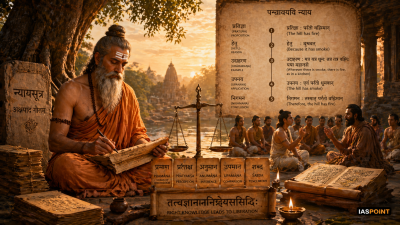
The Nyaya school is one of the six orthodox (Astika) systems of Indian philosophy, renowned for its focus on logic, methodology, and epistemology. Traditionally attributed to Sage Gautama (also known as Akshapada), who composed the Nyaya Sutras, this school posits that the attainment of valid knowledge is the only path to liberation from suffering. It provided the logical framework used by almost all other Indian philosophical schools for debate and inquiry.
The Goal of Nyaya: Apavarga
The ultimate objective of Nyaya is Apavarga (Release or Liberation). Nyaya philosophers argue that human suffering is caused by false knowledge (Mithya-jnana). By attaining “Right Knowledge” (Tattva-jnana), an individual can break the cycle of rebirth. The school lists 16 Padarthas (Categories of Reality) that must be studied to achieve this end, including Pramana (means of knowledge), Prameya (objects of knowledge), and Vada (discussion).
Epistemology: The Four Pramanas
Nyaya is most distinguished by its rigorous analysis of Pramanas, or the valid means of acquiring knowledge. While other schools accept fewer, Nyaya recognizes four distinct sources.
| Pramana | Definition | Practical Example |
| Pratyaksha | Perception: Knowledge through sensory contact. | Seeing a jar directly with the eyes. |
| Anumana | Inference: Knowledge derived from a prior perception. | Inferring fire on a hill after seeing smoke. |
| Upamana | Comparison: Learning through similarity. | Identifying a ‘gavaya’ (wild ox) based on its resemblance to a cow. |
| Shabda | Verbal Testimony: Reliable authority or scripture. | Accepting geographical facts from a trusted scientist or the Vedas. |
The Nyaya Syllogism (Anumana)
Nyaya developed a sophisticated five-membered syllogism to establish logical truths. Unlike the Aristotelian three-part syllogism, the Nyaya system requires an illustrative example to ground the logic in reality.
- Pratijna (Proposition): The statement to be proved (e.g., The hill is on fire).
- Hetu (Reason): The ground for the statement (e.g., Because it has smoke).
- Udaharana (Example): A universal proposition with a concrete example (e.g., Wherever there is smoke, there is fire, like in a kitchen).
- Upanaya (Application): Applying the example to the present case (e.g., The hill also has smoke).
- Nigamana (Conclusion): The final statement (e.g., Therefore, the hill is on fire).
Theory of Causation: Asatkaryavada
In contrast to the Samkhya school’s Satkaryavada, Nyaya proponents advocate Asatkaryavada (also known as Arambhavada).
- Core Belief: The effect is a new creation that does not pre-exist in the cause.
- Logic: A cloth is a new entity that comes into existence through the arrangement of threads; it is not simply the threads in a different form.
- Theistic Extension: Since the world is a complex effect, it must have an efficient cause—God (Ishwara)—who fashions the world out of eternal atoms.
Concept of God and the Soul
- Theism: Nyaya is a theistic school. It views God as the creator, sustainer, and destroyer of the world, acting as the moral governor who dispenses the fruits of Karma.
- Atman (Soul): The soul is an individual, eternal substance. Consciousness is not an inherent property of the soul but an accidental quality that arises when the soul is joined with the mind and senses. In the state of liberation (Apavarga), the soul is free from both pain and pleasure, existing in a state of pure unconsciousness.
Navya-Nyaya: The New School
In the 12th century CE, Gangesha Upadhyaya founded the Navya-Nyaya (New Nyaya) school with his seminal work Tattvachintamani.
- Focus: It shifted the focus from metaphysics to pure linguistic analysis and sophisticated logic.
- Regional Center: Mithila and later Nadia (Bengal) became the primary hubs for this intellectual movement.
- Influence: Navya-Nyaya developed a technical language so precise that it influenced Indian law, grammar, and even modern computer science logic.
Facts and Trivia for Prelims
- Tarkashastra: Nyaya is often referred to as Tarkashastra (Science of Reasoning) or Pramana Shastra (Science of Logic).
- Vatsyayana: The first major commentary on the Nyaya Sutras was written by Vatsyayana (not to be confused with the author of the Kamasutra).
- Vaisheshika Alliance: Nyaya and Vaisheshika are considered “sister schools.” Nyaya provides the logic (Pramana), while Vaisheshika provides the physical/atomic description of the universe (Prameya).
- Udayana: A famous Nyaya scholar who, in his work Kusumanjali, provided nine formal proofs for the existence of God, countering the arguments of atheistic schools like Buddhism and Samkhya.
- Pramanyavada: Nyaya holds the theory of Paratah-Pramanya, asserting that the validity of knowledge is not self-evident but must be verified by external practical results.