
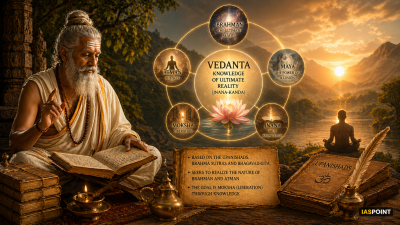
Vedanta, literally meaning “the end of the Vedas,” refers to the philosophical teachings found in the Upanishads. It is the most influential of the six orthodox (Astika) schools and forms the basis of most modern forms of Hinduism. While the Purva Mimamsa school focuses on the ritualistic action (Karma-kanda) of the Vedas, Vedanta focuses on the knowledge of the ultimate reality (Jnana-kanda).
The Prasthanatrayi: The Triple Canon of Vedanta
All sub-schools of Vedanta base their authority on three foundational sources, collectively known as the Prasthanatrayi. Any new philosophical commentary must align with these texts to be considered valid.
- The Upanishads (Shruti-prasthana): The “revealed” source consisting of the concluding portions of the Vedas.
- The Bhagavad Gita (Smriti-prasthana): The “remembered” source, providing a practical application of Upanishadic truths.
- The Brahma Sutras (Nyaya-prasthana): Authored by Badarayana, these provide the logical framework and systematic summary of Upanishadic teachings.
Core Concepts: Brahman, Atman, and Maya
Vedanta revolves around the investigation of three fundamental entities and their interrelationships:
- Brahman: The Ultimate Reality, the infinite, supreme, and unchanging source of the universe.
- Atman: The individual soul or self.
- Maya: The power of illusion or the creative energy that causes the singular Brahman to appear as a diverse, material world.
- Jagat: The manifest universe, which is perceived through the senses.
Major Sub-Schools of Vedanta
The interpretation of the relationship between the Soul (Jiva) and the Supreme (Brahman) led to the development of several distinct sub-schools.
| School | Founder | Core Philosophy | Metaphysical Stance |
| Advaita | Adi Shankaracharya | Radical Monism | Soul and Brahman are identical; world is Maya. |
| Vishishtadvaita | Ramanujacharya | Qualified Non-dualism | Soul and world are real attributes of Brahman (Vishnu). |
| Dvaita | Madhvacharya | Strict Dualism | Soul, World, and God are eternally distinct. |
| Dvaitadvaita | Nimbarkacharya | Dualistic Non-dualism | Relation is like the sun and its rays. |
| Shuddhadvaita | Vallabhacharya | Pure Non-dualism | The world is a real manifestation of Krishna, not an illusion. |
| Achintya Bheda Abheda | Chaitanya Mahaprabhu | Inconceivable Oneness & Difference | Relation is simultaneously one and different. |
Advaita Vedanta: The Path of Non-Dualism
Developed by Adi Shankaracharya (8th century CE), this is the most widely studied branch. It posits that only Brahman is real (Brahma Satyam), the world is an illusion (Jagan Mithya), and the individual soul is none other than Brahman (Jivo Brahmaiva Naparah).
The Two Levels of Truth
Shankaracharya introduced a two-tier system of reality to explain the existence of the world while maintaining the oneness of Brahman:
- Paramarthika (Absolute): The level of the ultimate truth where only Brahman exists.
- Vyavaharika (Relative/Empirical): The level of the material world where we live, conduct rituals, and perceive diversity.
Means to Liberation
Advaita emphasizes Jnana Yoga (The Path of Knowledge). The process involves:
- Sravana: Listening to the teachings of the Upanishads.
- Manana: Reflecting and contemplating on those teachings.
- Nididhyasana: Deep meditation to realize the truth of “Aham Brahmasmi” (I am Brahman).
Vishishtadvaita: Qualified Non-Dualism
Ramanujacharya (11th century CE) countered Shankaracharya’s view by arguing that the world and souls are not an illusion but are real attributes of Brahman.
- Relationship: Like a body and its soul, or a tree and its leaves, the individual souls and matter are part of God (Narayana/Vishnu).
- Bhakti Yoga: Unlike Advaita’s focus on pure knowledge, Ramanuja emphasized Bhakti (devotion) and Prapatti (surrender) as the primary means to attain salvation.
- Moksha: Liberation is not merging into Brahman but living in eternal communion with God in Vaikuntha.
Dvaita Vedanta: Strict Dualism
Founded by Madhvacharya (13th century CE), this school is a complete rejection of monism.
- Pancha-Bheda: Madhava proposed five eternal distinctions:
- God and Soul.
- God and Matter.
- Soul and Matter.
- One Soul and another Soul.
- One form of Matter and another form of Matter.
- Supremacy of Vishnu: Vishnu is the independent reality, while the souls and the world are dependent realities. Liberation is achieved solely through the grace of Lord Vishnu.
Shuddhadvaita and Dvaitadvaita
Shuddhadvaita (Pure Non-dualism)
Founded by Vallabhacharya, this school identifies Brahman with Krishna. It rejects the concept of Maya as an illusion, stating that the universe is a real, “pure” manifestation of God’s own essence. It promoted the Pushti Marg (Path of Grace).
Dvaitadvaita (Dual-Non-dualism)
Founded by Nimbarkacharya, this school suggests that the soul and world are different from Brahman in their attributes but identical in their essence. It is often compared to the relationship between the waves and the ocean.
Facts and Trivia for UPSC Prelims
- The Four Mathas: Adi Shankaracharya established four monastic centers to propagate Vedanta: Sringeri (South), Puri (East), Dwarka (West), and Joshimath/Badrinath (North).
- Vivekananda and Modern Vedanta: Swami Vivekananda introduced “Neo-Vedanta,” which applied the metaphysical principles of Advaita to social service and universal brotherhood.
- Concept of Jivanmukti: Vedanta (especially Advaita) supports the idea of being “liberated while alive”—a state where the person continues to live in the body but is no longer bound by worldly attachments.
- Sadhana Chatushtaya: The fourfold qualifications required for a student of Vedanta, including Viveka (discrimination between real and unreal) and Vairagya (dispassion).
- Dara Shikoh’s Contribution: The Mughal prince translated the Upanishads into Persian, calling them the “Great Secret” (Sirr-i-Akbar), which later helped in the global spread of Vedanta.