
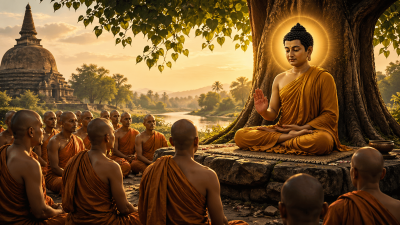
Buddhism emerged in the 6th century BCE as a “Sramana” tradition, a heterodox (Nastika) movement that challenged the ritualistic dominance and varna-based hierarchy of the later Vedic period. Founded by Siddhartha Gautama (the Buddha), it focused on ethical living, mindfulness, and the cessation of suffering.
Life of the Buddha: The Five Great Events
The life of Gautama Buddha is symbolized through specific motifs in Indian art and remains a core area for UPSC Prelims:
- Janma (Birth): Symbolized by the Lotus and Bull. Born in Lumbini (Nepal) to King Suddhodana and Queen Mahamaya.
- Mahabhinishkramana (Renunciation): Symbolized by the Horse (Kanthaka). At age 29, he left his princely life in search of truth.
- Nirvana/Sambodhi (Enlightenment): Symbolized by the Bodhi Tree. Attained at age 35 under a Pipal tree in Bodh Gaya.
- Dharmachakrapravartana (First Sermon): Symbolized by the Wheel. Delivered at Sarnath (Isipatana) to his first five disciples.
- Mahaparinirvana (Death): Symbolized by the Stupa. He passed away at age 80 in Kushinagar.
Core Tenets and Doctrines
The philosophical backbone of Buddhism is designed to provide a middle path (Madhyama Pratipada) between extreme self-indulgence and extreme asceticism.
The Four Noble Truths (Arya Satyani)
- Dukkha: Life is full of suffering.
- Samudaya: Desire (Tanha) is the root cause of suffering.
- Nirodha: Suffering can be removed by eliminating desire.
- Magga: The path to end suffering is the Eightfold Path.
The Eightfold Path (Ashtangika Marga)
These are categorized into Wisdom (Pragya), Ethical Conduct (Sila), and Concentration (Samadhi):
- Right View
- Right Resolve
- Right Speech
- Right Action
- Right Livelihood
- Right Effort
- Right Mindfulness
- Right Concentration
The Three Jewels (Triratnas) of Buddhism
- Buddha: The Enlightened One.
- Dhamma: The Teachings.
- Sangha: The Monastic Order.
Evolution of Buddhist Sects and Schools
As Buddhism spread, ideological differences led to the formation of distinct schools, each with unique iconographic and linguistic preferences.
| School | Language | Key Characteristics |
| Hinayana (Theravada) | Pali | “Lesser Vehicle”; believes in the individual attainment of Nirvana; views Buddha as a human teacher; avoids idol worship. |
| Mahayana | Sanskrit | “Greater Vehicle”; views Buddha as a deity; introduces Bodhisattvas; practices idol worship. |
| Vajrayana | Sanskrit/Tibetan | “Diamond Vehicle”; focuses on Tantric practices, mantras, and magic; prominent in Tibet, Bhutan, and Ladakh. |
| Zen (Mahayana branch) | – | Emphasizes meditation (Dhyana) and experiential wisdom; spread mainly to Japan and China. |
Concept of Bodhisattvas in Mahayana Buddhism
Bodhisattvas are enlightened beings who delay their own Nirvana to help others. Key Bodhisattvas include:
- Avalokiteshvara (Padmapani): Represents infinite compassion; holds a lotus.
- Vajrapani: Represents power; holds a thunderbolt.
- Manjushri: Represents wisdom; carries a sword to destroy ignorance.
- Maitreya: The “Future Buddha” who is yet to appear in this world.
- Tara: A female Bodhisattva representing protection and compassion.
The Buddhist Councils: Establishing the Canon
The councils were pivotal in compiling Buddhist literature and settling doctrinal disputes.
| Council | Period | Patron | Venue | Result |
| 1st Council | 483 BCE | Ajatashatru | Rajgir | Compilation of Sutta Pitaka and Vinaya Pitaka. |
| 2nd Council | 383 BCE | Kalasoka | Vaishali | Split between Sthaviravadins and Mahasanghikas. |
| 3rd Council | 250 BCE | Ashoka | Pataliputra | Compilation of Abhidhamma Pitaka; missions sent abroad. |
| 4th Council | 72 CE | Kanishka | Kashmir | Formal split into Hinayana and Mahayana schools. |
Buddhist Literature and Canon
The primary scriptures are the Tripitakas (Three Baskets), originally written in Pali.
- Vinaya Pitaka: Rules and regulations for monastic life (the Sangha).
- Sutta Pitaka: Buddha’s sermons and ethical teachings. It includes the Dhammapada and the Jataka Tales (stories of Buddha’s previous births).
- Abhidhamma Pitaka: Philosophical analysis and systematization of the teachings.
- Other Key Texts:
- Milinda Panha: Dialogue between King Menander and monk Nagasena.
- Buddhacharita: Biography of Buddha by Ashvaghosa (Sanskrit).
- Mahavamsa and Dipavamsa: Sri Lankan chronicles regarding the spread of Buddhism.
Art, Architecture, and Pilgrimage Sites
Buddhism revolutionized Indian art, moving from wood and clay to permanent stone structures.
- Stupas: Reliquary mounds (e.g., Sanchi, Amravati, Bharhut).
- Chaityas: Prayer halls or assembly halls containing a small stupa (e.g., Karle, Bhaja).
- Viharas: Residential quarters or monasteries for monks (e.g., Ajanta, Ellora, Nalanda).
- Major Pilgrimage Sites (The Buddhist Circuit):
- Lumbini: Birthplace.
- Bodh Gaya: Enlightenment.
- Sarnath: First Sermon.
- Kushinagar: Mahaparinirvana.
- Sravasti: Where Buddha performed miracles and spent 24 rainy seasons.
- Rajgir: Association with Gridhakuta Hill.
- Vaishali: Site of the last sermon.
Decline of Buddhism in India
Several factors contributed to the gradual fading of Buddhism from its land of origin by the 12th century:
- Institutional Corruption: Accumulation of wealth in monasteries (Viharas) led to moral decline.
- Revival of Brahmanism: Reforms by Adi Shankara and the rise of the Bhakti movement integrated Buddhist elements (e.g., viewing Buddha as an avatar of Vishnu).
- Loss of Royal Patronage: Shift of support toward Shaivism and Vaishnavism by later Gupta and Rajput rulers.
- Foreign Invasions: Destruction of universities like Nalanda and Vikramshila by Bakhtiyar Khilji.