
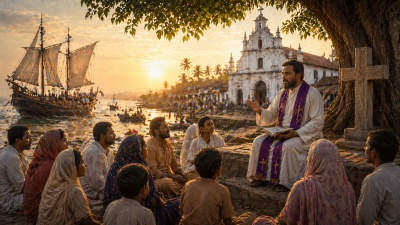
Christianity is one of the oldest religions in India, with its roots stretching back to the 1st century CE. Its arrival predates many European Christian traditions, evolving through distinct phases of maritime trade and colonial expansion.
- Apostolic Origin (52 CE): According to tradition, St. Thomas (Mar Thoma), one of the twelve apostles of Jesus Christ, arrived at the port of Muziris (modern-day Kodungallur, Kerala). He established the “Seven and a Half Churches” (Ezharappallikal) and converted several local families, forming the Syrian Christian (or Nasrani) community.
- The Second Wave (4th–9th Century): Nestorian merchants and missionaries from Persia and Syria arrived on the Malabar Coast, further strengthening the East Syriac traditions in India.
- The Latin/Colonial Phase (15th Century onwards): With the arrival of Vasco da Gama in 1498, the Roman Catholic tradition was introduced. St. Francis Xavier, a co-founder of the Jesuits, arrived in 1542, leading to large-scale conversions along the Pearl Fishery Coast and in Goa.
- Protestant Missions (18th Century onwards): Danish, British, and American missionaries introduced Protestantism. Significant figures include William Carey (the “Father of Modern Missions”) and the Serampore Trio in Bengal.
Major Denominations and Sectarian Classification
The Christian community in India is highly diverse, categorized into four primary groups based on liturgy, history, and ecclesiastical affiliation.
| Denomination | Key Characteristics | Geographic Strongholds |
| Syrian Christians | Follow East/West Syriac liturgy; claim apostolic descent from St. Thomas. | Kerala (Malabar Coast) |
| Roman Catholics | Follow the Latin Rite and recognize the Pope as the supreme head. | Goa, Mangalore, Tamil Nadu, Mumbai |
| Protestants | Includes Anglicans, Baptists, Methodists, and Presbyterians. | Northeast India, Tamil Nadu, Andhra Pradesh |
| Orthodox | Includes the Malankara Orthodox Syrian Church and Jacobite Syrian Church. | Kerala |
The Influence of Christianity in Northeast India
The spread of Christianity in the Northeast was largely a 19th and 20th-century phenomenon led by American Baptist and Welsh Presbyterian missions. It played a transformative role in tribal identity and literacy.
- States with Christian Majority: Nagaland (approx. 88%), Mizoram (approx. 87%), and Meghalaya (approx. 75%) are the three Christian-majority states in India.
- Cultural Integration: The adoption of the Roman script for tribal languages (like Khasi and Mizo) facilitated the preservation of local folk traditions alongside Christian teachings.
Christian Art and Architectural Heritage
Christianity introduced the Western/Gothic and Baroque styles to the Indian architectural landscape, which eventually blended with local motifs to create a unique “Indo-Portuguese” style.
- Basilic of Bom Jesus (Goa): A UNESCO World Heritage site holding the mortal remains of St. Francis Xavier; a prime example of Baroque architecture in India.
- Se Cathedral (Goa): One of the largest churches in Asia, built in the Portuguese-Gothic style.
- St. Philomena’s Church (Mysuru): Built in the Neo-Gothic style, inspired by the Cologne Cathedral in Germany.
- Indo-Syriac Architecture: Ancient Kerala churches often featured Deepastambhams (lamp towers) and Dwajasthambams (flag poles), mirroring Hindu temple layouts.
- Stained Glass Art: Introduced by British and French missionaries, seen prominently in the All Saints Cathedral in Prayagraj and San Thome Basilica in Chennai.
Key Christian Festivals and Their Cultural Context
While global Christian festivals are celebrated, Indian Christianity has incorporated several localized traditions.
- Christmas (December 25): Commemorates the birth of Jesus Christ. In India, “Crib making” and star decorations are distinctive cultural markers.
- Easter: Marks the resurrection of Jesus; celebrated with sunrise services.
- Feast of St. Francis Xavier (Goa): Observed on December 3rd, attracting pilgrims of all faiths.
- Perunnal: In Kerala, the annual feast of a patron saint is called Perunnal, characterized by colorful processions (Rasa) and traditional music.
- Maundy Thursday: Known as Pesaha in Kerala, where families prepare a special unleavened bread (Pesaha Appam).
Christianity and Social Reform in India
Missionaries played a pivotal role in the “Indian Renaissance” of the 19th century by modernizing education and healthcare.
- Education: Establishment of premier institutions like St. Stephen’s (Delhi), Madras Christian College (Chennai), and St. Xavier’s (Mumbai/Kolkata).
- Printing Press: The first printing press in India was established by Jesuits in Goa (1556). William Carey’s Serampore Mission Press was instrumental in printing the first Bengali newspapers and translating the Bible into Indian languages.
- Health: Introduction of modern nursing and systematic hospital management, notably by figures like Edith Brown and Ida Scudder (CMC Vellore).
Factful Trivia for UPSC Prelims
- Knanaya Christians: An endogamous group within the Syrian Christian community that claims descent from Jewish-Christian immigrants who arrived with Knai Thoma in 345 CE.
- The Synod of Diamper (1599): A turning point in Indian Christian history where the Portuguese tried to forcibly bring the Syrian Christians under the Roman Catholic Latin Rite.
- St. Thomas Mount: Located in Chennai, it is believed to be the site of the martyrdom of St. Thomas.
- Constitution and Minority Status: Christians are a notified minority under the National Commission for Minorities Act, 1992.
- Vatican Recognition: St. Alphonsa (from Kerala) was the first Indian woman to be canonized as a saint by the Roman Catholic Church in 2008.