
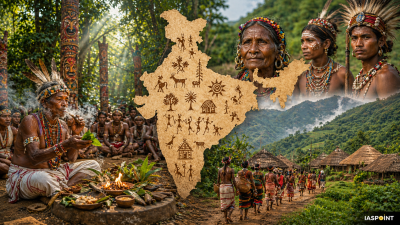
India is home to over 700 scheduled tribes, making up approximately 8.6% of the total population (2011 Census). While many tribes have integrated elements of Hinduism, Christianity, or Islam, they maintain a distinct core of “Animistic” or “Naturistic” beliefs. These religions are characterized by the absence of a written script, a lack of institutionalized clergy, and a profound spiritual connection to the natural environment.
Core Tenets of Tribal Spirituality
Tribal religions are rooted in the belief that the physical world is inhabited by spirits. Their theological framework usually includes:
- Animism: The belief that non-human entities (animals, plants, mountains, and rivers) possess a spiritual essence.
- Totemism: The identification of a clan with a particular animal or plant (Totem), which is considered sacred and serves as the clan’s protector.
- Ancestor Worship: The belief that the spirits of deceased ancestors influence the lives of the living and must be appeased through rituals.
- Shamanism: The role of a mediator (known as Pahan, Baiga, or Bhopa) who communicates with the spirit world to heal the sick or predict the future.
Major Tribal Religious Movements and Faiths
Several tribal groups have formalised their traditional beliefs into specific religious movements to preserve their identity against external cultural influences.
| Religion/Movement | Primary Tribe | Region | Key Features |
| Sarnaism | Munda, Oraon, Ho, Santal | Jharkhand, Odisha, Chhattisgarh | Worship of “Sarna” (Sacred Groves); belief in Dharmesh or Singbonga (Sun God). |
| Donyi-Polo | Tani people (Adi, Apatani) | Arunachal Pradesh | Focuses on the Sun (Donyi) and the Moon (Polo) as the supreme witnesses. |
| Sanamahism | Meitei (historically tribal) | Manipur | Worship of Lainingthou Sanamahi; focuses on household deities and clan ancestors. |
| Gond Religion | Gond | Central India | Worship of Bara Deo (Great God); emphasis on the “Phratry” (clan) system. |
| Khasi Religion | Khasi | Meghalaya | Monotheistic belief in U Blei Nongthaw (The Creator); strong matrilineal traditions. |
Sacred Spaces: The Concept of Sacred Groves
One of the most significant aspects of tribal religious culture is the protection of “Sacred Groves”—patches of forest dedicated to local deities where felling trees or harming wildlife is strictly prohibited.
- Sarna: Found in the Chota Nagpur plateau (Jharkhand/Bihar).
- Devara Kadu: Located in the Western Ghats (Karnataka).
- Kavu: Sacred groves in Kerala, often associated with snake worship (Naga Aradhana).
- Law Kyntang: Sacred forests of the Khasi hills in Meghalaya.
- Orans: Sacred groves in the desert regions of Rajasthan, protected for the deity Bhaironath.
Significant Tribal Deities and Mythologies
Tribal pantheons are often localized, with deities representing specific elements of the landscape or community welfare.
- Singbonga: The supreme deity of the Mundas and Hos, associated with the Sun.
- Marang Buru: The “Great Mountain” deity of the Santals, believed to reside in the Parasnath hills.
- Bara Deo (Budhal Pen): The supreme god of the Gonds, often associated with the Saja tree.
- Niyam Raja: The god of the Niyamgiri hills, worshipped by the Dongria Kondh tribe in Odisha.
- Tari Penu: The earth goddess of the Khonds, historically associated with fertility rituals.
Tribal Festivals and Ritualistic Art
Festivals in tribal culture are intrinsically linked to the agricultural cycle and the changing seasons.
- Sarhul: A spring festival celebrated by the Oraon, Munda, and Ho tribes marking the flowering of Sal trees.
- Baneshwar Fair: A major “Kumbh of the Tribals” in Rajasthan, where the Bhil tribe worships Lord Shiva at the confluence of the Mahi and Som rivers.
- Karama Festival: Celebrated across Central and Eastern India (Baiga, Oraon, Majhwar); involves the planting of a branch of the Karam tree to pray for a good harvest.
- Hornbill Festival: While modern and inter-tribal, it showcases the traditional religious warrior dances and folk songs of the 17 Naga tribes.
- Ritual Art:
- Pithora Paintings: Ritualistic wall paintings of the Rathwa and Bhilala tribes (Gujarat/MP) to thank God for a wish fulfilled.
- Warli Art: Indigenous to Maharashtra; uses geometric patterns to depict the “Circle of Life” and the Mother Goddess Palaghata.
Tribal Trivia for UPSC Prelims
- The Sarna Code: There is an ongoing socio-political movement by tribal groups in Jharkhand and Odisha demanding the recognition of “Sarna” as a separate religious category in the Census.
- Dormitory Systems: Many tribal religions are passed down through youth dormitories like the Ghotul (Gonds/Murias) or Dhumkuria (Oraons), where oral traditions and music are taught.
- Anthropomorphism: Unlike Puranic Hinduism, tribal deities are rarely represented in human form; they are often represented by unhewn stones, trees, or wooden poles.
- Tana Bhagat Movement: A tribal religious movement (1914-1920) among the Oraons that sought to purify tribal society from superstitions and was heavily influenced by Gandhian non-violence.
- Apatani Sun-Moon Worship: The Apatanis of Ziro Valley are known for their unique sustainable agriculture and the “Dree” festival, which seeks protection of crops from pests through divine intervention.