
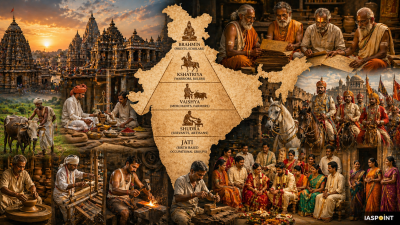
The traditional social structure in India is a complex, hierarchical system shaped by historical, religious, and occupational factors. Primarily rooted in the Vedic civilization, it has evolved through millennia, integrating various regional customs while maintaining a core framework centered on the Varna and Jati systems. This structure governs social interactions, marriage, and labor division, forming the bedrock of Indian Art, Culture, and Heritage.
The Varna System: The Fourfold Categorization
The Varna system is the macro-level classification of Indian society, first mentioned in the Purusha Sukta of the Rig Veda. It conceptualizes society as a functional organism.
- Brahmins: Positioned at the top of the hierarchy, they were traditionally the priests, scholars, and teachers. Their role was the preservation of sacred knowledge (Vedas) and the performance of rituals.
- Kshatriyas: The warrior and ruling class responsible for protection, administration, and justice. They held political power and managed the defense of the realm.
- Vaishyas: The mercantile and agricultural class. They were involved in trade, commerce, and farming, serving as the economic backbone of the community.
- Shudras: The service class whose primary role was to support the other three Varnas through labor and artisanal work.
The Jati System: Occupational and Regional Proliferation
While Varna is a theoretical framework, Jati (Caste) is the functional, lived reality of the Indian social structure. There are thousands of Jatis, often categorized by specific occupations and endogamous marriage patterns.
- Endogamy: Membership is determined by birth, and marriage is strictly within the same Jati.
- Occupational Specialization: Historically, each Jati was associated with a specific craft or service, such as the Lohars (Blacksmiths) or Sunars (Goldsmiths).
- Commensality: Strict rules once governed who an individual could eat with or accept water from, based on the perceived “purity” of the Jati.
Comparative Overview: Varna vs. Jati
| Feature | Varna | Jati |
| Origin | Scriptural (Vedic) | Evolutionary/Sociological |
| Number | Fixed at four (plus ‘Avarna’) | Thousands of units |
| Mobility | Historically rigid (in later Vedic) | Occasional mobility through ‘Sanskritization’ |
| Scope | Pan-India framework | Local or regional identity |
| Basis | Broad functional grouping | Specific hereditary occupation |
The Concept of Purusharthas and Ashramas
The social structure was traditionally supported by the Ashrama system, which divided an individual’s life into four stages to achieve the Purusharthas (Objectives of Life).
The Four Purusharthas
- Dharma: Righteousness and moral duty.
- Artha: Material prosperity and livelihood.
- Kama: Aesthetic pleasure and emotional fulfillment.
- Moksha: Spiritual liberation from the cycle of rebirth.
The Four Ashramas
- Brahmacharya (Student Life): Focused on education and celibacy.
- Grihastha (Householder): Focused on marriage, family, and social contribution.
- Vanaprastha (Retirement): Gradual withdrawal from worldly affairs.
- Sanyasa (Renunciation): Total devotion to spiritual pursuits.
The Jajmani System: Economic Interdependence
The traditional rural economy operated under the Jajmani system, a patron-client relationship that ensured social stability and economic exchange without the primary use of currency.
- Jajmans: The land-owning castes (Patrons) who received services.
- Kamin/Parjan: The service-providing castes (Clients) such as barbers, potters, and priests.
- Payment: Services were usually compensated through a share of the harvest, clothes, or housing rights, creating a hereditary bond between families.
Family and Kinship Structure
The Joint Family System (Vasudhaiva Kutumbakam philosophy at a micro level) is a hallmark of traditional Indian society.
- Patrilineal Descent: Lineage and property are generally traced through the male line.
- Patrilocal Residence: Brides typically move to the husband’s ancestral home.
- Decision Making: Usually rested with the eldest male member, known as the Karta.
- Social Security: The joint family acted as a safety net for the elderly, widowed, and unemployed members.
Significant Historical Facts and Trivia for Prelims
- The Fifth Category: Those outside the four Varnas were historically termed Avarna or Panchamas, often subjected to social exclusion.
- Sanskritization: A term coined by M.N. Srinivas to describe the process where lower castes adopt the rituals and lifestyle of higher castes to seek upward mobility.
- Megasthenes’ Observation: In his book Indica, the Greek ambassador Megasthenes identified seven classes in Indian society, confusing professional guilds with castes.
- The Concept of Gotra: A lineage system among Hindus that traces descent from a common ancestor (usually a Rishi). Marriage within the same Gotra is traditionally prohibited (Exogamy).
- Guilds (Shrenis): In ancient India, Jatis often organized themselves into powerful economic guilds that had their own laws and even minted coins.