

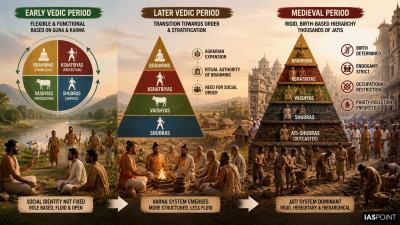
The Indian social hierarchy is a unique stratification system that transitioned from a flexible functional division in the early Vedic period to a rigid, birth-based structure in the later Vedic and medieval eras.
The Varna System: Scriptural and Functional Basis
The Varna system represents the macro-level four-fold division of Hindu society. It is primarily documented in the Purusha Sukta of the Rig Veda (10th Mandala), which metaphorically describes the creation of the Varnas from the body of the Purusha (Universal Being).
- Brahmins (Priests/Teachers): Representing the mouth of the Purusha, they were the custodians of the Vedas, performed Yajnas (sacrifices), and provided spiritual guidance.
- Kshatriyas (Warriors/Rulers): Emerging from the arms, they were responsible for Raksha (protection), administration, and maintaining Dharma through political power.
- Vaishyas (Traders/Agriculturists): Originating from the thighs, they formed the productive class involved in cattle rearing, trade, and agriculture.
- Shudras (Service Class): Emerging from the feet, they provided manual labor and served the upper three Varnas.
Transition from Varna to Jati (Caste)
While Varna is a broad category of four, Jati refers to thousands of localized, endogamous groups. The transition was marked by the emergence of Varnasamkara (intermixture of Varnas), leading to the birth of numerous sub-castes.
- Anuloma Marriage: Marriage between a higher Varna male and a lower Varna female (accepted in ancient texts).
- Pratiloma Marriage: Marriage between a lower Varna male and a higher Varna female (generally condemned, leading to lower social status for offspring).
- Untouchability: The emergence of ‘Antyajas’ or ‘Panchamas’ (the fifth group) occurred as certain occupations were deemed ‘impure,’ placing these groups outside the Varna fold.
Essential Characteristics of the Caste System
The sociologist G.S. Ghurye identified six core features that define the traditional caste structure in India:
- Segmental Division of Society: Society is divided into several small groups (Jatis) with membership determined solely by birth.
- Hierarchy: A definite scheme of social precedence exists where Brahmins are at the apex and Shudras/Dalits are at the base.
- Restrictions on Feeding and Social Intercourse: Elaborate rules regarding the types of food (Kachcha vs. Pakka) and water that can be accepted from different castes.
- Civil and Religious Disabilities: Historical restrictions on lower castes regarding temple entry, use of public wells, and wearing specific ornaments.
- Lack of Unrestricted Choice of Occupation: Traditionally, Jatis were associated with hereditary occupations (e.g., Nai for barbers, Kumbhar for potters).
- Endogamy: The most fundamental feature; individuals must marry within their own Jati to maintain ritual purity.
Comparative Analysis: Varna vs. Jati
| Feature | Varna | Jati (Caste) |
| Number | Fixed at 4 categories | Thousands of local groups |
| Scriptural Status | Universally recognized in Dharmashastras | Local and regional variations |
| Mobility | Rigid in theory | Permissible through ‘Sanskritization’ |
| Identity | National/Pan-Indian framework | Localized identity |
| Origin | Divine/Cosmic origin (Rig Veda) | Occupational and tribal integration |
Mechanisms of Social Change: Sanskritization and Westernization
Despite the rigidity of caste, Indian society has witnessed internal and external pressures for change.
Sanskritization
Coined by M.N. Srinivas, this is a process by which a “low” Hindu caste, tribal, or other group changes its customs, ritual, ideology, and way of life in the direction of a high, and frequently, “twice-born” (Dwija) caste. It usually results in upward mobility in the local hierarchy over generations.
Westernization
This refers to the changes brought about in Indian society and culture as a result of over 150 years of British rule, impacting technology, institutions, ideology, and values. It introduced egalitarianism and secularism, challenging the ritualistic foundations of caste.
The Jajmani System: Economic Dimension of Caste
The Jati system was not merely social but also a structured economic arrangement known as the Jajmani system.
- Structure: A reciprocal relationship between the Jajman (Patron/Landowner) and the Kamin (Service provider/Client).
- Exchange: Kamins provided specialized services (blacksmithing, laundry, priesthood) in exchange for a fixed share of the agricultural produce during harvests.
- Integration: It ensured the self-sufficiency of the Indian village economy for centuries.
Key Historical Facts and Trivia for UPSC
- Manusmriti: The most influential legal text that codified the duties and punishments for different Varnas, emphasizing the supremacy of the Brahmins.
- Ashoka’s Dhamma: An early historical attempt to transcend caste barriers and promote social harmony through Buddhist principles.
- Bhakti Movement: Medieval saints like Kabir, Ravidas, and Basavanna challenged the ritualistic hierarchy of caste, preaching spiritual equality.
- Article 17: The Constitution of India explicitly abolishes ‘Untouchability’ and forbids its practice in any form.
- Kaka Kalelkar Commission (1953): The first commission to identify Socially and Educationally Backward Classes (SEBC) based on caste.
- Mandal Commission (1979): Recommended 27% reservation for OBCs, acknowledging the persistence of caste-based educational and social backwardness.