
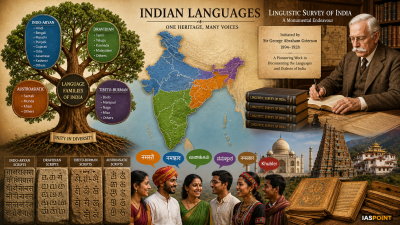
The classification of Indian languages is a cornerstone of the “Linguistic Culture” unit in Indian Art and Culture. India is home to several hundred languages and thousands of dialects, categorized primarily into four major families. The evolution and classification are governed by the Linguistic Survey of India, a monumental project initiated by Sir George Abraham Grierson, which identified the distinct branches of the Indian linguistic tree.
The Indo-Aryan Language Family (Indo-European)
This is the largest language group in India, spoken by approximately 74% of the population. It arrived with the Indo-Aryan migrations and evolved through three distinct stages: Old, Middle, and Modern Indo-Aryan.
- Ancient Period (2500 BCE – 600 BCE): Dominated by Vedic and Classical Sanskrit. Sanskrit is the “Mother of Indo-Aryan languages” and the primary liturgical language of Hinduism and Buddhism.
- Medieval Period (600 BCE – 1000 CE): Witnessed the rise of Prakrit (languages of the common people) and Pali (the language of Tripitakas). Regional variants like Magadhi, Shauraseni, and Maharashtri emerged.
- Modern Period (1000 CE – Present): Development of modern vernaculars through the Apabhramsha stage. This includes Hindi, Bengali, Marathi, Gujarati, Punjabi, Odia, Assamese, and Kashmiri.
The Dravidian Language Family
Concentrated mainly in South India, this family accounts for about 24% of the population. It is indigenous to the subcontinent and predates the Indo-Aryan group.
- Northern Group: Includes Brahui (spoken in Baluchistan), Kurukh, and Malto.
- Central Group: Includes Gondi, Kui, and Kolami.
- Southern Group: Includes the four major literary languages—Tamil, Telugu, Kannada, and Malayalam.
- Distinguishing Feature: Unlike Indo-Aryan languages, Dravidian languages are agglutinative, meaning prefixes and suffixes are added to roots to indicate grammatical relationships without changing the root itself.
Minor Language Families and Dialect Clusters
While smaller in speaker volume, these families represent the deep-rooted ethnic and geographical diversity of the Himalayan and tribal belts.
- Austroasiatic (Nishada): Spoken by tribal groups in Central India and the Northeast. It is divided into Munda (e.g., Santhali, Mundari, Ho) and Mon-Khmer (e.g., Khasi and Nicobarese).
- Sino-Tibetan (Kirata): Found in the Himalayan fringes and North-Eastern states. It includes the Tibeto-Burman branch (Manipuri, Bodo, Ladakhi) and the Siamese-Chinese branch.
- Afro-Asiatic: Represented by the Siddi community in Gujarat and Karnataka.
- Andamanese: A distinct, isolated group of languages spoken by the indigenous tribes of the Andaman Islands.
Comparative Summary of Language Families
| Language Family | Major Speakers (%) | Key Languages | Geographical Concentration |
|---|---|---|---|
| Indo-Aryan | ~74% | Hindi, Marathi, Bengali, Punjabi, Sanskrit | North, West, and East India |
| Dravidian | ~24% | Tamil, Telugu, Kannada, Malayalam | Southern India |
| Austroasiatic | ~1.2% | Santhali, Khasi, Mundari | Chhotanagpur Plateau, Meghalaya |
| Sino-Tibetan | ~0.6% | Bodo, Manipuri, Newari | North-East India, Himalayas |
The Constitutional Framework: Eighth Schedule
The Eighth Schedule of the Indian Constitution lists the official languages of the Republic of India. Originally, the schedule contained 14 languages; it currently features 22.
- Original 14 Languages: Assamese, Bengali, Gujarati, Hindi, Kannada, Kashmiri, Malayalam, Marathi, Odia, Punjabi, Sanskrit, Tamil, Telugu, and Urdu.
- 21st Amendment (1967): Added Sindhi.
- 71st Amendment (1992): Added Konkani, Manipuri, and Nepali.
- 92nd Amendment (2003): Added Bodo, Dogri, Maithili, and Santhali.
Classical Languages of India
The Government of India classifies certain languages as “Classical” based on their high antiquity, original literary tradition, and a gap between the classical and modern forms.
- Current Status: As of 2024, the list includes 11 languages.
- The List: Tamil (2004), Sanskrit (2005), Kannada (2008), Telugu (2008), Malayalam (2013), Odia (2014), Marathi (2024), Pali (2024), Prakrit (2024), Assamese (2024), and Bengali (2024).
- Benefits: This status provides for the establishment of a “Centre of Excellence for Studies in Classical Languages” and two major international awards for distinguished scholars.
Critical Facts and Trivia for Prelims
- The Mother of Indian Scripts: The Brahmi script is the ancestor of almost all modern Indian scripts (except those derived from Perso-Arabic).
- First Decipherment: James Prinsep deciphered the Brahmi script in 1837, unlocking the edicts of Emperor Ashoka.
- Highest Number of Speakers: Hindi remains the most spoken language, followed by Bengali and Marathi.
- Oldest Dravidian Literature: The Sangam Literature in Tamil provides the earliest secular records of South Indian history.
- Endangered Languages: According to UNESCO, India has the highest number of “endangered” languages in the world, many of which belong to the Andamanese and Tibeto-Burman families.
- Official Language vs National Language: India has no single “National Language.” Under Article 343, Hindi in Devanagari script is the Official Language of the Union, while English is the “subsidiary official language.”