

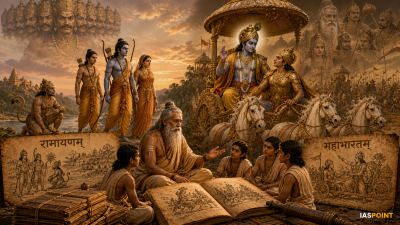
The Indian Epics, primarily the Ramayana and the Mahabharata, fall under the category of Itihasa (literally “it so happened”). Unlike the Shruti (Vedas), these are classified as Smriti (that which is remembered) and represent the transition from the Vedic age to the period of settled kingdoms and complex dharma. They serve as the bedrock of Indian moral, social, and cultural identity, blending historical core events with mythological and philosophical layers.
The Ramayana: The Adi-Kavya
Composed by Sage Valmiki, the Ramayana is known as the Adi-Kavya (the first poem). It consists of approximately 24,000 verses organized into seven books or Kandas.
Structural Division of Ramayana
- Bala Kanda: Details the birth and childhood of Rama and his marriage to Sita.
- Ayodhya Kanda: Focuses on the preparations for Rama’s coronation and his subsequent exile.
- Aranya Kanda: Describes the life of the trio in the forest and the abduction of Sita by Ravana.
- Kishkindha Kanda: Covers the meeting with Hanuman and the alliance with the Vanara King Sugriva.
- Sundara Kanda: Dedicated to Hanuman’s heroics and his journey to Lanka.
- Yuddha Kanda (Lanka Kanda): Details the war between Rama and Ravana and the return to Ayodhya.
- Uttara Kanda: Often considered a later addition, it discusses the banishment of Sita and the birth of Lava and Kusha.
Key Philosophical and Social Themes
- Maryada Purushottama: Rama is depicted as the ideal man who upholds Dharma even at great personal cost.
- Evolution of Versions: The story has been adapted across Asia, including the Ramcharitmanas (Awadhi) by Tulsidas, the Kamba Ramayanam (Tamil) by Kamban, and international versions like the Ramakien (Thailand) and Hikayat Seri Rama (Malaysia).
The Mahabharata: The Greatest Epic
Attributed to Sage Vyasa, the Mahabharata is the longest epic in world literature, containing over 100,000 verses. It is often called the Sata-Sahasri Samhita.
Evolution of the Text
The Mahabharata grew over centuries through three distinct stages:
- Jaya: The original core consisting of 8,800 verses, focusing on the victory of the Pandavas.
- Bharata: Expanded to 24,000 verses, including myths and legends of the Bharata clan.
- Mahabharata: The final version with 100,000 verses, incorporating extensive didactic (moral teaching) sections.
Structural Framework: The 18 Parvas
The epic is divided into 18 Parvas (books), followed by a supplement called the Harivamsa (genealogy of Krishna).
| Parva | Key Event / Content |
| Adi Parva | Origins of the Kuru and Pandu lineages. |
| Sabha Parva | The game of dice and the exile of the Pandavas. |
| Vana Parva | Twelve years of forest exile. |
| Virata Parva | One year of living incognito (Agyatvas). |
| Bhishma Parva | The start of the Kurukshetra war; contains the Bhagavad Gita. |
| Shanti Parva | The longest parva; Bhishma’s discourse on statecraft and ethics. |
| Mausala Parva | The destruction of the Yadavas and the passing of Krishna. |
| Mahaprasthanika Parva | The final journey of the Pandavas to the Himalayas. |
The Bhagavad Gita
Situated within the Bhishma Parva, the Gita is a 700-verse dialogue between Arjuna and Krishna on the battlefield. It synthesizes various strands of Indian philosophy:
- Karma Yoga: The path of selfless action.
- Jnana Yoga: The path of knowledge.
- Bhakti Yoga: The path of devotion.
- Nishkama Karma: Action performed without attachment to the results.
Socio-Cultural Significance and Facts
- The Fifth Veda: The Mahabharata is traditionally accorded the status of the Panchama Veda (Fifth Veda) due to its encyclopedic nature covering the four goals of life: Dharma (Duty), Artha (Wealth), Kama (Desire), and Moksha (Liberation).
- Geographical Horizon: The epics expanded the Indian geographical consciousness from the Northwest to the entire subcontinent and Southeast Asia.
- Archaeological Links: Prof. B.B. Lal’s excavations at sites like Hastinapur and Indraprastha identified the “Painted Grey Ware” (PGW) culture, which some scholars associate with the Later Vedic/Epic period.
- Ethical Dichotomy: While the Ramayana presents a conflict between ideal characters (Rama) and demonic forces (Ravana), the Mahabharata explores a more complex, “grey” conflict between cousins (Pandavas and Kauravas) within the same family.
Comparison of the Two Epics
| Feature | Ramayana | Mahabharata |
| Primary Author | Valmiki | Ved Vyasa |
| Literary Style | Adi-Kavya (Refined Poetry) | Itihasa (Chronicle/Narrative) |
| Core Conflict | Protection of Dharma against external evil. | Internal family feud over land and sovereignty. |
| Idealism vs. Realism | High idealism and moral absolutes. | Political realism and complex ethical dilemmas. |
| Characterization | Centralized around a single hero (Rama). | A vast ensemble of diverse, complex protagonists. |
Regional and Vernacular Versions
The epics played a crucial role in the development of regional languages during the medieval period.
- Bengali: Krittivasi Ramayan by Krittibas Ojha.
- Malayalam: Adhyathmaramayanam by Thunchaththu Ezhuthachan.
- Telugu: The Andhra Mahabharatam was a collaborative effort by the “Kavitrayam” (Trinity of Poets): Nannayya, Tikkana, and Yerrana.
- Odia: Sarala Das composed the Mahabharata in the 15th century.