

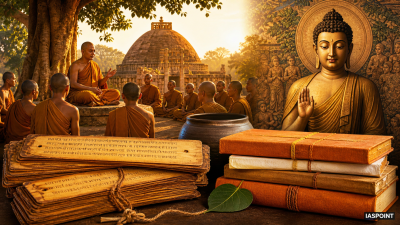
Buddhist literature represents a monumental shift in Indian literary history, moving away from the sacred Sanskrit of the Brahmanical tradition to the vernacular Pali and Prakrit languages to reach the masses. These texts were initially preserved through oral traditions by the Bhikkus (monks) and were codified during the various Buddhist Councils. The literature is broadly categorized into Canonical (the direct teachings of Buddha and his disciples) and Non-Canonical (commentaries, historical chronicles, and philosophical treatises).
Canonical Literature: The Tripitakas
The word Tripitaka means “Three Baskets.” These are the oldest and most fundamental scriptures of the Theravada school, composed in Pali.
Vinaya Pitaka (The Basket of Discipline)
This collection focuses on the monastic rules and regulations for the Sangha (monastic community).
- Suttavibhanga: Explains the basic code of conduct for monks (Patimokkha).
- Khandhaka: Deals with the regulations for joining the order and specific monastic ceremonies.
- Parivara: An analytical summary of the rules.
Sutta Pitaka (The Basket of Discourses)
This is the largest and most significant Pitaka, containing the sermons and teachings of the Buddha. It is divided into five Nikayas (collections):
- Digha Nikaya: Long discourses, including the Mahaparinibbana Sutta (the Buddha’s final days).
- Majjhima Nikaya: Middle-length discourses.
- Samyutta Nikaya: Linked discourses organized by subject.
- Anguttara Nikaya: Numerical discourses; notable for containing the list of the Sixteen Mahajanapadas.
- Khuddaka Nikaya: Minor collection, which includes the famous Dhammapada (ethical teachings), Therigatha (hymns of senior nuns), and the Jatakamala (stories of Buddha’s previous births).
Abhidhamma Pitaka (The Basket of Higher Teachings)
This section provides a systematic and philosophical analysis of the Buddha’s teachings, focusing on psychology and metaphysics rather than anecdotes. The Kathavatthu (Points of Controversy) is a key text within this basket, attributed to Moggaliputta Tissa during the reign of Ashoka.
Non-Canonical Pali Literature
These texts provide historical context and advanced philosophical interpretations outside the core Pitakas.
- Milinda Panha (Questions of Milinda): A dialogue between the Indo-Greek King Menander I (Milinda) and the monk Nagasena. It is a masterpiece of early Buddhist logic.
- The Chronicles (Vamsas): These are Sri Lankan historical records written in Pali.
- Dipavamsa (Island Chronicle): The oldest, focusing on the spread of Buddhism to Sri Lanka.
- Mahavamsa (Great Chronicle): Attributed to Mahanama, providing a more detailed history of Sri Lankan kings and Ashoka’s missions.
- Visuddhimagga (The Path of Purification): A comprehensive manual of Theravada doctrine composed by the great scholar Buddhaghosa.
Transition to Sanskrit: Mahayana Literature
As Buddhism evolved into the Mahayana school, scholars began using Sanskrit (specifically Mixed/Hybrid Sanskrit) for their compositions to engage with the contemporary intellectual discourse.
- Buddhacharita: An epic poem on the life of Buddha written by Asvaghosa, the court poet of Kanishka. It is considered the first complete biography of the Buddha.
- Lalitavistara Sutra: A biographical work depicting the Buddha’s life as a “divine play” (Lalita), which served as the inspiration for the relief carvings at Borobudur.
- Mahavastu: A transitional text from the Mahasanghika school that blends Pali and Sanskrit; it contains numerous Jataka stories.
- Prajnaparamita Sutras: A collection of texts focusing on the “Perfection of Wisdom,” including the famous Diamond Sutra and Heart Sutra.
- Saddharma Pundarika (Lotus Sutra): One of the most influential Mahayana texts, emphasizing that all beings can attain Buddhahood.
Significant Buddhist Scholars and Their Contributions
The development of Buddhist logic and epistemology was spearheaded by brilliant philosophers in ancient Indian universities like Nalanda and Vikramshila.
| Scholar | Key Work | Significance |
| Nagarjuna | Madhyamika Karika | Founder of the Madhyamika (Middle Way) school; propounded the theory of Shunyata (Emptiness). |
| Asanga & Vasubandhu | Yogachara-bhumi-shastra | Founders of the Yogachara or Vijnanavada (Consciousness Only) school. |
| Dignaga | Pramana Samuccaya | The “Father of Buddhist Logic”; established the school of Buddhist Epistemology. |
| Dharmakirti | Nyayabindu | A pioneer in Buddhist logic and philosophy of language. |
| Santideva | Bodhicharyavatara | A guide to the Bodhisattva’s way of life. |
Jataka Stories and Their Cultural Impact
The Jatakas are a collection of 547 stories depicting the previous incarnations of the Buddha (as both humans and animals).
- Ethical Core: They emphasize the cultivation of Paramitas (perfections) like generosity, patience, and wisdom.
- Artistic Influence: These stories provided the thematic material for the frescoes at Ajanta, the railings of Bharhut, and the gateways of the Sanchi Stupa.
- Common Examples: The Ruru Jataka (Deer), Mahakapi Jataka (Monkey), and the Vessantara Jataka (the perfection of charity).
Facts and Trivia for UPSC Prelims
- The Oldest Printed Book: The Diamond Sutra (868 CE), a Buddhist text, is recognized as the world’s oldest dated printed book (found in the Dunhuang caves).
- Language Hierarchy: While early Buddhism used Pali (the language of the common man), the Kushana period saw a shift to Sanskrit, marking the rise of Mahayana Buddhism.
- Therigatha: It is one of the world’s oldest collections of women’s literature, reflecting the spiritual experiences and struggles of Buddhist nuns.
- Netipakarana: A unique Pali text that provides rules for interpreting the teachings of the Buddha.
- Chinese Travelers: Much of our knowledge about lost Buddhist Sanskrit texts comes from the translations and accounts of Chinese pilgrims like Faxian, Xuanzang, and Yijing.