
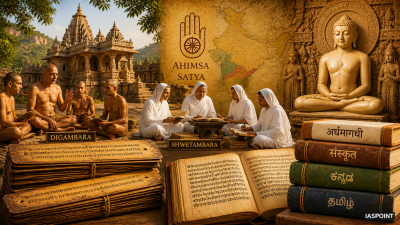
Jain literature, a cornerstone of Indian heritage, is primarily categorized into two major sects: Digambara and Shwetambara. The literature is characterized by its use of various languages, transitioning from Ardhamagadhai (a form of Prakrit) to Sanskrit and later to regional languages like Kannada and Tamil. This evolution ensured the dissemination of non-violence (Ahimsa) and truth (Satya) to the masses.
The Canonical Literature: Agamas
The teachings of Mahavira were initially preserved through oral tradition but were later compiled into the Agamas. These are considered the most sacred texts by the Shwetambara sect.
Structure of the Shwetambara Canon
The Shwetambara canon consists of 45 to 50 texts, broadly classified into the following categories:
- 12 Angas: The most vital part of the canon, containing the core philosophy, rules of conduct for monks, and refutations of heretical beliefs. The Acharanga Sutra is the oldest, dealing with monastic discipline.
- 12 Upangas: These serve as supplements to the Angas, providing detailed explanations on cosmology, geography, and the life of Mahavira.
- 10 Prakirnas: Miscellaneous texts written in verse covering various doctrinal subjects.
- 6 Chhedasutras: Texts focusing on the behavior of monks and nuns, including the famous Kalpa Sutra (attributed to Bhadrabahu).
- 4 Mulasutras: Basic texts intended for students beginning their monastic life.
The Digambara Perspective
The Digambara sect believes that the original Agamas were lost over time. Consequently, they rely on “Pro-canonical” texts:
- Karmaprabhrita (Discourse on Karma): One of the oldest Digambara texts.
- Kashayaprabhrita (Discourse on Passions): Focuses on the internal struggles of the soul.
- Shatkhandagama: Authored by Pushpadanta and Bhutabali, it is the most authoritative Digambara work on the theory of Karma.
Non-Canonical Literature and Secular Contributions
Beyond the Agamas, Jain scholars contributed extensively to logic, grammar, and literature.
Philosophical and Narrative Works
- Tattvartha Sutra: Written by Umaswati in the 2nd century AD, it is the first Jain work in Sanskrit. It is accepted by both sects as a definitive summary of Jain philosophy.
- Nyayavatara: Composed by Siddhasena Divakara, it laid the foundation for Jain logic.
- Ratnakaranda Sravakachara: A text by Samantabhadra detailing the conduct of a lay follower (Sravaka).
Regional Language Contributions
Jainism played a pivotal role in the development of South Indian languages:
- Tamil: The epic Silappatikaram (by Ilango Adigal) and Civaka Cintamani (by Tirutakkatevar) are steeped in Jain ethics. The ethical treatise Naladiyar was also composed by Jain monks.
- Kannada: Known as the “Golden Age” of Kannada literature, Jain poets like Pampa, Ponna, and Ranna (the Three Gems) produced works like Adipurana and Shantipurana.
Key Jain Scholars and Their Works
| Scholar | Famous Work | Subject Matter |
| Bhadrabahu | Kalpa Sutra | Biographies of Jain Tirthankaras |
| Hemachandra | Parishishtaparvan | History of Jainism and Maurya Kings |
| Haribhadra Suri | Anekantajayapataka | Logic and the doctrine of many-sidedness |
| Jinasena | Mahapurana | Stories of the 63 Illustrious Persons |
| Somadeva Suri | Yasastilaka | Socio-political life and religious ethics |
Significance of Languages in Jainism
Jain literature serves as a linguistic bridge in ancient India. While early texts were in Prakrit (to remain accessible to commoners), the 4th to 9th centuries saw a shift to Sanskrit to compete with Buddhist and Vedic scholars in philosophical debates. Later, the use of Apabhramsha (a precursor to modern Hindi and Gujarati) and Dravidian languages ensured Jainism’s deep roots in regional cultures.
Notable Facts and Trivia for Prelims
- Language Evolution: The Ardhamagadhai language used in Jain Agamas is often referred to as the “Language of the Gods” in Jain tradition.
- Council of Valabhi: The final version of the Shwetambara Agamas was compiled and written down during the Second Jain Council held at Valabhi (Gujarat) in the 5th/6th century AD under the leadership of Devardhi Kshamasramana.
- The Purvas: Jains believe there were originally 14 Purvas (ancient texts) that predated the Angas, but the knowledge of these was lost.
- Secular Sciences: Jain monks made significant contributions to Mathematics (concepts of infinity and sets) and Astronomy, documented in texts like Surya Prajnapti.
- Prabandhas: These are semi-historical biographies of Jain teachers and kings, such as the Prabandha Chintamani by Merutunga, which provide insights into medieval Indian history.