
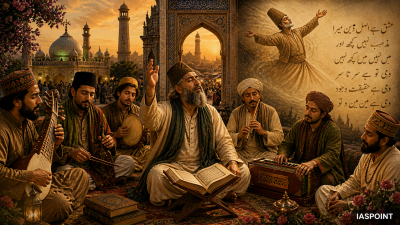
Sufi literature emerged as a profound mystical dimension of Islamic literature in India, paralleling the Bhakti movement. It served as a cultural bridge, blending Persian and Arabic traditions with local Indian dialects (Hindavi, Deccani, Bengali, and Punjabi). The literature primarily focuses on the concepts of Ishq (divine love), Fana (annihilation of the ego), and Wahdat-al-Wujud (Unity of Being).
Major Genres and Literary Forms
Sufi scholars and saints utilized specific literary formats to document their teachings and mystical experiences:
- Malfuzat (Discourses): These are records of the conversations and teachings of Sufi Shaikhs, usually compiled by their disciples.
- Maktubat (Letters): Collections of correspondence sent by Sufi masters to their disciples or contemporary rulers regarding spiritual and state matters.
- Tazkiras (Biographical Anthologies): Hagiographical accounts documenting the lives, miracles, and lineages of Sufi saints.
- Premakhyans (Sufi Love Epics): Narrative poems written in regional dialects (mostly Awadhi) that use human romance as an allegory for the soul’s longing for God.
Key Literary Works and Authors
The following table highlights the most influential Sufi texts that are critical for understanding the socio-religious history of medieval India:
| Work | Author | Form / Language | Significance |
| Kashf-ul-Mahjub | Data Ganj Baksh (Ali Hujwiri) | Persian Prose | The oldest Persian treatise on Sufism in India; explains the doctrines of various Sufi orders. |
| Fawaid-ul-Fuad | Amir Hasan Sijzi | Malfuzat (Persian) | Records the discourses of Nizamuddin Auliya; provides insights into 14th-century social life. |
| Chandayan | Maulana Daud | Premakhyan (Awadhi) | The earliest known Sufi romantic mathnawi in Hindavi/Awadhi (1379 AD). |
| Padmavat | Malik Muhammad Jayasi | Premakhyan (Awadhi) | An allegorical epic using the story of Padmini and Ratansen to explain spiritual journeys. |
| Maktubat-i-Imam Rabbani | Sheikh Ahmad Sirhindi | Maktubat (Persian) | Letters addressing the Naqshbandi order and opposing Akbar’s religious experiments. |
| Siyar-ul-Auliya | Sayyid Muhammad Kirmani | Tazkira (Persian) | A comprehensive biographical account of the Chisti saints in India. |
Contributions to Regional Languages
Sufi literature was instrumental in the maturation of several modern Indian languages, often preceding formal court literature.
Punjabi Sufi Literature
- Baba Farid (Fariduddin Ganjshakar): His “Slokas” are preserved in the Guru Granth Sahib. He is considered the pioneer of Punjabi Sufi poetry.
- Bulleh Shah: Famous for his “Kafi” style of poetry, his works like Kaman Wahadat challenged religious orthodoxy and emphasized universal love.
- Waris Shah: Authored the legendary Heer Ranjha, a masterpiece of Punjabi Sufi narrative poetry.
Deccani and Urdu Literature
- Khwaja Bandanawaz Gesudaraz: Author of Mi’raj-ul-Ashiqin, often cited as the first prose work in Deccani (an early form of Urdu).
- Mulla Wajhi: Wrote Sab Ras, a sophisticated allegorical prose work in Deccani Urdu dealing with the philosophy of the heart and soul.
Bengali Sufi Literature
- The Pir-Sahitya tradition in Bengal blended Islamic concepts with local folklore.
- Saiyad Sultan: Authored Nabi Bangsha, which localized Islamic prophets by presenting them in the context of Bengali cultural settings.
Major Sufi Orders (Silsilas) and Their Intellectual Focus
- Chishti Order: Focused on Sama (musical recitations). Their literature, such as the Khair-ul-Majalis (discourses of Nasiruddin Chirag-i-Delhi), is accessible and emphasizes humanitarian service.
- Suhrawardy Order: Produced scholarly works like Awarif-ul-Ma’arif (by Shihabuddin Suhrawardi), which served as a manual for Sufi conduct across Indian Madrasas.
- Qadiri Order: Dara Shikoh, the Mughal prince, belonged to this order. His work Majma-ul-Bahrayn (The Mingling of the Two Oceans) is a landmark comparative study of Sufism and Vedanta.
- Naqshbandi Order: Their literature was generally more orthodox and focused on the adherence to Sharia alongside spiritual practices.
Essential Facts and Trivia for Competitive Exams
- Amir Khusrau: Known as the “Tuti-e-Hind” (Parrot of India), he was a disciple of Nizamuddin Auliya. He pioneered the Qawwali and the Khayal style of music, and his Khaliq-e-Bari is a unique Persian-Hindi lexicon.
- The Concept of Prem: Sufi Premakhyans like Mrigavati (by Qutban) and Madhumalati (by Manjhan) used the Indian “Barahmasa” (twelve-month) poetic tradition to describe the pangs of separation from the divine.
- Sufi Shrines (Dargahs): Much of the oral literature and Qawwalis performed at Dargahs like Ajmer Sharif (Moinuddin Chishti) and Delhi (Nizamuddin Auliya) continue to be primary sources of Sufi cultural heritage.
- Syncretic Influence: Sufi literature frequently adopted local metaphors, such as the spinning wheel (Charkha-nama) or wedding songs (Shadi-nama), to teach mystical concepts to rural populations.