
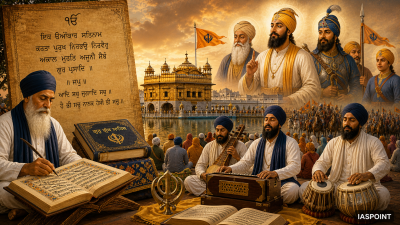
Sikh literature is a vital component of the Indian literary landscape, representing a shift from traditional Sanskrit and Persian to the vernacular Punjabi (written in the Gurmukhi script). It encapsulates the spiritual, social, and martial evolution of the Sikh faith from the 15th century onwards. The literature is characterized by its monotheistic philosophy, rejection of caste, and the synthesis of various Indian linguistic traditions including Braj Bhasha, Khari Boli, and Persian.
The Primary Canon: Adi Granth and Guru Granth Sahib
The most significant achievement of Sikh literature is the compilation of the Adi Granth, which was later elevated to the status of the “Eternal Guru.”
- Compilation: The first rendition was compiled by Guru Arjan Dev (the 5th Guru) in 1604 AD and installed at the Golden Temple (Harmandir Sahib).
- Expansion: The final version, known as the Guru Granth Sahib, was finalized by Guru Gobind Singh (the 10th Guru), who added the hymns of Guru Tegh Bahadur.
- Structure: The text is organized according to 31 Ragas (musical measures) rather than by subject matter. It begins with the Japji Sahib, a fundamental prayer composed by Guru Nanak.
- Inclusivity (Bhagat Bani): It is a unique example of inter-faith harmony, containing the verses of not only the Sikh Gurus but also:
- Bhakti Saints: Kabir, Namdev, Ravidas, Ramanand, and Pipa.
- Sufi Saints: Sheikh Farid.
- Bhatts: Professional court bards.
Contributions of the Ten Gurus
The literary contributions of the Gurus laid the theological foundation of the community.
| Guru | Key Literary Contribution / Theme |
| Guru Nanak Dev | Composed Japji Sahib, Asa di Var, and Siddh Gosht. Focused on Ik Onkar (One God). |
| Guru Angad Dev | Formalized the Gurmukhi script, which became the standard for Punjabi literature. |
| Guru Amar Das | Composed the Anand Sahib (Song of Bliss), used in Sikh ceremonies. |
| Guru Ram Das | Authored the Lavan, the hymns recited during the Sikh wedding ceremony (Anand Karaj). |
| Guru Arjan Dev | Compiled the Adi Granth and composed the Sukhmani Sahib (Prayer for Peace). |
| Guru Tegh Bahadur | Composed 116 Shalokas reflecting on the transient nature of the world. |
| Guru Gobind Singh | Established the Dasam Granth and popularized the use of Persian and Braj. |
The Dasam Granth
The Dasam Granth is a separate collection of writings attributed to the tenth Guru, Gobind Singh. Unlike the Guru Granth Sahib, which is purely spiritual, the Dasam Granth contains diverse themes including mythology, history, and martial ethics.
- Zafarnama: A “Letter of Victory” written in Persian to the Mughal Emperor Aurangzeb, upholding moral rectitude over military power.
- Bachitar Natak: An autobiographical account that provides insights into the Guru’s life and the battles of the time.
- Chandi di Var: A legendary composition in Punjabi describing the battle between the Goddess Chandi and demons, intended to instill martial spirit (Bir Rasa).
- Jaap Sahib: A rhythmic prayer praising the various attributes of the Formless Creator.
Exegetical and Historical Literature
Following the canonical texts, several other genres emerged to explain and document the Sikh tradition.
Janamsakhis (Birth Stories)
These are hagiographic biographies of Guru Nanak Dev. They mix historical facts with legends and were the primary source of Sikh history for centuries.
- Bhai Bala Janamsakhi: One of the most popular versions.
- Puratan Janamsakhi: Considered one of the oldest and most reliable.
Varan (Odes)
- Bhai Gurdas: Known as the “Ved Vyasa of Sikhism,” his works (Varan Bhai Gurdas) are considered the “Key to the Guru Granth Sahib.” He was the original scribe of the Adi Granth and his poems explain complex Sikh concepts in simple Punjabi.
Rehatnamas (Codes of Conduct)
These are manuals detailing the code of conduct for the Khalsa Panth. They provide historical evidence of the evolution of Sikh social and religious identity during the 18th century.
Modern Sikh Literature and the Singh Sabha Movement
In the late 19th and early 20th centuries, the Singh Sabha Movement revitalized Punjabi literature to counter proselytization and restore Sikh identity.
- Bhai Vir Singh: Often called the “Father of Modern Punjabi Literature.” He wrote novels like Sundari and Satwant Kaur, which revived Sikh pride through historical fiction.
- Kahn Singh Nabha: Authored the Mahan Kosh (Encyclopedia of Sikh Literature), a monumental scholarly work that remains a primary reference for Sikh studies.
Essential Facts for UPSC Prelims
- Linguistic Synthesis: While the script is Gurmukhi, the language of the Guru Granth Sahib is often called Sant Bhasha, a medieval poetic lingua franca containing elements of Persian, Sanskrit, Arabic, and various Indian dialects.
- The Concept of Shabad: In Sikh literature, the Shabad (The Word) is the spiritual guide. The emphasis is on the oral recitation and musical performance (Kirtan) of the texts.
- Historical Documentation: The Gurbilas literature (18th and 19th centuries) focuses on the lives of the 6th and 10th Gurus, highlighting the transition of the community into a martial force.
- Uniqueness of Guru Granth Sahib: It is perhaps the only major world scripture that includes the writings of people from different religions and social strata, including those labeled “untouchable” at the time.