
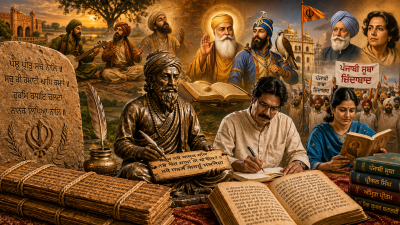
Punjabi literature, primarily written in the Gurmukhi script, is an integral part of India’s cultural heritage. It has evolved through distinct phases: the early mystical and Sufi traditions, the influential Sikh literature period, and the modern era shaped by socio-political movements.
Early Traditions and the Nath-Jogi Influence (9th – 14th Century)
The earliest foundations of Punjabi literature were laid by the Nath Jogis. Their compositions focused on spiritual discipline and detachment from the material world.
- Gorakh Nath: Often credited with the earliest poetic compositions in an early form of Punjabi (Apabhramsha).
- Baba Farid (1173–1266): Known as Sheikh Farid, he is the first great poet of the Punjabi language. His hymns (Saloks) are characterized by their simplicity and deep spiritual yearning. Notably, 112 of his Saloks are included in the Guru Granth Sahib, signifying his foundational role in the language’s literary history.
The Golden Age of Sikh Literature (15th – 18th Century)
This period is defined by the development of the Gurmukhi script by Guru Angad Dev and the compilation of Sikh scriptures, which standardized the Punjabi language.
The Adi Granth / Guru Granth Sahib
- Compilation: Compiled by Guru Arjan Dev in 1604.
- Literary Value: It is a monumental anthology of devotional poetry containing the compositions of six Sikh Gurus, Hindu Bhakti saints (like Kabir and Namdev), and Sufi saints.
- Japji Sahib: Composed by Guru Nanak Dev, it serves as the philosophical core of Sikhism and a masterpiece of Punjabi literature.
Other Significant Works
- Varan Bhai Gurdas: Known as the “Key to the Guru Granth Sahib,” these are 40 ballads (Varan) that explain Sikh philosophy in high-quality Punjabi verse.
- Dasam Granth: Attributed to Guru Gobind Singh, it contains works like Zafarnama (The Epistle of Victory, written in Persian) and Chandi di Var (the first major heroic ballad in Punjabi).
- Janamshakhis: Prose hagiographies detailing the life and travels of Guru Nanak Dev, serving as the earliest examples of Punjabi prose.
The Sufi and Qissa Traditions (17th – 19th Century)
While the Sikh Gurus focused on the divine, Sufi poets and secular writers developed the romantic and mystical traditions of Punjab.
Sufi Poetry (Sufiana Kalam)
- Shah Hussain: Introduced the Kafi (a short musical poem) to Punjabi literature.
- Bulleh Shah (1680–1757): The most celebrated Sufi poet of Punjab. His poetry challenged religious orthodoxy and emphasized universal love. His famous works include Kafis like “Bulla Ki Jaana Main Kaun.”
- Sultan Bahu: Known for his Si-harfi (alphabet-based) poems.
The Qissa (Epic Romance)
Qissas are narrative poems of tragic love and heroism, heavily influenced by Persian models but rooted in Punjabi folklore.
| Qissa | Author | Significance |
| Heer Ranjha | Waris Shah | Often called the “Shakespeare of Punjabi,” Waris Shah’s Heer is considered the greatest masterpiece of Punjabi secular literature. |
| Sohni Mahiwal | Hashim Shah | A tragic romance set on the banks of the Chenab. |
| Mirza Sahiban | Peelu | Known for its raw, tragic depiction of tribal honor and love. |
| Sassi Punnun | Hashim Shah | Famous for its emotional intensity and desert imagery. |
The Modern Era: Singh Sabha and Beyond (19th Century – Present)
The 19th-century transition was marked by the influence of the British Raj and the Singh Sabha Movement, which sought to modernize and reform Punjabi culture.
Pioneers of Modern Punjabi
- Bhai Vir Singh: Known as the “Father of Modern Punjabi Prose and Poetry.” He wrote novels like Sundari and epic poems like Rana Surat Singh. He was instrumental in reviving the language’s prestige.
- Puran Singh: A mystic poet known for his free-verse style, often compared to Walt Whitman.
- Dhani Ram Chatrik: Known for bringing secular and nature-centric themes to Punjabi poetry (e.g., Chandanvari).
Post-Independence and Progressive Literature
- Amrita Pritam: The first woman to win the Sahitya Akademi Award (1956) and the Jnanpith Award (1981). Her poem “Aaj Aakhaan Waris Shah Nu” is a haunting lament on the Partition of India.
- Shiv Kumar Batalvi: Known as the “Birha Da Sultan” (The King of Pathos), his work Luna won the Sahitya Akademi Award and reinterpreted Punjabi folklore from a feminist perspective.
- Gurdial Singh: A pioneer of the modern Punjabi novel; his works like Marhi Da Deeva focus on the rural marginalized classes.
Key Facts and Trivia for UPSC Prelims
- Script: While Punjabi is written in Gurmukhi in India, it is written in Shahmukhi (Perso-Arabic script) in Pakistan.
- Classical Status: Unlike several Southern Indian languages, Punjabi does not currently hold “Classical Language” status from the GoI, despite its ancient roots.
- Jnanpith Award Winners:
- Amrita Pritam (1981): For Kagaz Te Kanvas.
- Gurdial Singh (1999): Shared with Nirmal Verma.
- Paash (Avtar Singh Sandhu): A revolutionary poet associated with the Naxalite movement, famous for the poem “Sabse Khatarnak” (The Most Dangerous).
- The Trinity of Punjabi Sufism: Often cited as Shah Hussain, Bulleh Shah, and Ali Haider.
- Sahitya Akademi Presence: The Sahitya Akademi recognizes Punjabi and awards works across poetry, fiction, and drama annually.