
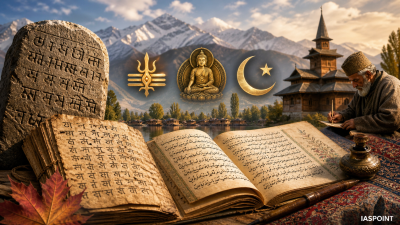
Kashmiri literature, written in the Sharada and later Perso-Arabic scripts, is a unique blend of Vedic philosophy, Buddhist traditions, and Islamic Sufism. Its evolution is characterized by the synthesis of Shaivism and Islam, creating a distinct cultural identity known as Kashmiriyat.
The Early Period: Foundations of Kashmiri Thought (Up to 14th Century)
The early phase was dominated by Sanskrit scholarship, but the transition to the Kashmiri language (Koshur) began with mystical verses.
The Sharda Script
Historically, Kashmiri was written in the Sharda script, an indigenous script of the 8th century related to Devanagari. Today, it is primarily written in the Perso-Arabic script with additional diacritical marks.
Lalleshwari (Lall Ded) and the Vaakh Tradition
The 14th-century mystic poetess Lalleshwari, popularly known as Lall Ded, is the foundational figure of Kashmiri literature.
- Vaakhs: She composed four-line stanzas called Vaakhs, which were pithy, philosophical, and rejected orthodox rituals.
- Significance: Her work bridged the gap between Kashmiri Shaivism and Sufism, making spiritual concepts accessible to the common person.
The Medieval Period: The Rise of Sufi and Romantic Traditions
This era saw the emergence of the Shruk and the introduction of Persian literary forms like the Masnavi and Ghazal.
Sheikh Noor-ud-din Wali (Nund Rishi)
The patron saint of Kashmir and founder of the Rishi Order, his poetry is known as Shruks.
- Themes: He used metaphors from rural life (agriculture, nature) to preach morality, environmental conservation, and social justice.
- Integration: His work represents the pinnacle of the cultural synthesis between indigenous Kashmiri traditions and Islamic values.
The Romantic Movement: Habba Khatoon and Arnimal
- Habba Khatoon (16th Century): Known as the “Nightingale of Kashmir,” she introduced the Lol-lyric, a short, emotional poem centered on themes of love and longing.
- Arnimal (18th Century): Famous for her poignant lyrics describing the pain of separation, further refining the Lol genre.
Literary Genres in Medieval and Early Modern Kashmir
| Genre | Description | Key Figures |
| Vaakh | Four-line mystical poetic style. | Lalleshwari |
| Shruk | Couplets or stanzas focused on moral teachings. | Nund Rishi |
| Lol | Short, rhythmic, melodic love lyrics. | Habba Khatoon, Arnimal |
| Masnavi | Long narrative poems with epic/romantic themes. | Mahmud Gami |
| Lila | Devotional poetry dedicated to Hindu deities. | Paramananda |
The Modern Era: Renaissance and Political Consciousness
The 19th and 20th centuries marked a shift from mysticism to social realism and nationalism.
Pioneers of the Modern Period
- Mahmud Gami: Often called the “Nizami of Kashmir,” he pioneered the Persianized style of Kashmiri poetry and introduced the Masnavi, Ghazal, and Naat.
- Rasool Mir: Revered as the “John Keats of Kashmir,” he brought a secular and aesthetic beauty to the Kashmiri Ghazal.
- Maqbool Shah Kralawari: Famous for Gulrez, a masterpiece of narrative poetry.
The National Movement and Progressive Writers
- Mahjoor (Peerzada Ghulam Ahmad): Known as the “Poet of the People” (Shayer-e-Kashmir). He revolutionized Kashmiri literature by moving away from religious themes to focus on patriotism, youth, and social reform.
- Zinda Kaul (Masterji): The first Kashmiri writer to win the Sahitya Akademi Award (1956) for his book Sumran.
- Abdul Ahad Azad: A revolutionary poet who championed the cause of the working class and humanism.
Post-Independence Developments and Contemporary Trends
Modern Kashmiri literature has expanded into prose, drama, and critical essays, heavily influenced by the socio-political turmoil of the region.
- Dina Nath Nadim: He broke away from traditional meters and introduced Free Verse in Kashmiri. His opera Bombur Yamberzal is a landmark in Kashmiri drama.
- Akhtar Mohiuddin: A pioneer of the modern Kashmiri short story, known for his work Sath Sangar.
- Rehman Rahi: A towering figure in contemporary Kashmiri literature and the only Kashmiri writer to receive the Jnanpith Award (2004).
Key Facts and Trivia for UPSC Prelims
- Jnanpith Award: Rehman Rahi received the award for his collection Siyah Rood Jaeren Manz (In Black Drizzle).
- Classical Status: While Kashmiri has a documented history of over 1,500 years, it is currently listed in the Eighth Schedule of the Indian Constitution but has not yet been designated a “Classical Language” by the Union Government.
- Rajatarangini Integration: While Kalhana’s Rajatarangini (12th Century) is written in Sanskrit, it is the primary historical source for the cultural backdrop against which Kashmiri literature evolved.
- Bhand Pather: The traditional folk theatre of Kashmir, which utilizes Kashmiri oral literature, satire, and music to provide social commentary.
- Lalla-Vakyani: The collection of Lall Ded’s verses which was first edited and translated into English by George Grierson and Lionel Barnett.
- Official Language: In 2020, the Parliament passed the Kashmiri Official Languages Act, making Kashmiri one of the official languages of the Union Territory of Jammu and Kashmir alongside Dogri, Hindi, English, and Urdu.