
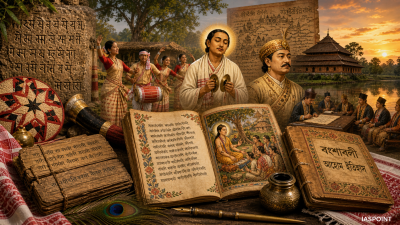
Assamese literature, recognized as a Classical Language in 2024, has a history spanning over a thousand years. It evolved from the Magadhi Apabhramsha and is characterized by its unique blend of indigenous tribal influences, the Vaishnavite Bhakti movement, and the historiographic tradition of the Ahom court.
The Formative Stage: Early Foundations (10th – 14th Century)
The earliest period of Assamese literature is marked by mystic songs and the transition from oral to written traditions.
The Charyapada and Folk Origins
- Charyapada (10th–12th Century): Like Bengali and Odia, the earliest traces of Assamese are found in these Buddhist tantric verses.
- Pre-Vaishnavite Poets: The 13th and 14th centuries saw the emergence of poets like Hema Saraswati (author of Prahlada Charita) and Madhav Kandali.
- Madhav Kandali’s Ramayana: He translated the Sanskrit Ramayana into Assamese (Saptakanda Ramayana) in the 14th century. This was one of the earliest translations of the epic into a modern Indo-Aryan language, predating Tulsidas’s Awadhi version.
The Golden Age: The Neo-Vaishnavite Movement (15th – 16th Century)
The most significant era in Assamese literature was the 16th-century socio-religious reform movement led by the polymath Srimanta Sankardev.
Srimanta Sankardev and Madhavdev
- Bhakti Movement: Sankardev promoted Ekasarana Nam Dharma, which emphasized devotion to Krishna. He introduced several new literary and artistic forms.
- Borgeets: Devotional songs composed in Brajavali (a literary mix of Assamese and Maithili).
- Ankiya Naat: One-act plays introduced by Sankardev. These were the first dramatic works in any modern Indian language.
- Kirtan Ghosha: A foundational scripture containing narrative poems praising Lord Krishna.
- Madhavdev: Sankardev’s chief disciple, who composed the Naam Ghosha, often called the “Book of Psalms” of Assam.
The Ahom Era: Buranjis and Court Literature (17th – 19th Century)
The Ahom dynasty (1228–1826) introduced a unique historiographic tradition that distinguished Assamese literature from other Indian vernaculars.
The Buranji Tradition
- Definition: Buranjis are historical chronicles written in prose. Initially written in the Ahom language, they later transitioned to Assamese.
- Significance: Unlike the mythological focus of contemporary Indian literature, Buranjis provided factual accounts of wars, diplomacy, and administration.
- Key Fact: This tradition made Assamese prose highly developed and standardized much earlier than many other Indian languages.
The Modern Era: The Jonaki Age (19th Century – Present)
The 19th century saw a decline during the initial British occupation (when Bengali was briefly imposed as the official language) followed by a massive literary revival.
The Arunodoi and the Revival
- Arunodoi (1846): The first Assamese periodical published by Baptist Missionaries in Sibsagar. It played a pivotal role in re-establishing the Assamese language.
- The Jonaki Era (1889): Named after the magazine Jonaki, this period marked the birth of Romanticism in Assamese literature.
- The Trinity of Jonaki:
- Lakshminath Bezbaroa: Known as Roxoraj (King of Wit). He wrote the state anthem “O Mur Apunar Desh” and pioneered the modern Assamese short story.
- Chandra Kumar Agarwala: The pioneer of modern Assamese poetry.
- Hemchandra Goswami: Credited with writing the first Assamese sonnet (Priyatamar Chithi).
Major 20th Century Movements
- Prose Development: Hemchandra Barua authored Hemkosh, the first etymological dictionary of Assamese.
- Nationalist Literature: Writers like Ambikagiri Raichoudhury focused on the Indian freedom struggle.
- Modern Novel: Rajanikanta Bordoloi is known as the “Walter Scott of Assam” for his historical novels like Manomati.
Assamese Jnanpith Award Winners
Assamese literature has received two Jnanpith Awards, highlighting its excellence in depicting human struggles and local culture.
| Year | Recipient | Notable Work |
| 1979 | Birendra Kumar Bhattacharya | Mrityunjay (Focused on the Quit India Movement in Assam). |
| 2000 | Mamoni Raisom Goswami | Known for The Shadow of Kamakhya and her work on social reform. |
| 2021 | Nilmani Phookan | Recognized for his profound contribution to modern Assamese poetry. |
Key Facts and Trivia for UPSC Prelims
- Classical Language Status: In October 2024, the Union Cabinet chaired by PM Narendra Modi approved Assamese as a Classical Language.
- Brajavali Language: A unique artificial literary language created by Sankardev for religious compositions; it is not a spoken dialect.
- Sattriya Dance: The literature of the Vaishnavite period (Borgeets and Ankiya Naat) forms the basis of Sattriya, one of India’s eight Classical Dances.
- Hema Saraswati: His Prahlada Charitra is considered the first book in the Assamese language.
- Padmanath Gohain Baruah: The first president of the Asam Sahitya Sabha (1917), the premier literary organization of the state.
- Jyoti Prasad Agarwala: A giant of Assamese culture who wrote plays and songs (Jyoti Sangeet) and directed the first Assamese film, Joymoti (1935).
- Birinchi Kumar Barua: A pioneer of modern literary criticism in Assam.