
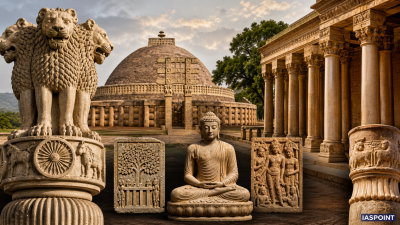
The Mauryan Empire (c. 322–185 BCE) marked a significant transition from the use of perishable materials like wood and bamboo to the permanent medium of stone. Under rulers like Chandragupta Maurya and Ashoka the Great, Indian architecture reached its first peak of refinement, heavily influenced by Buddhist and Jain ideologies while maintaining indigenous Vedic roots and incorporating subtle Achaemenian (Persian) elements.
Classification of Mauryan Architecture
Mauryan art and architecture are broadly classified into two categories based on patronage:
- Court Art: Initiated by the emperors, comprising palaces, pillars, and stupas.
- Popular Art: Developed by individual initiative, including cave architecture, pottery, and sculpture.
Court Art: The Imperial Grandeur
The Mauryan court architecture reflected the power and religious inclination of the state.
Royal Palaces
- Pataliputra Palace: The capital city featured a magnificent palace primarily built of wood. Megasthenes, the Greek ambassador, described it as one of the greatest creations of mankind, rivaling the palaces at Susa and Ecbatana.
- Kumrahar Site: Excavations at Kumrahar (modern-day Patna) revealed a high pillared hall. The 80-pillared hall suggests a centralized administrative or ceremonial function.
Ashokan Pillars
The Ashokan pillars are the most celebrated examples of Mauryan craftsmanship. Unlike Greek pillars, which are constructed in segments, Mauryan pillars are monolithic (carved from a single piece of stone).
- Material: Chunar sandstone, quarried near Varanasi.
- The Shaft: A long, tapering monolithic shaft with a highly polished surface (Mauryan Polish), which remains lustrous after 2,000 years.
- The Capital: Usually bell-shaped or shaped like an inverted lotus.
- The Abacus: A circular or rectangular base for the crowning animal.
- The Animal Crown: Features lions, elephants, bulls, or horses (e.g., Sarnath Lion Capital, Rampurva Bull).
Stupa Architecture
Stupas evolved from pre-Buddhist burial mounds into grand commemorative structures holding relics of the Buddha or his disciples.
- Anda: A hemispherical mound representing the universe.
- Harmika: A square railing on top of the mound, representing the abode of God.
- Chhatra: A central pillar supporting three umbrellas (representing the Three Jewels of Buddhism: Buddha, Dhamma, Sangha).
- Pradakshina Patha: A circular path for circumambulation.
- Note: The original Sanchi Stupa was built by Ashoka using bricks; the stone casing and elaborate gateways (Toranas) were added later during the Shunga and Satavahana periods.
Popular Art: The People’s Craft
While the court focused on monuments, local traditions produced cave dwellings and refined sculptures.
Rock-Cut Cave Architecture
Mauryan caves were primarily used as Viharas (living quarters) for monks, particularly the Ajivika sect.
- Barabar and Nagarjuni Caves: Located in Bihar, these are the earliest rock-cut caves in India.
- Lomas Rishi Cave: Features an arched entrance that mimics contemporary wooden architecture. The interior walls are finished with the characteristic Mauryan mirror-like polish.
Sculptural Traditions
- Yaksha and Yakshini Figures: Large-scale free-standing stone statues representing fertility spirits. The most famous is the Didarganj Yakshini (holding a fly-whisk or Chauri).
- Religious Significance: These figures indicate the simultaneous prevalence of folk-deity worship alongside organized Buddhism and Jainism.
Technical Features of Mauryan Art
| Feature | Description |
| Material | Sandstone (Chunar) and Wood (Palaces). |
| Polish | “Mauryan Polish” – a lustrous, mirror-like finish on stone surfaces. |
| Influence | Indigenous motifs mixed with Achaemenian (Persian) stone-working techniques. |
| Monolithism | Preference for carving entire structures (pillars) from a single block of stone. |
Key Sites and Their Significance
- Sarnath (Varanasi): Location of the Lion Capital, now the National Emblem of India. It commemorates the Buddha’s first sermon (Dharmachakrapravartana).
- Sanchi (Madhya Pradesh): Home to the most intact stupa complex originally commissioned by Ashoka.
- Lauriya-Nandangarh (Bihar): Known for a well-preserved Ashokan pillar featuring a single lion capital and Brahmi inscriptions.
- Rumminidei (Nepal): A pillar marking the birthplace of the Buddha; significant for its inscription regarding tax exemptions granted by Ashoka.
- Dhauli (Odisha): Features a rock-cut elephant carving, representing the transition from Kalinga War violence to Buddhist peace.
Mauryan Pottery: NBPW
The Mauryan period is associated with Northern Black Polished Ware (NBPW).
- Texture: Fine fabric with a glossy, metallic finish.
- Colors: Predominantly black, but also found in golden and silver hues.
- Significance: It serves as an archaeological marker for the peak of urban productivity and trade during the Mauryan era.
Architectural Trivia for Aspirants
- National Emblem: The Sarnath Lion Capital depicts four lions standing back-to-back, symbolizing power, courage, pride, and confidence. The wheel at the base (Dharma Chakra) contains 24 spokes.
- Animal Symbolism: The four animals on the abacus of the Sarnath Capital—the Elephant, Horse, Bull, and Lion—are said to represent the four stages of Buddha’s life or the four cardinal directions.
- Foreign Comparison: While Achaemenian pillars were often fluted and part of larger buildings, Mauryan pillars were smooth and free-standing religious/political markers.