
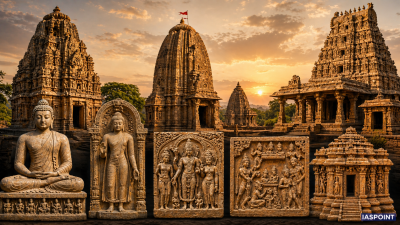
The Gupta Period (c. 319–550 CE) is heralded as the “Golden Age” of Indian architecture. This era marked the culmination of a long architectural evolution, transitioning from the use of wood and bamboo to stone and brick. Most significantly, it witnessed the birth of the Hindu Temple, establishing the structural and aesthetic foundations of the Nagara and Dravidian styles.
Evolution of Hindu Temple Architecture
The Guptas were the first to move away from open-air altars to permanent structural temples. This evolution occurred in five distinct stages:
- Stage I: Flat-roofed, square temples with shallow pillars and a low platform (e.g., Temple 17 at Sanchi).
- Stage II: Similar to Stage I but built on high platforms (Upapitha). Some were two-storied with an enclosed ambulatory passageway (Pradakshina Patha) around the sanctum (e.g., Parvati Temple at Nachna Kuthara).
- Stage III: Introduction of the Shikhara (curvilinear tower) instead of a flat roof. The Panchayatana style of temple layout emerged (e.g., Dashavatara Temple at Deogarh).
- Stage IV: Temples became more rectangular, featuring a barrel-vaulted roof (e.g., Ter Temple in Maharashtra).
- Stage V: Circular temples with shallow rectangular projections (e.g., Maniyar Math at Rajgir).
Features of Gupta Temples
- Garbhagriha: The “womb-house” or the innermost sanctum where the deity was placed. Initially, it was a small, plain square room.
- Mandapa: A pillared hall in front of the Garbhagriha for devotees to gather.
- Panchayatana Style: A central main shrine surrounded by four smaller subsidiary shrines, forming a five-shrine complex.
- Doorways: Exquisitely carved with figures of river goddesses Ganga (on a crocodile/Makara) and Yamuna (on a tortoise/Kurma).
- Materials: Both stone and burnt bricks were used. The Bhitargaon Temple in Kanpur is the oldest surviving brick temple.
Buddhist Architecture in the Gupta Era
Buddhist architecture reached a state of classical perfection, characterized by balance and serenity.
- Stupas: The Dhamekh Stupa at Sarnath is a prime Gupta example. It is a solid cylinder of bricks faced with stone, featuring intricate geometric and floral carvings instead of narrative Jataka reliefs.
- Monasteries: This period saw the rise of Nalanda University, an architectural marvel of brick-built Viharas and temples.
Rock-Cut Cave Architecture
While the Guptas pioneered structural temples, they also refined the tradition of rock-cut caves.
- Ajanta Caves (Maharashtra): Though started earlier, several Mahayana caves were completed under Gupta patronage (specifically the Vakatakas). These are famous for Mural Paintings and the “Flying Gandharva” motifs.
- Ellora Caves: The earliest Brahmanical and Buddhist caves at Ellora were initiated during this period.
- Udayagiri Caves (Madhya Pradesh): Commissioned by Chandragupta II, these are Hindu caves. The most famous sculpture here is the colossal Varaha (Boar incarnation of Vishnu), representing the rescue of Earth.
- Bagh Caves (Madhya Pradesh): A group of nine Buddhist caves known for their paintings, which are more secular in nature compared to the religious themes of Ajanta.
Significant Gupta Temples and Sites
| Temple Name | Location | Key Feature |
| Dashavatara Temple | Deogarh, UP | Earliest Panchayatana temple with a Shikhara. |
| Bhitargaon Temple | Kanpur, UP | Terracotta brick temple with an early arch/shikhara. |
| Vishnu Temple | Tigawa, MP | Early flat-roofed structural temple. |
| Parvati Temple | Nachna Kuthara, MP | Features an enclosed Pradakshina Patha. |
| Shiva Temple | Bhumara, MP | Known for the exquisitely carved T-shaped doorway. |
| Laxman Temple | Sirpur, Chhattisgarh | A magnificent brick temple from the late Gupta/Somavamshi period. |
Gupta Sculptural Excellence
Gupta sculpture moved away from the “nudity” and “sensuality” of the Kushana period toward meditative expressions and spiritual calm.
- Sarnath School of Sculpture: Characterized by the use of cream-colored sandstone and “Transparent Drapery” (the robe lacks folds and clings to the body).
- Sultanganj Buddha: A 7.5-foot-tall copper statue (now in Birmingham Museum), showcasing the advanced metallurgical skills of the era.
- Iron Pillar at Mehrauli: Though technically a metallurgical feat, its polished surface and Garuda-topped capital are integral to Gupta architectural aesthetics.
Key Facts and Trivia for UPSC Prelims
- The Curvilinear Tower: The transition from flat roofs to Shikharas at Deogarh marked the formal beginning of the Nagara Style of North India.
- Secular Architecture: While little remains of residential buildings, contemporary texts like the Kamashastra and Vastu Shastra describe elaborate multi-storied houses with balconies (Gavaksas).
- Temple Entry: Gupta temples were built on high platforms (Jagati) to provide a sense of grandeur and to protect the structure from floods.
- The “Vakataka” Connection: While the Guptas ruled the North, their contemporaries, the Vakatakas, were instrumental in the development of the caves at Ajanta, blending Northern and Deccani styles.