
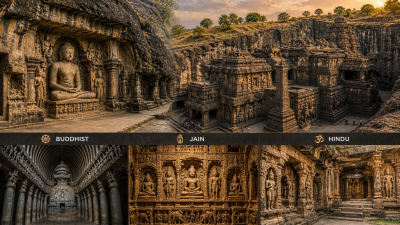
Rock-cut architecture represents the most spectacular manifestation of Indian art, where entire structures were carved out of solid natural rock. Unlike structural architecture, which involves assembling components, rock-cut architecture is “subtractive,” requiring immense precision and a deep understanding of geological formations. This tradition spans over 1,500 years, primarily evolving through Buddhist, Jain, and Hindu patronage.
Early Phase: Mauryan and Post-Mauryan Origins
The transition from wood to stone began in the 3rd century BCE. Early caves mimicked the contemporary wooden structures, including ribbed ceilings and arched doorways.
Mauryan Innovations
- Barabar and Nagarjuni Caves (Bihar): Commissioned by Ashoka and his grandson Dasharatha for the Ajivika sect. These are the oldest surviving rock-cut caves in India.
- Lomas Rishi Cave: Notable for its “Chaitya Arch” entrance, which served as a prototype for later Buddhist architecture.
- Distinctive Feature: The interior walls possess the “Mauryan Polish,” a mirror-like glass finish.
Post-Mauryan Expansion
- Udayagiri and Khandagiri (Odisha): Carved under King Kharavela for Jain monks. Unlike the deep Buddhist halls, these are mostly residential cells.
- Ranigumpha (Queen’s Cave): A double-storied monastery with elaborate decorative friezes.
Buddhist Rock-Cut Architecture: Chaityas and Viharas
The Western Ghats (Sahyadri ranges) became the epicenter of Buddhist rock-cut activity due to the suitable basaltic rock.
Architectural Components
- Chaitya: A prayer hall with a stupa at the far end. It is characterized by a horseshoe-shaped window (Gavaksha) to admit light.
- Vihara: A residential monastery consisting of a central hall surrounded by small sleeping cells.
Major Sites and Chronology
- Hinayana Phase (Earlier): Represented Buddha through symbols (Footprints, Stupa). Examples include Bhaja, Kondane, and early Karle.
- Mahayana Phase (Later): Featured human icons of Buddha and Bodhisattvas. Examples include later Ajanta and Kanheri caves.
- Karle Caves: Houses the largest Hinayana Chaitya in India, featuring 15-meter high pillars topped with exquisite sculptures of elephants and couples.
The Zenith: Ajanta and Ellora Complexes
These UNESCO World Heritage sites represent the pinnacle of rock-cut engineering and artistic integration.
Ajanta Caves (Aurangabad, Maharashtra)
- Quantity: 29 caves, exclusively Buddhist.
- Technique: Known for Fresco-secco paintings (tempera). The pigments were derived from local minerals and plants.
- Key Artworks: The Dying Princess, Bodhisattva Padmapani, and Bodhisattva Vajrapani.
- Layout: Mostly Viharas with a few Chaityas (Caves 9, 10, 19, and 26).
Ellora Caves (Aurangabad, Maharashtra)
- Diversity: 34 caves representing three religions—Buddhist (1-12), Hindu (13-29), and Jain (30-34).
- Kailasa Temple (Cave 16): Commissioned by Krishna I of the Rashtrakuta dynasty. It is a monolithic structure carved top-down from a single basalt hill, mimicking a multi-storied structural temple.
- Jain Caves: Includes the Indra Sabha (Cave 32), known for its intricate carvings of Ambika and the Tirthankaras.
Brahmanical (Hindu) Rock-Cut Architecture
The 6th to 9th centuries saw the rise of Hindu rock-cut shrines, moving from simple cells to elaborate mythological galleries.
- Elephanta Caves (Mumbai): Famous for the Trimurti (three-headed Shiva) sculpture. The caves reflect the Pashupata sect of Shaivism.
- Badami Cave Temples (Karnataka): Built by the Early Chalukyas. These four caves (one Shaiva, two Vaishnava, one Jain) bridge the gap between Northern and Southern styles.
- Varaha Cave (Mamallapuram): A Pallava-era masterpiece featuring the Varaha (Boar) avatar of Vishnu rescuing the Earth goddess.
Monolithic Rathas of Mahabalipuram
Under the Pallava King Narasimhavarman I, the rock-cut tradition evolved into free-standing “Rathas” or chariots.
- The Five Rathas: Named after the Pandavas and Draupadi. Each ratha is carved from a single granite boulder.
- Significance: These served as architectural models for the later evolution of the Dravidian “Vimana” and “Gopuram.”
Comparison of Major Rock-Cut Traditions
| Feature | Buddhist Caves | Hindu Rock-Cut | Jain Rock-Cut |
| Primary Goal | Congregational prayer and monastic residence. | Abode for the deity; symbolic representation of Mount Kailash. | Ascetic seclusion and Tirthankara veneration. |
| Key Structures | Chaityas and Viharas. | Mandapas and Monolithic Rathas. | Small cells and elaborate pillared halls (Indra Sabha). |
| Iconography | Jataka tales, Stupas, Bodhisattvas. | Dashavatara, Nataraja, Puranic legends. | Tirthankaras, Gommateshwara, Yakshas. |
| Major Examples | Ajanta, Karle, Kanheri. | Ellora (13-29), Elephanta, Mahabalipuram. | Udayagiri-Khandagiri, Ellora (30-34), Sittanavasal. |
Technical and Archaeological Trivia
- Top-Down Carving: Monolithic temples like Kailasa at Ellora were carved from the top of the hill downwards, eliminating the need for scaffolding.
- Acoustics: Many Chaityas were designed with specific dimensions to amplify the chanting of monks, creating a resonant environment.
- Sittanavasal (Tamil Nadu): A rare example of Jain rock-cut architecture in South India, famous for its 9th-century ceiling paintings depicting a lotus pond.
- Dhauli (Odisha): Features the rock-cut elephant of Ashoka, which is considered the earliest rock-cut sculpture in India, symbolizing the Buddha.
- Masrur Rock-Cut Temple (Himachal Pradesh): Known as the “Himalayan Pyramids,” these are rare Nagara-style monolithic temples carved into sandstone.